Electric Hoists - The Precision Partner for Industrial Lifting
In modern industrial production, efficient and safe material handling remains a core concern. As the "light cavalry" of lifting machinery, electric hoists, with their compact structure, precise control, and reliable performance, play an indispensable role in workshops, warehouses, ports, construction sites, and other settings. These electrically powered mechanical devices, capable of vertical lift or horizontal movement, have become a key link in the production process thanks to their standardized design and modular components.
I. Precision Integration of Mechanical and Electrical Features
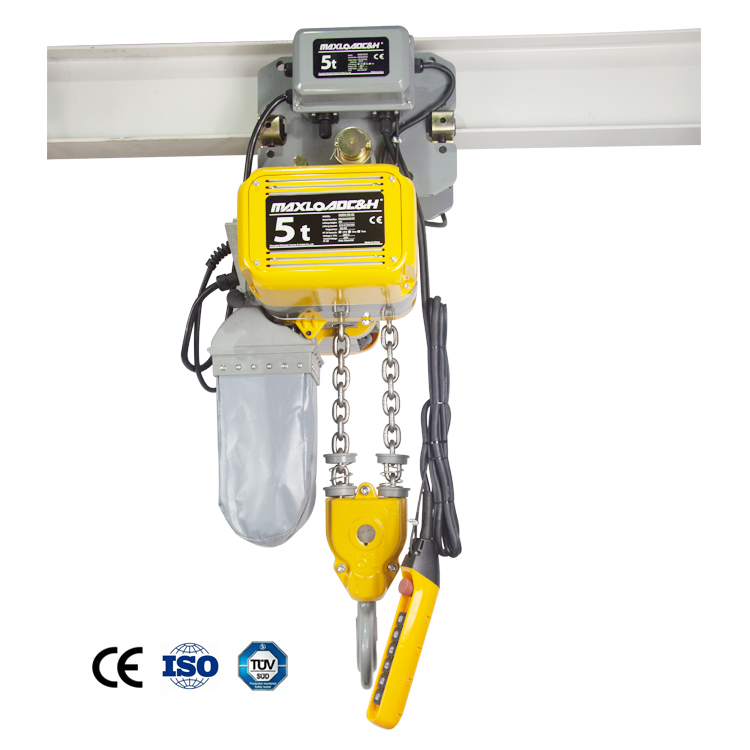
The core components of an electric hoist can be broken down into four main components: the power unit, the transmission system, the lifting mechanism, and the control module. The power unit typically uses an AC or DC motor, which, through a speed reducer, converts high-speed rotation into low-speed, high-torque output to drive the drum or sprocket. A steel wire rope or high-strength alloy chain serves as the traction medium, wound regularly around the drum to lift and lower the load. Some models are equipped with dual-speed motors or variable frequency controllers, enabling infinitely variable speed regulation and micro-motion operation to meet the demands of precision assembly.
Safety protection is a paramount concern in electric hoist design. The overload limiter monitors the load in real time using sensors, automatically cutting off power when the rated load is exceeded. The travel limiter limits the lifting height and operating range using mechanical contacts or photoelectric sensors, preventing the wire rope from derailing or equipment damage. The emergency stop button and under-pressure protection device provide dual safeguards, ensuring operators can quickly interrupt operation in emergencies.
II. Diversified Paths for Scenario Adaptation
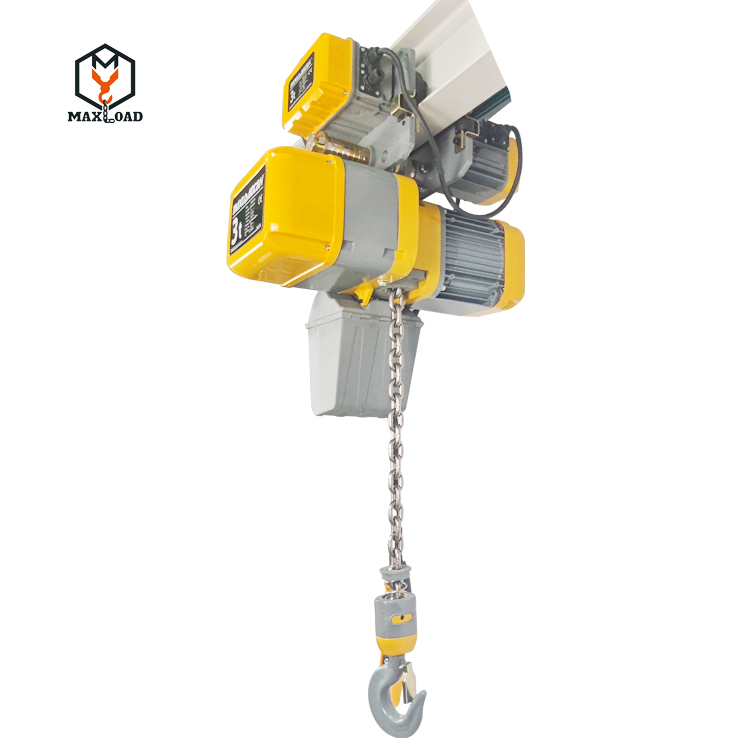
Depending on the traction medium, electric hoists are primarily categorized as wire rope hoists and chain hoists. The former, leveraging the high strength and wear resistance of wire rope, is suitable for large-tonnage, long-travel lifting operations, commonly found in heavy machinery manufacturing and port loading and unloading. The latter, with the compactness and fatigue resistance of the alloy chain, excels in space-constrained factories or workstations requiring frequent starts and stops.
Specialized environments necessitate the development of specialized models. Explosion-proof electric hoists, with their fully sealed motors and anti-static design, operate safely in flammable and explosive environments such as petrochemical plants and coal mines. Low-headroom electric hoists, with their optimized structural layout, achieve maximum lifting efficiency in factory buildings with limited floor heights. Dual-hook synchronous electric hoists, with their electronic control system, enable coordinated operation of two hoists, meeting the requirements for stable lifting of large components.
III. Invisible Drivers of Efficiency Improvement
In automotive manufacturing workshops, electric hoists work in conjunction with jib cranes to precisely assemble heavy components such as engines and gearboxes. In e-commerce logistics centers, electric hoists on circular tracks enable rapid movement between shelves, improving sorting efficiency. On construction sites, attached electric hoists work in conjunction with construction elevators to vertically transport precast concrete components.
Compared to traditional manual hoists, electric hoists offer significantly improved operating efficiency. Based on tonnage, a single electric hoist can complete dozens of lifting cycles per hour, while manual operation would take several times longer. More importantly, their precise positioning reduces repeated adjustments, preventing material damage or accidents caused by operator errors.
IV. The Secret to Long-Term Operation
The reliability of electric hoists is built on standardized maintenance. Daily inspections should cover key indicators such as wire rope wear, chain slack, and brake sensitivity. Monthly maintenance should include motor bearing lubrication, reducer oil level testing, and electrical wiring tightening. Annual overhauls require disassembly to inspect gear wear, replace seals, and calibrate limiter accuracy.
The concept of preventive maintenance is gaining widespread adoption. Vibration sensors are installed to monitor gearbox operating conditions, temperature sensors are used to monitor motor winding temperature rise, and IoT technology is integrated to enable remote condition monitoring and fault warnings. This shift from "reactive maintenance" to "proactive predictive maintenance" significantly extends equipment life and reduces overall lifecycle costs.
V. Rigorous Standards for Life Protection
Safe operating procedures are the foundation of electric hoist operation. Operators must receive professional training and be familiar with equipment performance parameters and emergency response procedures. Before lifting, ensure that the lifting point is secure and the load is balanced. Overloading, diagonal pulling, or dragging are prohibited. Maintain a safe distance during operation and avoid walking under the load. After completion of the operation, disconnect the power supply and raise the hook to a safe height.
The effectiveness of safety devices must be regularly verified. The sensitivity of the overload limiter must be calibrated using standard weights, and the triggering accuracy of the travel limiter must be verified through mechanical testing. In hazardous areas, safety guardrails, warning signs, and audible and visual alarms form a multi-layered protection network to minimize the risk of human intervention.
Conclusion
From the steam cranes of the Industrial Revolution to today's electric hoists, the evolution of lifting technology has consistently revolved around the core principles of "safety, efficiency, and intelligence." As a fundamental piece of equipment in modern industry, electric hoists, with their precision, reliability, and ease of use, play the role of "invisible craftsmen" in the production process. With the continuous integration of new materials, processes, and technologies, this traditional equipment is experiencing renewed vitality, writing a new chapter in the intelligent manufacturing landscape.
 0086 156 1824 5535
 0086 156 1824 5535