Electric Hoists: Highly Efficient Equipment in Industrial Lifting
In modern industrial production and logistics systems, electric hoists, with their lightweight design, flexible operation, and stable lifting performance, have become key equipment that connects various stages of the material flow. Widely used in multiple scenarios from workshop production lines to large warehousing centers, they effectively replace traditional manual handling, significantly improving operational efficiency and safety, making them an indispensable basic equipment in the process of industrial modernization.
I. Core Structure Analysis and Performance Advantages
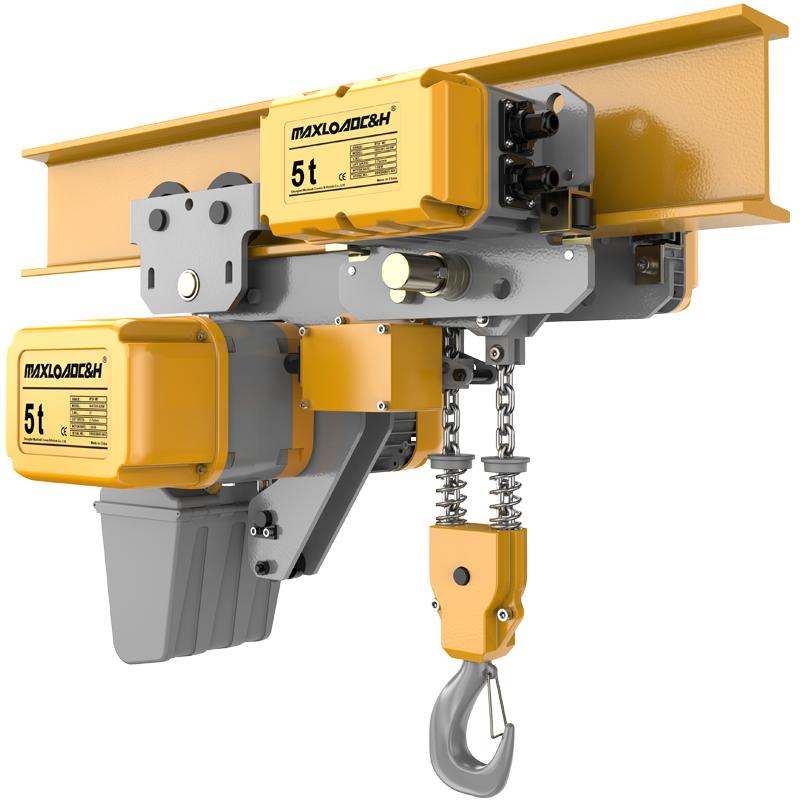
The stable operation of electric hoists relies on the coordinated work of four core systems, each designed to fully consider both functionality and safety. The power system generally uses a conical rotor brake asynchronous motor. This type of motor integrates the braking device into the rotor structure, eliminating the need for an additional brake, simplifying the equipment size while increasing response speed by more than 30%. The motor insulation class is mostly Class B or Class F.
The transmission system is based on a three-stage fixed-axis helical gear reducer. The gears are made of 20CrMnTi alloy material, carburized and quenched, with a surface hardness of HRC58-62. The tooth surface precision is controlled to level 6 of GB/T 10095.1, ensuring a stable transmission efficiency of over 92%.
The electrical control system operates on a 36V safe voltage and is equipped with upper and lower travel limit switches and an emergency cut-off button. When the hook reaches its limit position, the limit switch automatically cuts off the power to prevent over-winding or over-unwinding of the rope. Some high-end models also integrate variable frequency speed control to meet the precision requirements of lifting operations in precision assembly scenarios.
II. Scenario Adaptability
Based on the difference in the load-bearing medium, electric hoists are mainly divided into two categories: wire rope type and chain type. Each type has its own emphasis in structural design and application scenarios. Wire rope electric hoists use phosphated or galvanized steel wire rope as the load-bearing component, possessing wear-resistant and corrosion-resistant properties. This type is suitable for medium to heavy load scenarios, such as container loading and unloading in ports and billet transfer in steel plants.
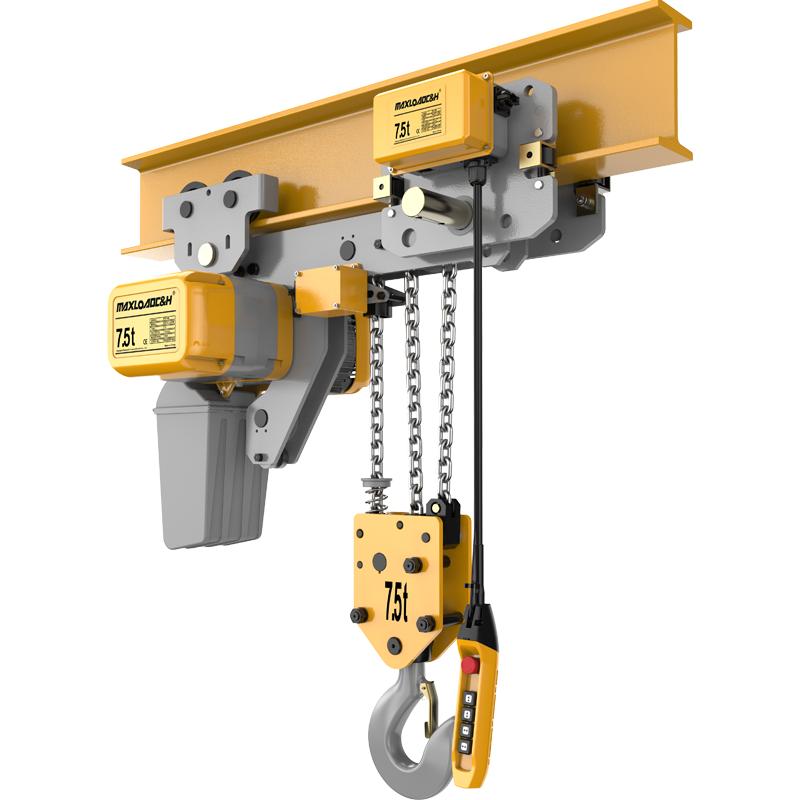
Electric chain hoists use high-strength alloy chains and are driven by sprocket meshing. Due to their compact structure and light weight, they are more suitable for confined spaces. They are widely used in stage machinery—through inverted installation, they can achieve the lifting and lateral movement of lighting rigs and sound equipment, and with a programmable control system, complete complex stage scene transitions. Furthermore, chain hoists are easy to maintain, requiring only periodic chain cleaning and application of special lubricant; there is no need for frequent replacement of wear parts, so they are also commonly used in scattered operations such as electromechanical maintenance and workshop equipment repair.
III. Cross-Industry Application Value
In the construction industry, electric hoists are core equipment in prefabricated building construction. In high-rise building construction, using attached lifting scaffolds with electric hoists enables vertical transportation of precast wall panels and composite floor slabs, increasing efficiency by 50% compared to traditional tower cranes, without occupying tower crane resources, effectively shortening the construction period.
In manufacturing production lines, electric hoists, combined with automated track systems, create "aerial material corridors," enabling seamless transfer of raw materials and semi-finished products. This is seen in automobile manufacturing workshops. In the new energy battery production sector, explosion-proof electric hoists are used for handling lithium battery cells and modules, avoiding safety hazards caused by static electricity and ensuring a safe and controllable production process.
Warehousing and logistics are also important application scenarios for electric hoists. In automated warehouses, electric hoists, in conjunction with stacker cranes, enable the storage and retrieval of goods between high-level shelves, significantly reducing warehousing operating costs.
IV. Safe Operation and Maintenance Management
To ensure the safe operation of electric hoists, operating procedures and maintenance processes must be strictly followed. Before operation, operators must conduct a comprehensive inspection: check the wire rope/chain for defects such as broken wires, wear, and deformation; check the sensitivity of the braking device, test the braking effect through a no-load test run, and ensure the hook can reliably stop at any position; clear obstacles from the track and check the track joints for flatness to avoid impacts during operation.
Routine maintenance should focus on key components: Change the gear oil in the reducer every 2000 hours, ensuring the oil level gauge marks are accurate to avoid over- or under-lubrication; clean the wire rope/chain weekly and apply dedicated lubricant to prevent rust and wear; replace brake rings when wear exceeds 3mm to ensure stable braking performance. For periodic inspections, calibrate the travel limit switch monthly by manually adjusting its position to ensure accurate power cut-off when the hook reaches its limit position; check the insulation of electrical wiring quarterly using a megohmmeter to ensure phase-to-phase insulation resistance is not less than 0.5MΩ; conduct a comprehensive disassembly and overhaul annually, replacing worn bearings, seals, and other vulnerable parts to ensure long-term stable equipment operation.
V. Technological Development Trends
Electric hoists have transitioned from "mechanical transmission" to "mechatronics." Currently, lightweighting, high efficiency, and intelligence are the main development directions: In terms of lightweighting, the use of aluminum alloy shells and high-strength alloy materials reduces the weight of the equipment by 25% compared to traditional models, while improving load-bearing capacity; in terms of high efficiency, permanent magnet synchronous motors are gradually replacing traditional asynchronous motors, reducing energy consumption by 30% and eliminating the need for regular carbon brush replacements, thus reducing maintenance costs by 50%; combined with visual recognition technology, it can automatically locate heavy objects, completing unmanned grasping and handling, further improving operational efficiency and safety. As a fundamental piece of equipment in the industrial lifting field, the technological innovation of electric hoists will continue to drive the upgrading of material handling systems, providing more efficient and safer solutions for modern industrial production.
 0086 156 1824 5535
 0086 156 1824 5535