Electric Hoists: The Invisible Muscle of Modern Industry
In vast, bustling factory workshops, towering construction sites, and busy, orderly logistics ports, there is always this kind of equipment—unassuming yet incredibly powerful; compact in structure yet the core of the system. This is the electric hoist, the invisible yet ubiquitous "steel muscle" of modern industry.
I. From Simple Lifting to Intelligent Control
Essentially, an electric hoist is a lightweight lifting device driven by electricity, integrating a motor, transmission mechanism, control system, and lifting device. Its birth and development represent the culmination of human wisdom in seeking a more efficient, labor-saving, and precise way to control the fundamental action of "lifting."
Its core working principle is clear and efficient: the electric motor converts electrical energy into rotational mechanical energy, which, through a gear reduction system, transforms the high-speed, low-torque rotation into the low-speed, high-torque force required to lift heavy objects. This force ultimately drives the drum to wind the wire rope or circulate the chain, achieving vertical lifting of the load. The core of all this lies in "control." A well-designed control system, like giving this brute force sensitive nerves, allows the operator to use it as if using their own arm, achieving inching, micro-speed, and smooth start-stop of heavy objects, and completing precise positioning. Modern advanced electric hoists have even incorporated variable frequency speed control technology, making the lifting and running process as smooth as silk, greatly reducing load sway and ensuring operational safety and accuracy.
II. Diverse Solutions
To adapt to ever-changing industrial scenarios, electric hoists have evolved into different forms, mainly divided into two types: wire rope electric hoists and chain electric hoists.
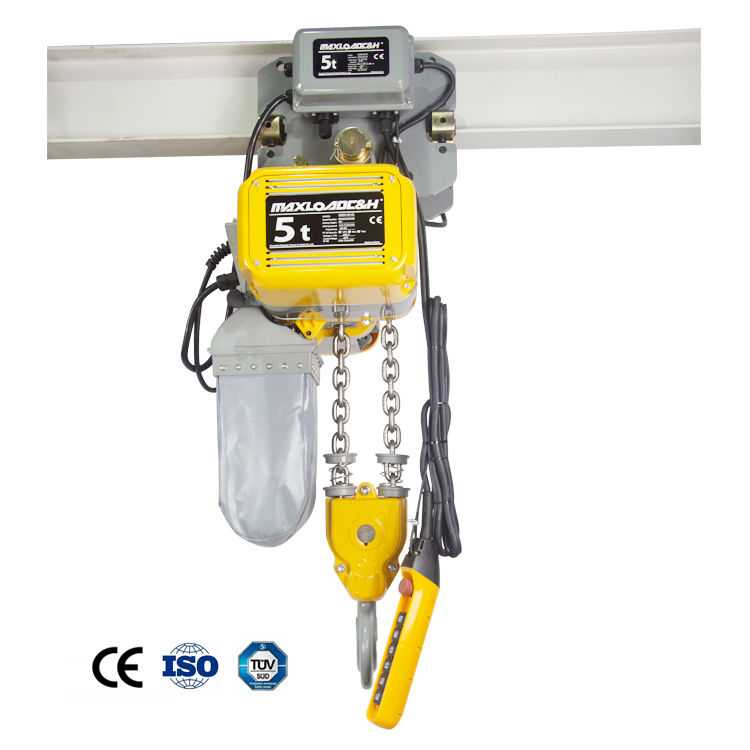
Wire rope electric hoists, with their large lifting height, fast lifting speed, and strong load-bearing capacity (up to tens of tons or even higher), play a leading role in workshops, warehouses, and construction sites that need to handle large and heavy materials. Their wire rope drum structure provides excellent performance even with medium spans.
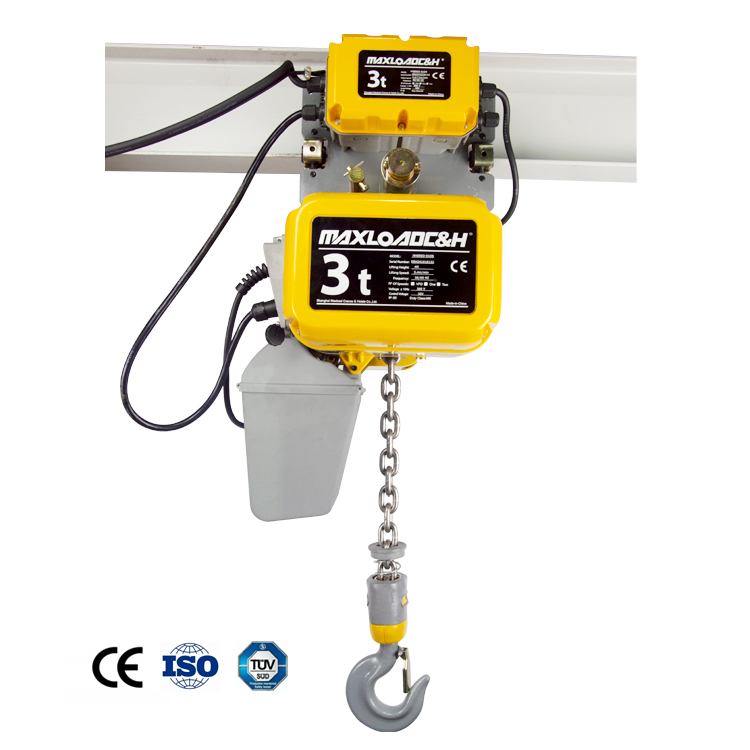
Chain electric hoists, on the other hand, are known for their light weight, compact structure, and economical price. Its robust alloy chain can be tightly folded, making it ideal for use in low-ceilinged factories with limited space or in situations requiring frequent relocation. While its lifting speed and height are generally lower than wire rope hoists, its flexibility and portability are irreplaceable advantages.
Furthermore, based on the track type, it can be divided into I-beam traveling hoists and stationary hoists. Traveling hoists can move horizontally on pre-set I-beam tracks, greatly expanding their operational coverage and forming flexible, lightweight crane systems, while stationary hoists focus on vertical lifting tasks at a single point.
III. Wide Range of Applications
The application areas of electric hoists cover almost every corner of modern industry.
In manufacturing plants, it is an indispensable "handler" on the production line, precisely hoisting heavy parts and molds onto machine tools, a powerful assistant in the assembly process.
In equipment maintenance workshops, it acts like a "powerful doctor," easily moving motors and gearboxes, creating a safe passage for maintenance.
In busy construction sites, it acts as a "vertical transporter," easily delivering materials such as bricks, mortar, and pipes to different floors.
In warehousing and logistics, it works in conjunction with racking systems to become an efficient "storage and retrieval officer," enabling rapid loading and unloading of goods.
Even in auto repair shops, it serves as the "powerful heart," acting as the main power source for lifting machines, steadily lifting entire vehicles.
It can be said that any situation requiring repeated, safe, and efficient vertical handling is a stage where the electric hoist demonstrates its value.
IV. Safety: The Indispensable Bottom Line
When discussing lifting several tons of weight into the air, safety becomes the paramount concern. A high-quality electric hoist must have a comprehensive and multi-layered safety design.
Overload protection devices are the primary line of defense; when the load exceeds the rated capacity, they automatically cut off the power to prevent accidents. Upper limit switches ensure that the hook automatically stops when it reaches the preset highest position, avoiding severe structural damage caused by "overshooting." For wire rope hoists, a broken rope fall prevention device is usually installed, which can serve as a last resort for life protection in extreme situations. In addition, emergency stop buttons, phase sequence protection (to prevent malfunctions caused by incorrect power phase sequence connection), and dual braking systems (electromagnetic brakes and mechanical brakes as backups for each other) collectively form a solid safety barrier. Strictly adhering to safe operating procedures and conducting regular professional inspections and maintenance are not only regulatory requirements but also a matter of respect for life.
V. The Trend of Intelligentization and Integration
With the surge of Industry 4.0 and intelligent manufacturing, the traditional electric hoist is being endowed with new intelligence. The electric hoist of the future will no longer be an isolated tool but a node in the data flow of a smart factory.
Integrated sensors can monitor real-time status data such as load, motor temperature, and number of runs, and upload this data to a cloud platform via IoT technology to achieve predictive maintenance—issuing warnings before failures occur. Combined with an automated control system, the electric hoist can link with AGVs (Automated Guided Vehicles) or other equipment according to preset programs to achieve fully automated material handling and loading/unloading, becoming a tireless "robotic arm" in an unmanned workshop. Human-centered design is constantly evolving, with quieter operation, more ergonomic remote controls, and clearer status indicators all aimed at creating a more comfortable and efficient working environment for operators.
Conclusion:
The electric hoist, this seemingly ordinary industrial piece of equipment, actually embodies profound human wisdom in the fields of mechanics, electrical engineering, control, and safety. With its robustness, precision, and reliability, it silently supports the operation of modern industry, liberating humans from heavy physical labor and allowing us to focus on more creative work. The next time you see it steadily lifting heavy objects and gliding through the air in a factory or construction site, you might feel a sense of respect—a tribute to this unassuming yet crucial "industrial muscle" hidden within the steel jungle.
 0086 156 1824 5535
 0086 156 1824 5535