Electric Hoists: The "High-Efficiency Lifting Partner" in Industrial Production
I. The "Everyday Hero" Hidden in the Workshop:
In the early morning of a logistics warehouse, a 1-ton cargo box is being smoothly lifted and moved to the top shelf—this task is accomplished by an electric hoist less than 1.5 meters tall. In fields such as machinery manufacturing, construction, and port loading and unloading, it acts like the "capillaries of industrial production." Though not as conspicuous as large cranes, it undertakes more than 70% of medium and light load lifting tasks.
Compared to manual hoists, electric hoists eliminate "human dependence": a 2-ton part that used to require 3 people to move can now be lifted by just 1 person operating a button; traditional cranes require fixed rails and large working spaces, while electric hoists can be flexibly installed on single-beam rails, even enabling cargo turning within a 5-meter-wide workshop. More importantly, it offers "precision"—on an automotive parts assembly line, it can lift an engine assembly to a position with an error of less than 2 mm. With its precise millimeter-wide installation position, it can gently lift fragile glass reagent bottles in pharmaceutical warehouses, making it a core reason for its status as an essential piece of equipment in industrial production.
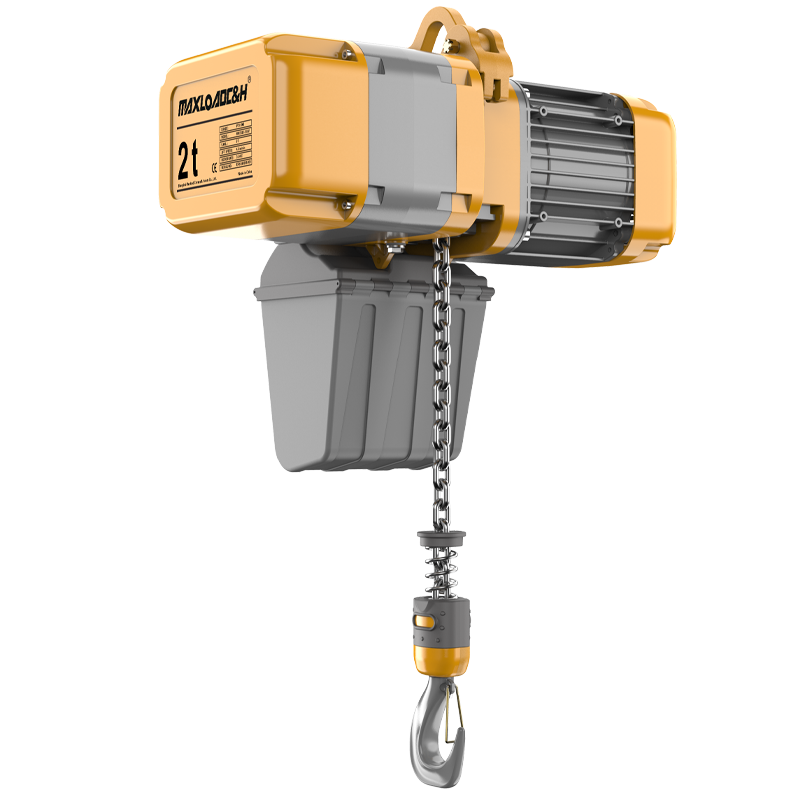
II. How does an electric hoist "lift" heavy objects?
Its working principle is like a "power relay chain," requiring only four steps from electrical energy to lifting action:
Power Start: Pressing the operation button powers on the three-phase asynchronous motor, like an "engine" starting to generate power.
Speed Reduction and Power Amplification: The motor speed reaches up to 1400 rpm, which would be "too fast and too forceful" to directly drive the hook. Therefore, a speed reducer is needed for "speed reduction and power amplification"—internal three sets of gears mesh together to reduce the speed to 20-50 rpm while simultaneously amplifying the torque by tens of times. For example, a 7.5kW motor, after speed reduction, can lift a 10-ton object. "Power".
Action Execution: The decelerated power is transmitted to the drum (wire rope type) or sprocket (chain type): the wire rope rotates and winds around the drum, causing the hook to rise; conversely, it descends. If equipped with a travel motor, it can also drive the wheels to move left and right along the track, achieving "moving while suspended".
Safety Locking: Double protection throughout: First, mechanical braking; after a power failure, the spring pushes the brake pads to "grip" the motor shaft, preventing the hook from slipping. Second, electrical limit switches; when the hook reaches the top or bottom, the limit switch cuts off the power to prevent "overtravel" damage to the equipment.
III. Selecting Models Based on "Needs": Adaptable Solutions for Different Industries
There is no "one-size-fits-all" electric hoist; instead, they are precisely designed according to industry pain points:
Logistics and Warehousing: Choose a chain electric hoist—small in size and lightweight, it can move in narrow aisles between shelves, such as in e-commerce warehouses, where it can be used with stacker cranes.
Chemical Industry: Explosion-proof electric hoists are a must— All electrical components are sealed, and cable interfaces are sealed with explosion-proof rubber rings. Even if flammable gases such as methanol and gasoline are present in the workshop, there will be no explosion due to electrical sparks. It is commonly used for lifting chemical raw material tanks.
Precision Manufacturing: Dual-speed electric hoists are the first choice – high speed for long-distance movement, low speed for precise positioning.
IV. Practical Guidelines
To ensure an electric hoist is "durable and safe," two key points are crucial:
1. Simple Maintenance: 3 High-Frequency Inspection Points
Check 2 points daily: Check for cracks or deformation in the hook (replace if the hook opening exceeds 10% of its original size); check for broken wires in the wire rope (replace if more than 5 broken single strands). This is crucial to prevent objects from falling.
Do 1 thing weekly: Add lithium-based grease to the gearbox and apply lubricating oil to the wheel axles. Otherwise, excessive friction will cause the motor to overheat. Weekly lubrication can extend the motor's lifespan by 3-5 years.
Test 1 item monthly: Use a multimeter to measure the motor's insulation resistance. The value should be greater than [value missing]. 0.5MΩ. If the resistance is lower than this value, it indicates that the motor is damp and may be leaking electricity. It should be dried immediately.
2. Safe Operation: 4 "Absolutely No's"
No angled pulling or lifting: The hook must be vertically aligned with the center of the load. Pulling at an angle will wear down the wire rope and may cause the load to sway and injure people.
No overloading: For example, a hoist rated at 1 ton should not be used to lift more than 1.1 tons (10% overload testing is allowed). Long-term overloading will cause gear deformation and brake failure.
No lifting personnel: Electric hoists are designed for lifting goods and do not have fall protection. They must not be used to carry people for equipment maintenance.
No unattended operation: Someone must be present to observe during lifting. If there is a sudden power outage, the main switch must be turned off immediately to prevent the equipment from restarting after power is restored.
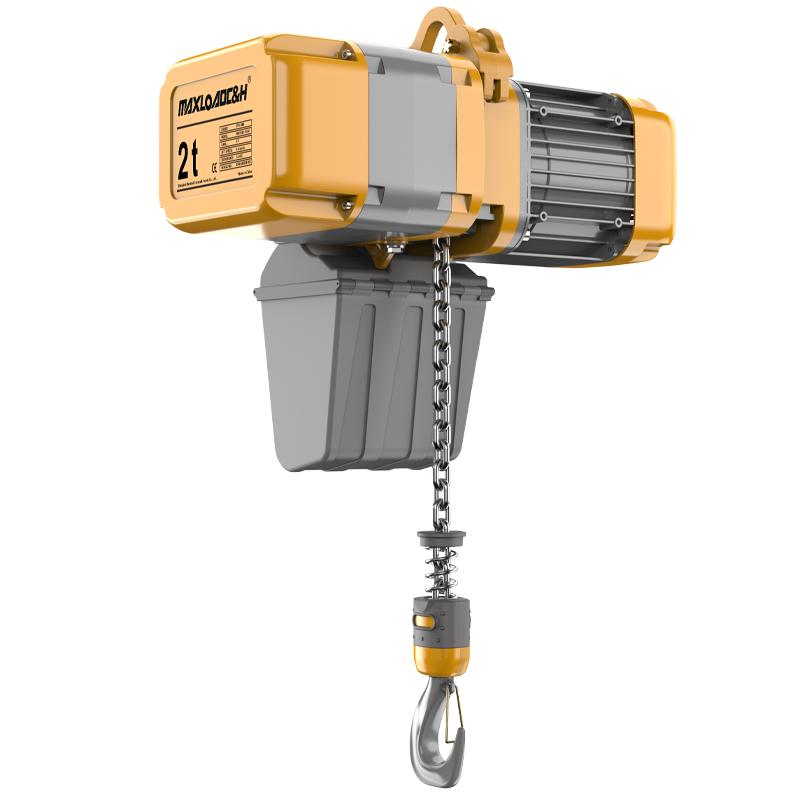
V. More Intelligent and More Scenario-Specific
The next generation of electric hoists will be more "understanding" of industrial needs: On the one hand, they will be deeply integrated with automated equipment, such as working with AGV robots to automatically complete "picking up - transporting - unloading" in unmanned workshops. The entire process is streamlined; on the other hand, it's more environmentally friendly. Some models already use permanent magnet synchronous motors, which save 25% more electricity than traditional motors. In the future, biodegradable lubricating oil will be used to further reduce environmental pollution.
For ordinary industrial workers, electric hoists may not be "high-tech stars," but they are indispensable "old partners" they rely on every day. With their simple and reliable design, they silently support the efficient operation of production lines, becoming an indispensable "invisible driving force" for improving industrial efficiency.
 0086 156 1824 5535
 0086 156 1824 5535