How Electric Hoists Are Reshaping Our Work Dimensions
Under the ceilings of modern factories, beside the gantry cranes of busy docks, and on the elevated tracks of construction sites, a mechanical device is moving tons of heavy objects in an almost silent manner – this is the electric hoist. Unlike giant cranes, it may not be as eye-catching, but with its ingenious design and reliable performance, it has become an indispensable "muscle and nerve" in the modern industrial system. This article will delve into the technical secrets, diverse applications, and future trends of electric hoists, revealing how this equipment is quietly changing our understanding and practice of heavy lifting.
I. Basic Principles and Technological Evolution
Modern electric hoists are characterized by advancements in several key areas: firstly, the innovation in motor technology, from traditional squirrel-cage motors to variable-frequency speed-regulating motors, achieving smoother starting and stopping and precise speed control; secondly, the improvement of braking systems, in addition to conventional electromagnetic brakes, many devices are also equipped with redundant safety braking devices; thirdly, the diversification of control methods, from simple button control to remote control, intelligent programming control, and even Internet of Things integrated control. These technological advancements have not only improved the performance parameters of the hoists but also greatly expanded their application scope.
II. Type Classification and Application Scenarios
Based on structural characteristics and applicable environments, electric hoists can be divided into various types, each with its unique advantages and application scenarios.
Wire rope electric hoists, with their large lifting height, smooth operation, and wide load capacity range, are the most common type. They are widely used in mechanical manufacturing, assembly workshops, warehousing and logistics, and are particularly suitable for applications requiring frequent lifting and high positioning accuracy. In automated production lines, these hoists are often combined with track systems to form two-dimensional or even three-dimensional mobile lifting units.
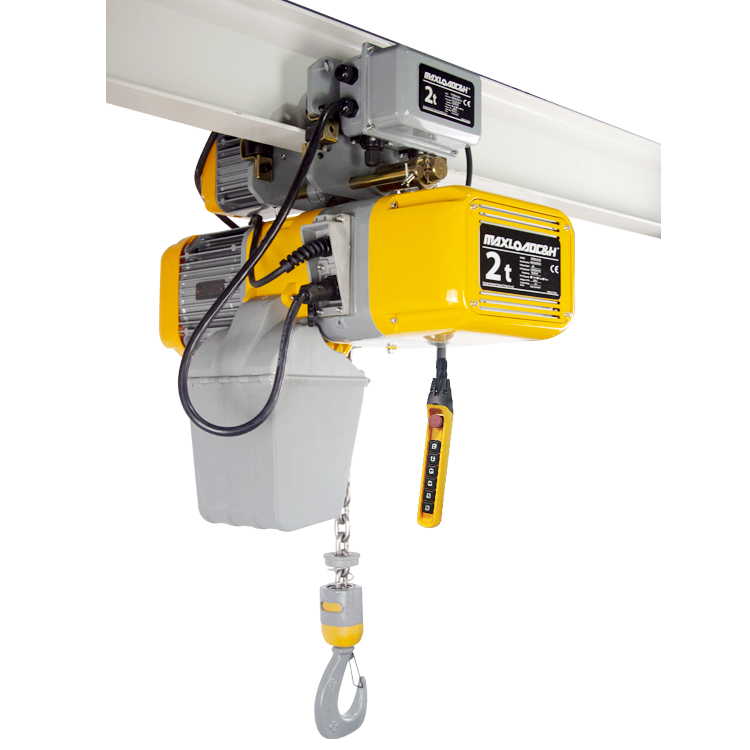
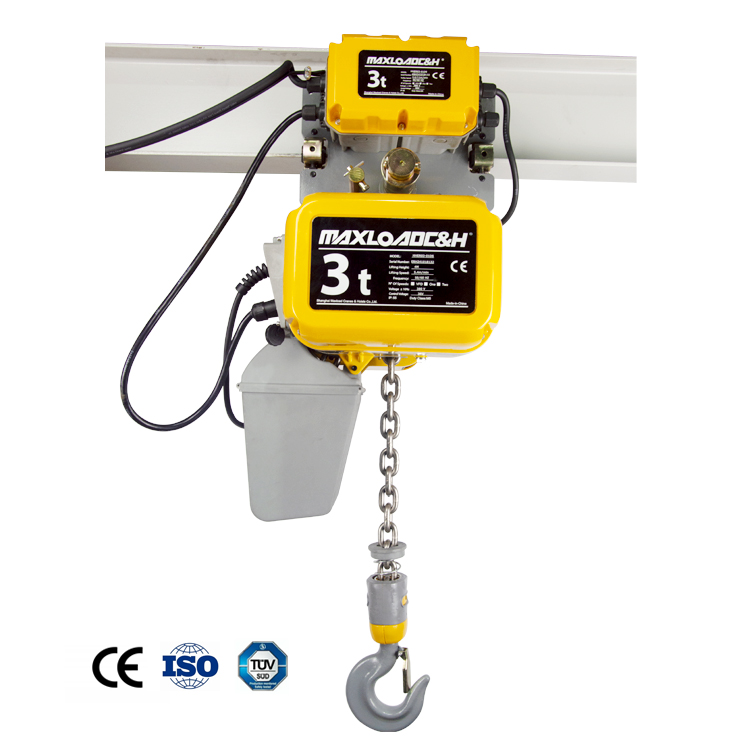
Chain electric hoists, on the other hand, are favored in repair workshops, small processing plants, and temporary operations due to their compact structure, light weight, and economical price. Their enclosed chain design provides good dust and dirt protection, making them suitable for working in relatively harsh environments. Some specially designed explosion-proof chain hoists are essential equipment in hazardous areas such as petrochemical plants and mines. Besides these two mainstream types, there are numerous specialized electric hoists to meet specific needs: low-headroom hoists provide solutions for height-restricted spaces, and dual-speed hoists allow for flexible switching between precise lifting and rapid movement.
In the construction industry, electric hoists are invaluable assistants for formwork installation and building material transportation; in automobile manufacturing plants, they form suspended conveyor systems, precisely moving car body components; in the field of stage arts, hoist systems quietly control the lifting and lowering of lighting, sound equipment, and scenery, creating spectacular visual effects. These diverse applications demonstrate that electric hoists have become deeply integrated into every aspect of modern production.
III. Safety Philosophy and Selection Wisdom
As specialized lifting equipment, the safety of electric hoists directly relates to the safety of personnel and property. The safety design of modern electric hoists reflects a multi-layered protection concept: the electrical system has overload, phase loss, and phase error protection; the mechanical system is equipped with overload limiters, upper and lower limit switches, and emergency braking devices; and the structure is optimized through finite element analysis to ensure that catastrophic failure will not occur even in extreme circumstances.
Operator safety awareness and skills are equally crucial. Formal training includes not only equipment operation but also a complete set of knowledge covering load estimation, lifting point selection, and hand signals. Many accidents are not caused by equipment failure, but rather by operators misjudging the center of gravity of the load or neglecting daily inspection and maintenance. Therefore, a comprehensive safety management system must organically integrate equipment, personnel, and procedures.
Faced with the wide array of products on the market, choosing the right electric hoist is a challenge that users must address. This decision-making process requires systematic consideration of multiple dimensions: first, the work class, which is the expected frequency of use and load rate of the equipment, determining the structural strength standards of the hoist; second, the lifting height and speed, which must be precisely matched to actual process requirements; the characteristics of the working environment determine the protection level and material selection; installation space limitations affect the structural form of the hoist; and finally, but equally important, the supplier's technical support capabilities and spare parts supply guarantee.
IV. Intelligent Integration and Future Outlook
Electric hoists are undergoing a profound intelligent transformation. The integration of sensor technology enables hoists to monitor parameters such as load, speed, temperature, and vibration in real time, and predict potential failures through data analysis. The Internet of Things connectivity enables remote monitoring and optimized scheduling of equipment, allowing for precise coordination of multiple hoists through a central control system.
The introduction of digital twin technology takes this a step further: while the actual hoists are operating, a virtual model simultaneously simulates their operation. This can be used not only for operator training but also to optimize operating modes using historical data, predict component lifespan, and implement preventative maintenance. In some advanced applications, machine vision systems enable the hoists to automatically identify load shapes and centers of gravity, autonomously plan lifting paths, and avoid obstacles, achieving a certain degree of autonomous operation.
The future development of electric hoists will evolve along several clear directions: firstly, even greater energy efficiency, maximizing the utilization of every kilowatt-hour through technologies such as permanent magnet motors and energy recovery systems; secondly, deeper intelligence, with hoists becoming nodes in the smart factory data network, participating in the optimization decisions of the entire production system; and thirdly, stronger human-machine collaboration, using user-friendly interaction methods such as augmented reality interfaces and force-feedback remote control to lower the operating threshold and improve operational accuracy and safety.
Conclusion
The story of the electric hoist is a microcosm of the evolution of industrial civilization – from a simple labor-saving tool to a complex system integrating multiple disciplines such as mechanics, electrical engineering, materials science, and information technology. It hangs silently above the factory floor, yet powerfully supports the flow of materials in modern society. Every smooth lift, every precise positioning, is a concentrated embodiment of the essence of engineering technology.
In this era of pursuing efficiency and safety, the value of electric hoists is no longer measured solely by tonnage and speed, but also reflected in their harmonious coexistence with human work. They extend our arms, amplify our strength, yet leave the control to human intelligence. In the future, as technology continues to integrate and innovate, electric hoists will undoubtedly operate in a wider range of fields and in a more intelligent manner.
 0086 156 1824 5535
 0086 156 1824 5535