The Perfect Partner in Industrial Lifting
In busy workshops, we often see this scene: a massive metal structure slowly moves along tracks on the factory ceiling, while smaller, suspended devices below precisely lift and lower heavy workpieces. For those unfamiliar with the industry, these two devices are often confused, collectively referred to as "overhead cranes" or "cranes." However, they are actually two closely related yet functionally distinct concepts.
Today, we'll delve into the relationship between electric hoists and overhead cranes, exploring how this "perfect partner" in industrial lifting works together, and what essential considerations are involved in their selection.
I. Concept Clarification: Which Includes Which?
In everyday speech, people often refer to all lifting equipment on the factory ceiling as "overhead cranes." However, from a professional machinery classification perspective, electric hoists and overhead cranes are related as "component" and "complete machine," or, in other words, "part" and "whole."
An electric hoist, essentially, is a lifting mechanism. Its core task is to lift or lower heavy objects. It consists of an electric motor, reducer, drum or sprocket, and braking device, and can operate independently suspended from a fixed support, but its function is relatively simple.
A traveling crane, commonly known as a gantry crane, often refers to a bridge crane in industry terminology. It is a complete piece of equipment capable of omnidirectional displacement: it can not only lift up and down, but also move the lifted load forward, backward, left, and right along factory tracks.
Simply put: if you compare a traveling crane to a truck that can travel on rails, then the electric hoist is the truck's "cargo box + lift," responsible for loading and unloading goods. The electric hoist is the core component of the traveling crane, while the traveling crane provides the platform for the electric hoist to have a greater range of motion.
II. Composition and Classification of Traveling Cranes
As a complete lifting device, a traveling crane typically consists of three main parts: the bridge, the traveling mechanism, and the hoisting mechanism. The hoisting mechanism is, in most cases, an electric hoist, or, on some large-tonnage traveling cranes, a more complex winch system.
Based on their structure and application scenarios, overhead cranes are mainly classified into the following categories:
Single-girder cranes: This is the most common type of overhead crane. It has only one main girder, with the electric hoist suspended below it, allowing for lateral movement. Simultaneously, the entire main girder can move forward and backward on the main track. This structure is lightweight, easy to install, and relatively inexpensive.
Double-girder cranes: These have two main girder sections, with the lifting mechanism running on a track above the main girder. Compared to single-girder cranes, double-girder cranes have stronger load-bearing capacity, better stability, and higher lifting height, making them suitable for large spans, heavy loads, and applications requiring frequent, high-intensity operations.
Cantilever cranes: These cranes do not have a complete "bridge" but instead have a rotating boom, with the electric hoist running on the cantilever. They offer extremely high flexibility and are often used for material handling near workstations or in specific areas, effectively complementing large bridge cranes.
III. Types and Selection of Electric Hoists
Since the electric hoist is the "heart" of the overhead crane, choosing a powerful and suitable "heart" is crucial. Based on their structure and lifting medium, electric hoists used in overhead cranes mainly fall into two categories:
1. Wire Rope Electric Hoists
This is the most widely used type. A wire rope is wound around its drum, and the lifting and lowering of heavy objects is achieved by winding and unwinding the wire rope.
Advantages: High lifting height, fast operating speed, strong load-bearing capacity, mature structure, and high safety.
Applicable Scenarios: General machining workshops, steel structure assembly, warehouses, logistics transfer stations, and most other conventional industrial scenarios.
Selection Points: In addition to basic tonnage and lifting height, special attention should be paid to the working level, which reflects the designed workload of the equipment. For workshops with high daily operating frequency, a hoist with a higher working level must be selected. At the same time, the material should be selected according to the operating environment; for example, galvanized steel wire rope can be considered for humid environments.
2. Chain Electric Hoists
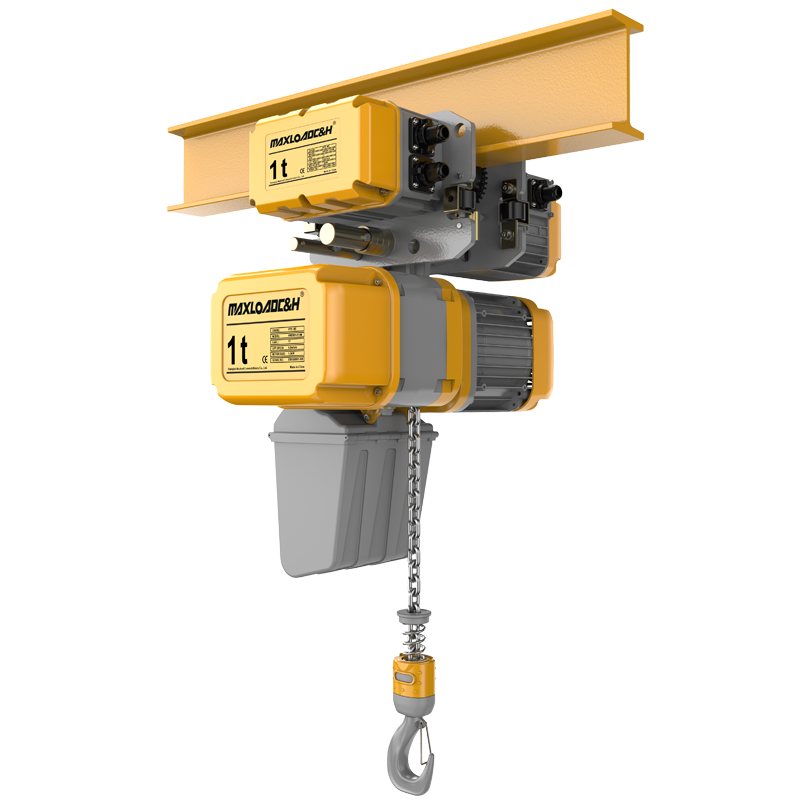
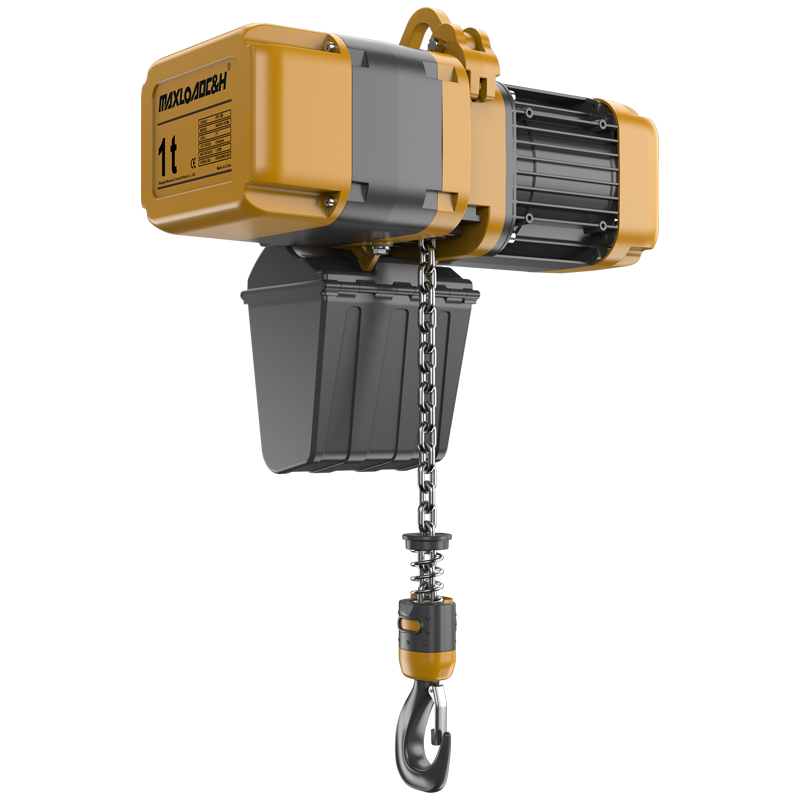
This type of hoist uses a specially processed lifting chain as the lifting component.
Advantages: Extremely lightweight, compact size, low headroom, suitable for use in space-constrained locations, and relatively economical price.
Applicable Scenarios: Production line workstations, precision equipment installation, maintenance work, mold replacement, etc.
Selection Considerations: Chain hoists typically have a smaller tonnage. When selecting, pay attention to the chain's wear resistance and protective measures, as well as the type of trolley—manual, manual chain, or electric.
IV. Collaborative Selection: The Secret to 1+1 > 2
To ensure perfect coordination between the electric hoist and the overhead crane, achieving a 1+1 greater than 2 effect, consider the following key points during selection:
Matching of Operating Modes: Electric hoists on overhead cranes mainly operate in two ways: electric trolley type and manual trolley type.
Electric Trolley Type: The hoist has a built-in motor driving the wheels. The operator can control its position on the main beam via a button. Suitable for frequent movement, large tonnage, or situations where the operator is nearby.
Manual Trolley Type: The hoist is moved by pulling the chain or pushing. It has a simple structure and low cost, suitable for occasional movement, small tonnage, or situations where the operator is nearby.
Installation Dimensions Considerations: When installing an electric hoist on a gantry crane, the hook distance and clearance height must be accurately checked. The hook distance refers to the distance from the center of the hook to the top surface of the rail, which determines the maximum height of the workpiece that can be lifted within the limited height of the factory. It is essential to ensure that the overall dimensions of the hoist are completely compatible with the structure of the gantry crane.
Control System Integration: Modern gantry cranes mostly use wireless remote control operation. This requires the electric hoist's control system to seamlessly integrate with the gantry crane's control system, enabling a single remote control to simultaneously control all actions of the gantry crane's movement, hoist lifting, and lowering, greatly improving operational convenience and safety.
V. Safety Standards: The Bottom Line We Share
Both electric hoists and gantry cranes fall under the category of special equipment, and safety is always the top priority.
Certified Operation and Daily Inspections: Operators must undergo professional training and be certified before operating the equipment. Before each day's operation, the hook, wire rope/chain should be checked for any abnormalities, the brakes should be sensitive and reliable, and the limit switches should be effective.
Strictly prohibit unauthorized operations: The "Ten No-Lifting" principle must be strictly adhered to, especially overloading and oblique lifting. Overloading and oblique lifting are the main causes of electric hoist damage and even falls.
Proper Parking and Maintenance: After work is completed, the hook should be raised to a height of at least 2 meters above the ground, and the main power supply should be disconnected. Regularly lubricate the reducer and check the aging and wear of the electrical wiring to ensure the equipment is always in optimal condition.
Conclusion: Electric hoists and overhead cranes, one a powerful "heart" and the other a broad and sturdy "body," complement each other and together form the backbone of modern industrial material handling. Understanding their relationship, mastering scientific selection methods, and adhering to strict safety operating procedures not only improves production efficiency but also provide a solid guarantee for the safety of every worker. In the future wave of intelligentization, this golden duo will inevitably evolve towards greater intelligence, precision, and safety.
 0086 156 1824 5535
 0086 156 1824 5535