The Core of Industrial Lifting: Electric Hoists and Overhead Cranes
In modern industrial plants, warehousing and logistics centers, and various construction sites, one often sees this scene: massive steel beams spanning the plant's roof, a movable hook device that flexibly lifts and lowers heavy objects, easily moving hundreds of kilograms or even tens of tons of goods. The core of this smooth operating system lies in the golden pair of "overhead cranes" and "electric hoists."
Many practitioners operate them daily, but may not have a systematic understanding of the classification, selection, and safety regulations of this pair. This article will set aside brands and take you on a deep dive into electric hoists and overhead cranes from a purely technical and application perspective.
I. Concept Clarification: The Relationship Between Overhead Cranes and Electric Hoists
In industrial contexts, an overhead crane usually refers to a complete bridge structure, including crossbeams, a main trolley traveling mechanism, and a trolley assembly. The electric hoist, installed on the main beam of the overhead crane, is the core "power heart" responsible for lifting heavy objects.
In simple terms, the overhead crane provides the track platform for "lateral movement" and "longitudinal movement," while the electric hoist is responsible for the "vertical lifting" action. Together, they form a three-dimensional logistics handling system with an X-axis (lateral movement of the trolley), a Y-axis (front and rear movement of the trolley), and a Z-axis (vertical movement of the hoist).
II. Classification and Structural Analysis of Electric Hoists
Based on the different lifting mechanisms, the mainstream electric hoists on the market are mainly divided into two categories, each with its own advantages and suitable for different working conditions.
1. Wire Rope Electric Hoist
This is the most common type. It uses a motor to drive a drum, which winds a wire rope to raise and lower the hook.
Advantages: High lifting height, relatively fast operating speed, relatively simple structure, convenient maintenance and replacement, suitable for frequent lifting of medium to large objects.
Structural characteristics: Usually adopts a "I"-shaped series layout, featuring high rigidity and durability, and various models can be selected to meet different speed requirements.
2. Electric Chain Hoist
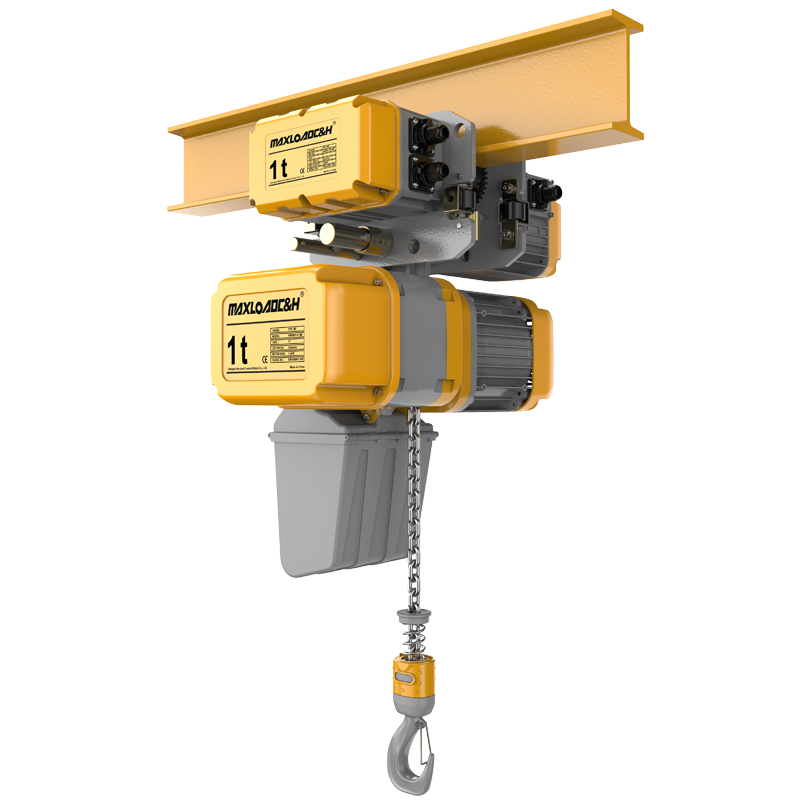
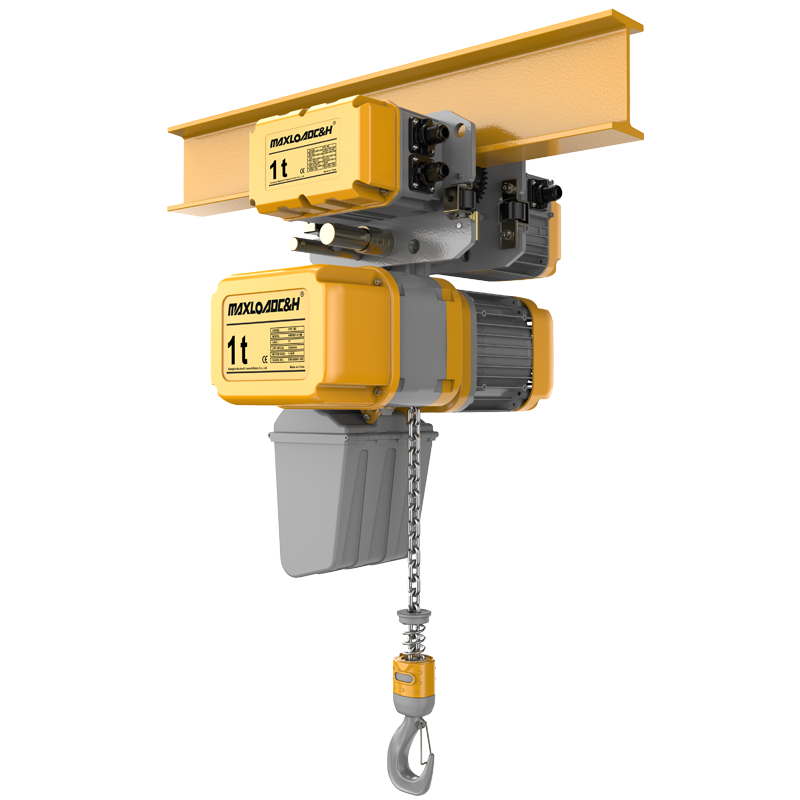
Electric chain hoists use a special alloy steel chain as a flexible component, with lifting achieved by driving the chain through a sprocket.
Advantages: Lightweight and compact, particularly suitable for low-headroom factories. Due to its chain flexibility, it is less prone to derailment, performing excellently in scenarios requiring precise micro-motion, such as mold installation and precision equipment debugging.
Technical Highlights: Modern chain hoists are typically equipped with a disc-type DC electromagnetic brake, providing high braking torque and low noise. Simultaneously, the fully sealed aluminum alloy shell design provides excellent heat dissipation and dustproof capabilities.
III. Intelligent Load-Bearing Capacity of the Overhead Crane
The overhead crane design must not only bear the weight of the electric hoist itself but also withstand the enormous dynamic load from lifting heavy objects. A high-quality overhead crane steel beam structure is typically a box girder or H-beam structure to ensure minimal deflection under heavy loads.
In terms of design, overhead cranes can be divided into:
Electric Single-Girder Cranes: Utilizing a single main beam, the electric hoist runs below the trolley or I-beam rails, suitable for light-duty and small-tonnage operations.
Electric double-girder cranes: These consist of two main beams on which an electric hoist or trolley runs. This structure offers greater load-bearing capacity, lifting to hundreds of tons, higher lifting height, and better stability.
To prevent collisions or crushing accidents when the trolley reaches its limit position, conductive frames and buffers are typically installed at both ends of the crane. Furthermore, to ensure operational safety, the power supply system often uses flexible cables or safety conductor rails, avoiding the risks associated with exposed wires.
IV. How to Select and Match Models?
When selecting a combination of "crane + electric hoist," the following dimensions need to be considered:
Working Class: This is the most important parameter, bar none. The working class reflects the equipment's workload and load condition. For high-frequency operation environments such as machining workshops or mold repair, a high-working-class hoist must be selected to ensure fatigue life.
Lifting Height and Headroom: In newly built factories with low ceiling heights, low-headroom electric hoists are recommended. This type of hoist optimizes the relative position of the hook and winch mechanism, shortening the distance between the machine body and the track, thereby maximizing the effective lifting space within a limited height.
Operating Methods:
Ground Operation: Controlled via a wired handle or wireless remote control. The operator has a clear view, but must pay attention to their position and avoid walking under the load.
Driver's Cab Operation: Suitable for heavy lifting or harsh operating environments. The driver's field of vision must be greater than 280 degrees to ensure safety.
V. Safety First
Whether it's an electric hoist or a crane, safety is always paramount. According to statistics from the Safety Production Association, many accidents stem from the failure of safety devices or improper operation. The following are the "ironclad rules" that must be followed:
1. Three Confirmations Before Operation
Confirm Limit Devices: The hook's upward limit and travel limit must be sensitive and reliable. During a no-load test run, check whether the power is automatically cut off when the hook reaches its limit position.
Confirm Brakes: When the load is lifted approximately 10cm off the ground, stop the machine and check the brakes for any hook slippage. Especially for disc brakes, ensure rapid response.
Check the wire rope/chain: Inspect the wire rope for broken strands, flattening, or corrosion, and the chain for cracks. Replace immediately if any damage is found.
2. Ten Don'ts for Lifting During Operation
Strictly adhering to the "Ten Don'ts for Lifting" is crucial to preventing accidents, including but not limited to: not lifting overloaded loads, not lifting at angles, not lifting with insecure bindings, and not lifting without supervision.
3. Environment and Regulations
Overhead cranes and electric hoists are not suitable for flammable, explosive, corrosive, gas-filled, or environments with relative humidity greater than 85%.
Operators must be certified and operate from a safe platform. No one is allowed to remain under the overhead crane beam or under the load.
After the operation, the hook must be raised to a height of at least 2 meters above the ground, and the main power supply must be disconnected.
Conclusion
Electric hoists and overhead cranes, as the backbone of modern industry, are advancing towards intelligent and precise technology. Today, many high-end systems possess electronic anti-sway functions, micro-speed inching capabilities, and multi-vehicle collaborative control, significantly improving lifting efficiency and positioning accuracy.
For businesses, choosing suitable lifting equipment is not just about purchasing a machine, but also a commitment to production efficiency and employee safety. This article aims to help you make more informed choices in future selection and use, allowing this "industrial partner" to create greater value for you.
 0086 156 1824 5535
 0086 156 1824 5535