The Core of Flexible Industrial Logistics
In modern industrial production, the efficiency of material handling directly determines the workshop's throughput and production costs. Whether in heavy machinery manufacturing workshops or precision assembly lines, we can see various types of lifting equipment. Among them, the electric hoist, as the core lifting mechanism, is often used in combination with overhead cranes and JIB cranes, forming the cornerstone of modern industrial flexible logistics. This article will explore the technological connections and practical application scenarios among these three components.
I. Electric Hoists: The "Power Heart" of the Lifting World
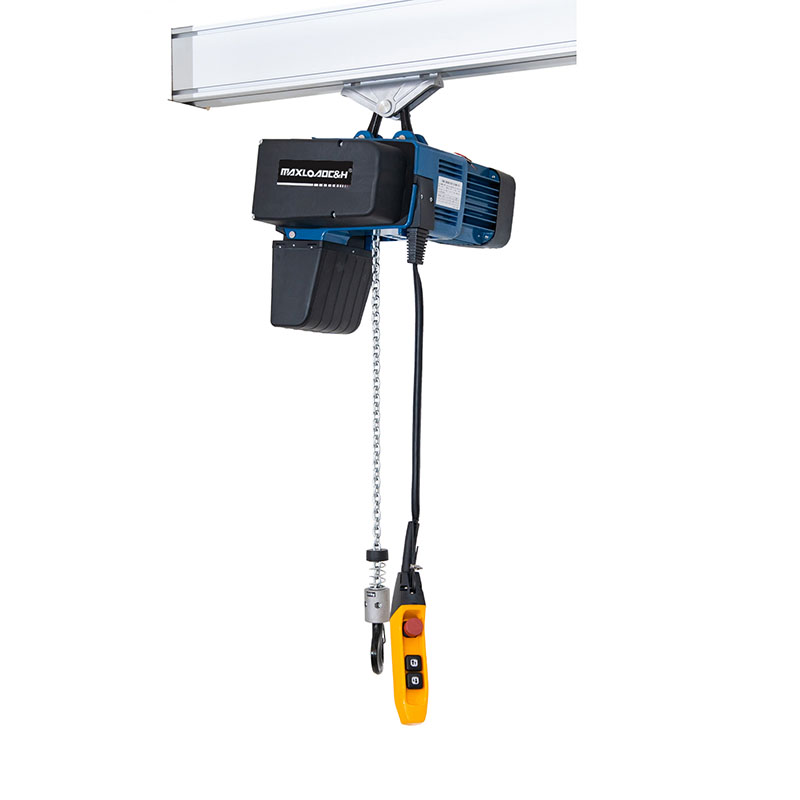
The electric hoist is a small and lightweight lifting device that integrates a motor, reducer, drum or sprocket, and braking device. It is characterized by its small size, light weight, and simple operation. Based on different structures, it is mainly divided into two types: wire rope electric hoists and chain electric hoists.
From a technological evolution perspective, modern electric hoist designs are becoming increasingly compact and efficient. For example, the lifting motor typically uses a conical rotor brake asynchronous motor, which can automatically and quickly engage the brake upon power failure, ensuring the safety of the load when it stops in mid-air. In terms of internal transmission structure, designs where the motor shaft is parallel to the drum or the motor is built into the drum are gradually becoming mainstream. This allows the equipment to achieve a greater lifting height while reducing its overall size, facilitating installation in various confined spaces.
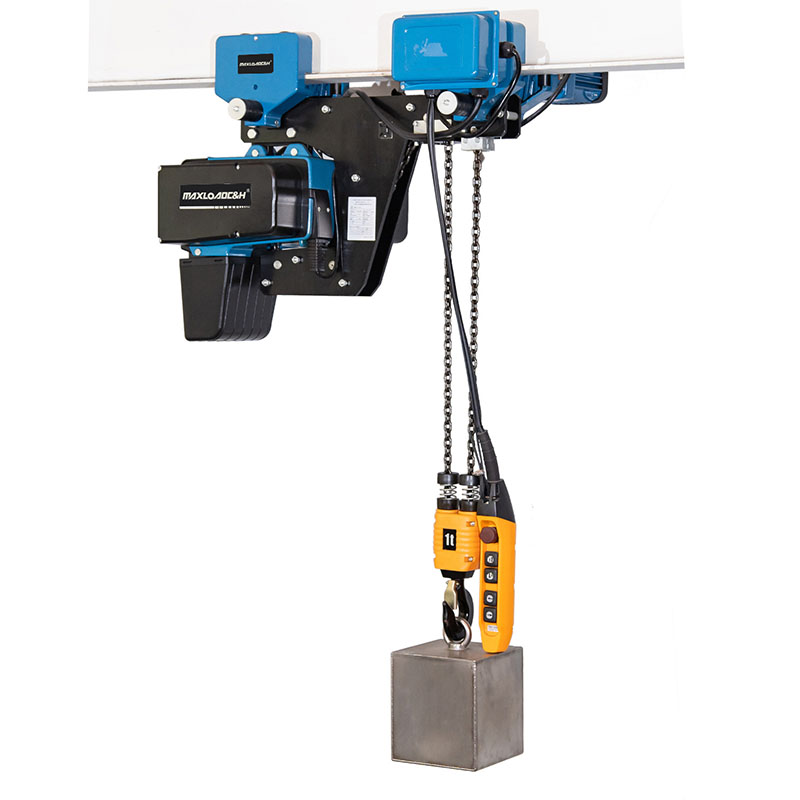
It is worth noting that the electric hoist does not exist as a standalone device, but rather as a power component integrated into a larger mechanical system. It can move linearly suspended on a single beam, or it can travel in curves on I-beam tracks in conjunction with a traveling trolley. It is precisely because of this highly flexible adaptability that the electric hoist has become the "heart" of overhead cranes and jib cranes.
II. Overhead Cranes: The "Transportation Arteries" Above the Workshop
Overhead cranes, also known as bridge cranes, are lifting equipment that spans across workshops, warehouses, or material yards to transport materials. Because of their bridge-like shape and ability to travel overhead, they are named "overhead cranes" or "traveling cranes."
In application, overhead cranes primarily handle large-span, high-frequency material transfer tasks within workshops. Its structure mainly consists of three parts: a lifting trolley to carry heavy loads, a bridge frame for lateral movement, and a traveling mechanism for longitudinal movement along the factory floor.
Typical Application Scenarios:
Heavy Machinery Manufacturing: In excavator and loader assembly workshops, structural components weighing 10-20 tons need to be lifted. In this case, overhead cranes equipped with double-hook synchronization or micro-motion functions are particularly important. Through variable frequency speed control technology, operators can precisely place machine tool beds weighing up to 15 tons onto the assembly line with errors controlled to the millimeter level—an advantage that forklifts cannot match.
Automotive Manufacturing: In welding and final assembly workshops, overhead cranes, in conjunction with specialized lifting equipment, are used to move body-in-white or engine assemblies. Due to the fast pace of the production line, these overhead cranes typically have a high working level and wireless remote control capabilities, allowing operators to perform lifting operations from the optimal field of vision, achieving seamless integration with automated production lines.
Metallurgy and Heat Treatment: In harsh environments with high temperatures and high dust levels, overhead cranes must undergo special heat-resistant and dust-proof designs. For example, when hoisting molten steel ladles, the wire rope of the electric hoist needs to have good resistance to high-temperature radiation, and the electrical control system also needs to have a higher insulation level.
The biggest advantage of overhead cranes is that they do not occupy ground space. They can effectively utilize the upper space of the workshop, solving the contradiction between narrow ground passages and huge material flow.
III. Cantilever Cranes: "Flexible Robotic Arms" Next to the Workstation
If overhead cranes solve the problem of coverage on a "surface," then cantilever cranes focus on service at a "point." A cantilever crane consists of a column, a slewing arm, and an electric hoist; its structure is simple and its operation is flexible.
The core value of a cantilever crane lies in solving the high-frequency lifting needs of specific workstations. Unlike overhead cranes, which need to move long distances along an entire track, it is fixed next to a certain workstation, covering a circular or fan-shaped working area through the rotation of the cantilever and the movement of the electric hoist.
Application differences between different types:
Ground-mounted: This is the most common type. The column stands on the ground, and the cantilever can rotate 360°. It is very suitable for loading and unloading workpieces on machine tools. For example, next to large CNC machining centers, cantilever cranes are used to lift workpieces weighing tens of kilograms or even several tons onto machine tools, replacing manual labor and avoiding the risk of collisions with precision equipment caused by manual handling.
Wall-mounted: When the spacing between workshop columns is small or the passageway is narrow, the cantilever crane can be directly installed on the columns or walls of the factory building. The cantilever typically rotates within 180°. This design makes full use of the existing building structure, does not occupy floor space, and is very suitable for component assembly next to the production line.
Mobile: In situations where it is impossible to set up a fixed track or where the work location needs to be changed periodically, mobile cantilever cranes come in handy. Equipped with casters and counterweights, it can be pushed to any location needed, like a handcart, offering extremely high flexibility.
In recent years, with the development of new materials, aluminum alloy rail-mounted cantilever cranes have become increasingly popular. These cantilever cranes are lightweight and have low running resistance, making them particularly suitable for use in applications requiring extremely high cleanliness and quiet operation, such as new energy vehicle battery assembly and aseptic production lines in the food and pharmaceutical industries.
IV. Selection and Application Logic
In actual project planning, choosing between overhead cranes and jib cranes is not a simple either-or choice, but a systematic planning process.
Large-scale logistics: Overhead cranes are primary: For raw material warehouses, finished product stacking areas, and processes requiring cross-workshop transfers, overhead cranes are irreplaceable. They can cover the entire length and width of the factory, efficiently transporting heavy objects from point A to point B.
Fine assembly: Jib cranes are secondary. At specific assembly or machining stations, if every process requires an overhead crane, it will lead to difficulties in crane scheduling and reduced production efficiency. In this case, configuring a jib crane next to each station, which is responsible for flipping and assembling the workpieces within that station, while the overhead crane handles the flow between processes, thus forming an optimal logistics model of "main arteries + capillaries."
Core connecting component—electric hoist: Whether it's an overhead crane or a jib crane, the final lifting action relies on an electric hoist. When selecting one, not only should tonnage be considered, but also the working level. For applications requiring frequent starts and stops, heavy-duty electric hoists should be selected, equipped with more fatigue-resistant wire ropes and more wear-resistant reduction gears.
V. Safety and Maintenance: The Indispensable Lifeline
Safe operation of any lifting equipment is the top priority in production. In the application of overhead cranes and jib cranes, the following points must be emphasized:
Limit Devices: Lifting limit switches must be sensitive and reliable to prevent the hook from overshooting and breaking the wire rope. Travel limits must also be set for the trolley and crane itself to prevent derailment.
Anti-Sway Technology: Swaying of the load is a common problem on high-speed overhead cranes. Modern variable frequency drive technology can effectively control acceleration and deceleration curves, combined with mechanical anti-sway devices, to achieve rapid hook stabilization, which is crucial for automated lifting.
Environmental Adaptability: Ordinary electric hoists are not suitable for lifting molten metal or flammable and explosive materials. In locations with such risks, specialized metallurgical or explosion-proof models must be selected.
In conclusion, from simple electric hoists to overhead cranes covering the entire workshop, and then to flexible, mobile cantilever cranes, these lifting devices collectively constitute the material-handling system of modern industry. They are not substitutes for each other, but rather complement each other. Understanding the technical characteristics and optimal application scenarios of each piece of equipment, and combining this with scientific planning in conjunction with production processes, is essential to truly achieve efficient, automated, and safe logistics, injecting strong momentum into improving the quality and efficiency of enterprises.
 0086 156 1824 5535
 0086 156 1824 5535