Precision Lifting and Flexible Coverage
In modern industrial manufacturing, logistics, warehousing, and machining workshops, the efficiency of material handling and transportation directly determines production line rhythm and safety levels. The combination of electric hoists and jib cranes, owing to their compact structure, flexible operation, and controllable costs, has become the core solution for workstation-level material handling. This article will analyze the underlying logic and value of their synergistic application from dimensions including technical characteristics, application scenarios, selection key points, and safety maintenance.
I. Technical Characteristics of Core Equipment
1. Electric Hoist: The Core Actuator for Precision Lifting
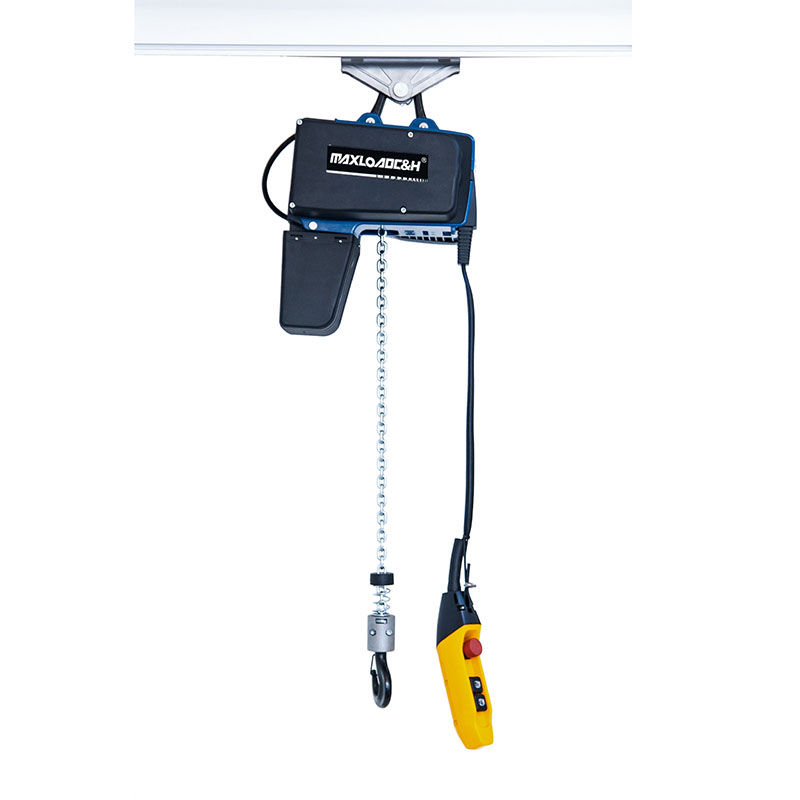
An electric hoist is a lifting device installed on a crane runway or fixed support, driven by an electric motor to lift and lower heavy objects via wire rope or chain. Its technical core lies in the stability and control precision of the lifting mechanism.
Structurally, common electric hoists are divided into wire rope electric hoists and chain electric hoists. Wire rope hoists offer greater lifting height and higher duty cycles, suitable for heavy-load, high-frequency applications. Chain electric hoists, due to their lightweight structure and good chain flexibility, are better suited for low headroom, small-capacity, or confined installation spaces.
Key technical parameters for electric hoists include rated lifting capacity, lifting height, duty cycle, and control mode. Modern electric hoists commonly adopt dual-speed or variable frequency drive systems to achieve micro-motion precise positioning, effectively avoiding potential risks caused by load swinging that could impact workpieces or operators.
2. Jib Crane: The Flexible Support Achieving Circular Coverage
A jib crane is a lifting device consisting of a column, a jib arm, and a slewing mechanism. Its core value lies in its ability to achieve full coverage of workstations within a circular or sector-shaped area, centered around the column.
Based on installation methods, jib cranes can be divided into freestanding (column-mounted) and wall-mounted types. The freestanding type is independently supported and installed on the floor, offering wide coverage. The wall-mounted type utilizes the structural wall of the building for fixing, saving floor space, and making it suitable for narrow, long workshops or workstations along walls. The rotation mode of the jib arm can be manual rotation or electric rotation. Manual rotation relies on manual force, offering flexibility and economy; electric rotation is suitable for large-capacity applications or automated scenarios requiring frequent slewing.
Jib crane arms typically use I-beam or box girder structures. Through rational cross-sectional design, they maximize rigidity while minimizing dead weight, thereby reducing inertial impact on the slewing mechanism.
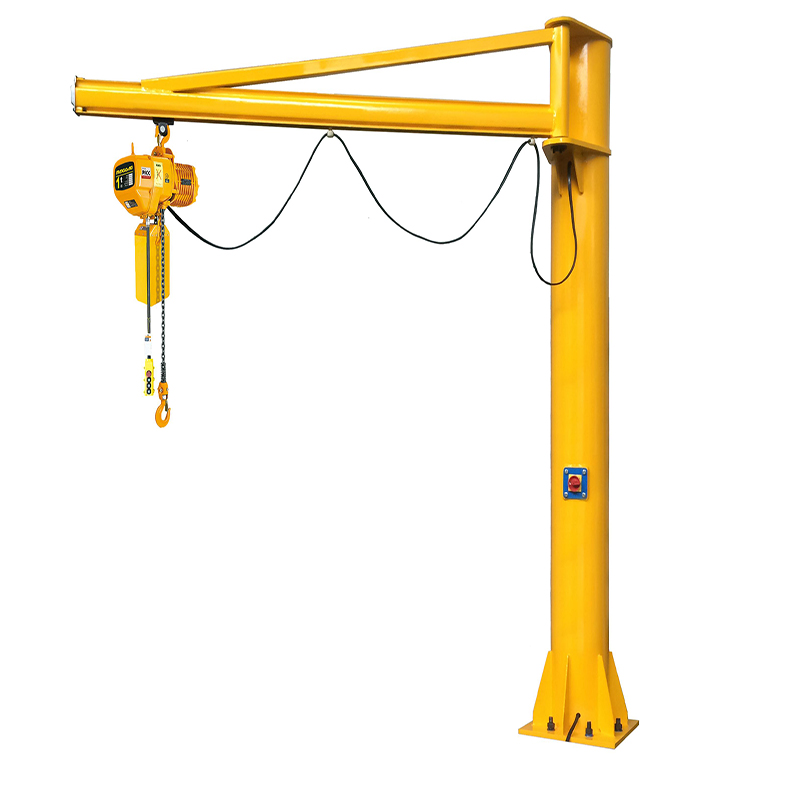
II. Synergistic Application Scenarios of Electric Hoists and Jib Cranes
The essence of their combination is the integration of "point and area": the jib crane solves the problem of horizontal movement to any point within its coverage area, while the electric hoist handles precise vertical lifting. This synergy is particularly prominent in the following scenarios:
1. Machining Workshops: The Perfect Pair for Machine Tool Loading and Unloading
In workshops dense with CNC machine tools and machining centers, workpiece loading and unloading for each machine are often concentrated in fixed workstation areas. A freestanding jib crane is installed next to the machine tool, with its jib radius covering the machine worktable and the material staging area. The operator uses a remote control to manage the electric hoist, lifting the blank from the rack, rotating the jib to the machine worktable, and utilizing the hoist's micro-motion function for precise placement. Compared to traditional overhead cranes, this combination avoids long-distance crane travel and waiting time, reducing the single loading/unloading cycle time by over 30%.
2. Assembly Lines: Nodes for Material Distribution on Flow Lines
In automotive parts, construction machinery, and other flow line assembly operations, multiple material supply points are typically set up along the line. Wall-mounted jib cranes are arranged along the assembly line, and the electric hoist handles transferring materials from pallets to the assembly station. Due to the jib crane's flexible rotation, the operator can guide the hook with one hand while assisting workpiece orientation with the other, significantly reducing labor intensity. For high-mix, low-volume production models, this combination also allows quick adaptation to workstation changes – simply by moving the column base or re-fixing the wall bracket.
3. Warehouse Loading Areas and Docks: Efficient Handling in Confined Spaces
In areas where large overhead cranes are difficult to deploy, such as warehouse doorways and truck loading docks, the combination of a jib crane and electric hoist becomes an ideal choice. Its small footprint and easy installation allow it to be placed flush against the loading platform edge. With appropriate matching of hoist lifting speed and jib slewing speed, it can quickly complete vertical lifting and horizontal swinging of goods inside truck carriages, particularly suitable for unloading heavy single-piece goods or packaging boxes.
4. Maintenance and Die Change Workstations: Precise Positioning of Heavy Components
In stamping and injection molding workshops, molds often weigh several hundred kilograms or even tons. A dedicated jib crane is installed between the mold storage rack and the press worktable. Using the electric hoist's inching function, a single operator can complete mold lifting, turning, and alignment for closing. Compared to using forklifts or requiring multi-person coordination for handling, this method significantly reduces alignment difficulty and safety risks.
III. Core Considerations for Selection and Configuration
To achieve optimal synergy between the electric hoist and jib crane, the following factors must be considered during the selection phase:
1. Load Matching and Duty Cycle
The rated lifting capacity of the electric hoist must be determined based on the maximum workpiece weight, including the weight of the lifting accessory. Furthermore, the duty cycles of both components should be coordinated – if the jib crane is intended for high-intensity applications with frequent slewing, a high-duty-cycle electric hoist and matching slewing mechanism should be selected to avoid premature failure due to insufficient fatigue strength.
2. Coverage Area and Interference Avoidance
The jib arm length should cover all operational points within the target workstation. It is also necessary to verify the jib arm's slewing path for spatial interference with surrounding equipment, building columns, lighting fixtures, etc. For scenarios where multiple jib cranes share the same area, limit devices or area interlock systems should be used to prevent jib arms from colliding.
3. Coordination of Control Modes
The controls for the electric hoist and the jib crane's slewing drive should ideally be integrated into a single operator interface. If using wireless remote control, a programmable multi-channel remote control is recommended, integrating lifting, trolley/hoist traverse (if applicable), and slewing functions for one-handed operation. For applications requiring precise positioning, the electric hoist should be equipped with variable frequency lifting and electronic limit functions.
4. Installation Foundation and Load Verification
Freestanding jib cranes have strict foundation requirements. The concrete foundation dimensions and anchor bolt specifications must be calculated based on the maximum overturning moment. For wall-mounted types, the structural capacity of the wall must be verified to ensure it can effectively bear the bending moment transmitted by the jib arm. The runway or suspension points for the electric hoist also require load calculations.
IV. Safe Usage and Maintenance Specifications
Safe equipment operation is a prerequisite for the application. A comprehensive maintenance system must be established during use:
Daily Inspections: Before operation, inspect the electric hoist's wire rope (or chain) for broken wires or wear, the hook for deformation or cracks, and the limit switch for sensitivity. Inspect the jib crane's slewing bearing for abnormal noise and the jib arm's levelness to ensure it is within allowable limits.
Periodic Maintenance: According to the equipment maintenance manual, perform regular lubrication and gap adjustment on the electric hoist's gearbox, wire rope, and brake. Perform grease replenishment for the jib crane's slewing mechanism and column bearings, and conduct foundation settlement observations every six months.
Overload Protection: Overloading is strictly prohibited. Electric hoists with a rated capacity greater than 1 ton should be equipped with an overload limiter. This device should provide a warning when the load reaches 95% of the rated value and automatically cut off the lifting circuit when it exceeds 105%.
Personnel Training: Operators must undergo professional training to become familiar with the equipment's operational characteristics and emergency stop procedures. Especially when using wireless remote controls, the operator's position should allow full visual monitoring of the load, and the operator should avoid standing directly beneath the suspended load.
V. Technology Development Trends
With the advancement of industrial automation and intelligent manufacturing, the synergistic application of electric hoists and jib cranes is exhibiting new technological characteristics:
Intelligent Sensing: By integrating load cells, laser distance meters, and RFID identification systems, equipment can automatically identify workpiece weight, height, and identity information, enabling semi-automatic or fully automatic material handling.
Human-Machine Collaboration Safety: Using safety laser scanners and area control technology, the equipment automatically slows down or stops when personnel enter a hazardous area, enabling a safe working environment for human-machine coexistence.
Energy Efficiency and Lightweighting: The application of high-strength steel and composite materials in jib arms reduces the equipment's own inertia. The promotion of permanent magnet synchronous motors in electric hoists further improves energy utilization efficiency.
Conclusion
The combination of electric hoists and jib cranes, characterized by precision, flexibility, and efficiency, has become an ideal choice for workstation-level material handling. Whether in heavy machining, precision assembly, logistics warehousing, or maintenance operations, their synergy significantly enhances operational efficiency and safety. For enterprises, rational selection, standardized usage, and the establishment of a scientific maintenance system are key to maximizing the value of this combination. As technology continues to evolve, this classic combination will integrate more intelligent elements, providing stronger support for flexible production in modern industry.
A
 0086 156 1824 5535
 0086 156 1824 5535