Precise Coordination in Material Handling
In the logistics aspects of modern industrial production, achieving efficient, safe, and cost-effective material handling remains a core challenge in process design. For small to medium-sized workpiece processing, station assembly, and equipment maintenance areas, the combination of an electric hoist and a jib crane forms a highly representative point-load handling solution.
This combination is not a simple stacking of equipment but an integration based on ergonomics, structural mechanics, and electrical control. This article delves into the selection logic, structural coordination, typical working conditions, and safety operation and maintenance key points for electric hoists applied in jib crane systems.
I. Structural Coordination: Mechanical Characteristics of the Jib Crane and Hoist Compatibility
The core advantages of a jib crane lie in its 360-degree rotational coverage and space utilization, achieved through either a mastless design or an independent column.
When pairing with an electric hoist, engineers need to focus on the following three matching aspects:
1. Lifting Capacity and Duty Classification
The rated load of a jib crane typically ranges from 125 kg to 5000 kg. The selection of the electric hoist should not only meet the maximum load requirement but also consider the duty classification. According to FEM or ISO 4301 standards, if the workstation involves high frequency and high load factor, both the jib's slewing mechanism and the hoist's lifting mechanism need to be selected with a higher duty classification, such as M5 (A5) or even M6 (A6), to avoid structural fatigue and premature aging of electrical components caused by "overkill or frequent overloading."
2. Cantilever Rigidity Deflection
The vertical deflection at the end of the jib crane under full load is a key indicator of structural performance. Industry standards typically control this deflection between L/250 and L/300 (where L is the cantilever length). If the electric hoist operates with off-angle lifting or side-pulling, it generates additional horizontal lateral forces, exacerbating the lateral deformation of the cantilever. Therefore, during the design phase, it is crucial to ensure a solid connection between the hoist's runway and the jib's rigid beam, and that the hoist's trolley travel mechanism has low-friction, self-lubricating characteristics to reduce wear on the runway.
3. Power Supply Method Selection
For electric hoists on jib cranes, the power supply system design directly impacts the equipment's cleanliness and safety. Common solutions include:
Safe Conductor Bar: Suitable for frequent rotation conditions. It supplies power to the hoist via an enclosed conductor bar installed on the side of the jib, providing stable power collection and a high protection level.
Cable Trolley: Suitable for limited rotation angles (e.g., 180 degrees) or light-load conditions. It drags the cable via nylon trolleys on a steel wire rope or track. The cost is lower, but attention must be paid to the cable's bending radius lifespan.
II. Technical Selection of Electric Hoists in Jib Applications
Electric hoists used in jib crane applications are mainly divided into two categories based on operating characteristics: chain hoists and wire rope hoists. The application scenarios for these two types differ significantly.
1. Chain Hoist: Flexibility and Space Utilization
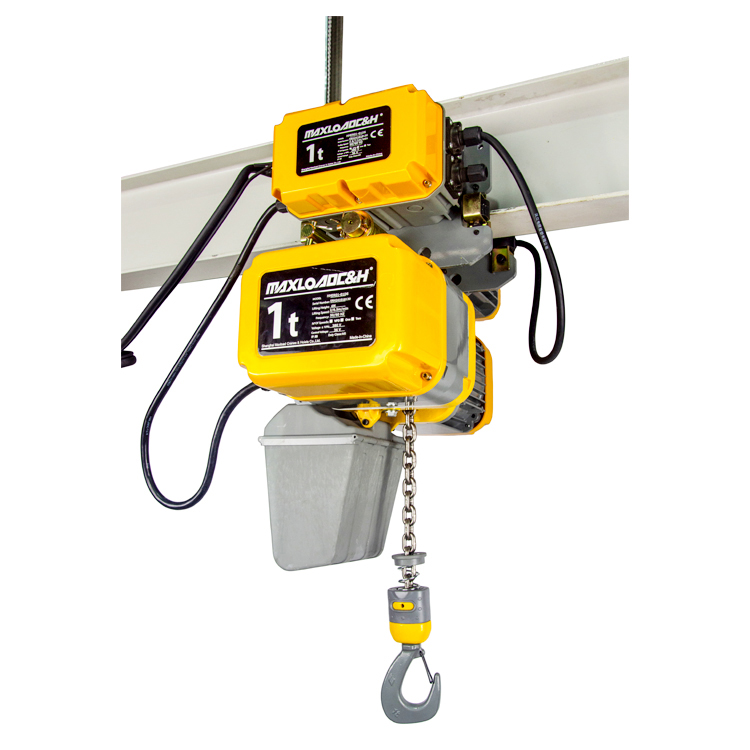
Chain hoists are the most widely used companion for jib cranes due to their compact structure, light self-weight, and strong chain passability.
Advantages: Small installation limits allow the hook to get closer to the end of the cantilever, maximizing the use of the radius; chains are more corrosion-resistant than wire ropes and do not risk "kinking" or tangling, making them suitable for environments with welding spatter or cutting fluids.
Application Scenarios: CNC machine tool loading/unloading, mold maintenance workshops, parts transfer at assembly stations.
2. Wire Rope Hoist: High Lift and Large Span
When the lifting height exceeds 6 meters or the lifting capacity exceeds 2 tons, wire rope hoists offer greater advantages.
Advantages: Higher lifting speed, typically reaching over 8 m/min, suitable for operations requiring fast lifting/lowering; the rope drum structure allows for more precise limit switches, and operational noise is lower than that of chain hoists.
Application Scenarios: Heavy equipment assembly, maintenance of port ship parts, flipping and welding of large structural components.
3. Key Safety Configurations
Regardless of the type selected, electric hoists used with jib cranes must be mandatorily equipped with the following safety devices:
Upper and Lower Limit Switches: Prevents overwinding or excessive lowering that could cause rope/chain derailment.
Overload Limiter: Since jib cranes are often single-point supported, overload poses a significant destructive moment on the cantilever root. Electronic overload limiters are recommended; they provide a warning when the load reaches 95% of the rated value and automatically cut off the lifting circuit at 105%.
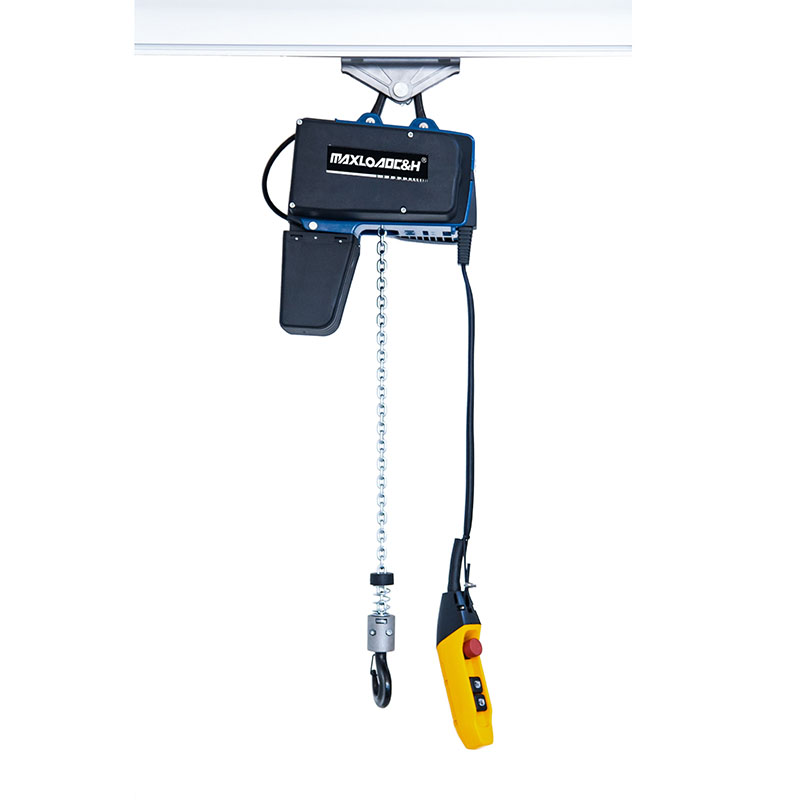
Emergency Stop Device: Must be located on the control pendant or remote control and have a self-locking function.
III. Typical Application Scenarios and Process Advantages
In an actual production organization, the combination of electric hoists and jib cranes primarily addresses the handling pain points at the "workstation level."
1. "One-to-One" Service for Precision Machining Centers
In machine shop environments, a wall-mounted or freestanding jib crane is placed next to each CNC machine, paired with a 0.5t to 1t chain hoist. The operator can complete the loading/unloading of workpieces from the material rack to the machine table within 15 seconds using one-handed operation. This layout avoids the energy waste associated with waiting for and traveling with traditional overhead cranes. The coverage is precise, minimizing the operator's physical exertion.
2. Coordination with Welding Fixtures and Positioners
At large structural component welding stations, the jib crane's rotating arm can cover the loading/unloading area of the positioner. The micro-speed performance of the electric hoist is particularly critical here. High-quality electric hoists, using variable frequency control, can achieve low-speed micro-movements below 0.1 m/s. This allows welders to accurately align heavy workpieces weighing hundreds of kilograms into fixtures, reducing communication time with crane operators and improving positioning accuracy.
3. Clean Environments and Special Conditions
In industries like food, pharmaceuticals, or electronics assembly, surface treatment requirements are extremely high. In such cases, electric hoists often use stainless steel chains or special coatings, while jib cranes utilize sealed bearings. Explosion-proof configurations for electric hoists are also common in chemical or painting workshops, requiring motors and electrical components to meet ATEX or Ex d II BT4 explosion-proof ratings.
IV. Safety Operation and Service Life Management
To ensure safe operation throughout the equipment's lifecycle, maintenance personnel need to establish a three-dimensional management mechanism based on "structure, mechanism, and electrical systems."
1. Wear Monitoring of Runway and Travel Mechanism
The runway on the jib crane arm is the carrier for the electric hoist's travel. During daily inspections, focus on checking the runway tread for indentations, spalling, and the integrity of the end stops. If the hoist's travel wheels exhibit "rail gnawing," it usually indicates horizontal bending deformation of the cantilever due to foundation settlement or long-term full-load operation. In this case, operations must cease, and stress testing or replacement of the cantilever is required.
2. Chain and Wire Rope Inspection Standards
Chain: According to the ISO 16872 standard, the chain must be scrapped when wear exceeds 10% of the original diameter. In jib applications, due to the chain frequently twisting as the cantilever rotates, inspect for chain jamming or abnormal wear on the chain pockets.
Wire Rope: Focus on the number of broken wires and the reduction in diameter.
3. Electrical Corrosion Protection and Grounding
Jib cranes are rotating equipment. Electrical connections at the conductor ring or conductor bar interfaces need regular cleaning to remove dust accumulation. For jib cranes installed outdoors, the electric hoist's protection rating should reach IP55 or higher to prevent rain ingress that could cause brake failure.
V. Future Trends: Intelligent and Ergonomic Upgrades
With the advancement of Industry 4.0, the combination of electric hoists and jib cranes is evolving towards intelligence.
Variable Frequency Drive (VFD) Technology: Its adoption rate is increasing. Using VFDs to control hoist lifting and travel eliminates the "secondary impact" phenomenon, making load starts and stops smoother, reducing dynamic load impact on the jib structure, and protecting workpieces from damage.
Wireless Remote Control and Zone Interlocking: Traditional pendant controls are gradually being replaced by wireless remote controls with emergency stop functions, allowing operators to choose the safest position. In areas with overlapping coverage of multiple jib cranes, adding zone interlocking sensors can prevent collisions between hoists.
Load Data Management: Electric hoists equipped with smart sensors and displays can record lifting counts and load weights in real-time. Via communication modules, this data can be uploaded to MES (Manufacturing Execution System) systems for digital management of equipment utilization.
Conclusion
The combination of electric hoists and jib cranes, characterized by its compact structure, precise coverage, and high return on investment, plays an irreplaceable role in discrete manufacturing, heavy maintenance, and modern logistics.
A successful application depends not only on the rated load of the lifting equipment but also on the systematic matching of duty classification, structural rigidity, control methods, and safety accessories. From structural selection to daily maintenance, only by considering the "rotation of the jib" and the "lifting/lowering of the hoist" as a mechanically integrated system can the highest efficiency of this combined equipment be truly realized, achieving precision and efficiency in material handling while ensuring safety.
 0086 156 1824 5535
 0086 156 1824 5535