The Revolution of Workstation Precision
In the realm of material handling within modern industrial production, achieving "point-to-point" precise delivery while balancing operational efficiency and space utilization has always been a core challenge in process layout. For most workstation-level, repetitive lifting and rotating handling scenarios, a single piece of lifting equipment often struggles to perfectly balance the contradictions between load capacity, coverage range, and operational precision.
The combination of an electric hoist and a jib crane is a classic solution to this contradiction. This combination is not a simple stacking of equipment but a deep integration based on ergonomics, structural mechanics, and automation control. This article will delve into the specialized application logic, selection factors, and technical advantages of this combination under different working conditions.
I. Technical Characteristics of Core Components
To understand the application value of this combination, it is first necessary to analyze the technical characteristics of the two core components separately.
1. Electric Hoist: From "Simple Lifting" to "Multi-Dimensional Control"
Electric hoists in modern industrial environments have long surpassed simple "up and down" motion. Based on their installation form and drive method, they are mainly divided into chain electric hoists and wire rope electric hoists.
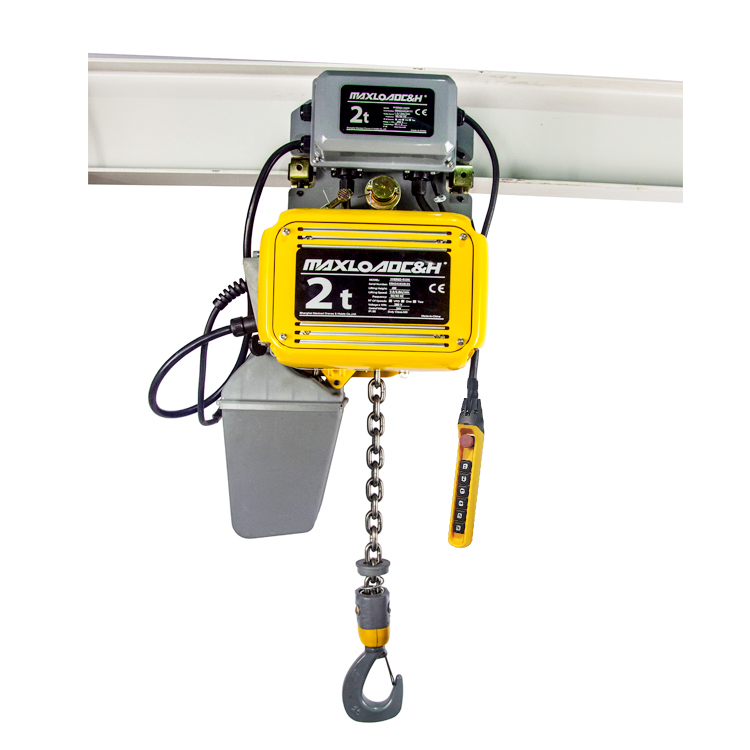
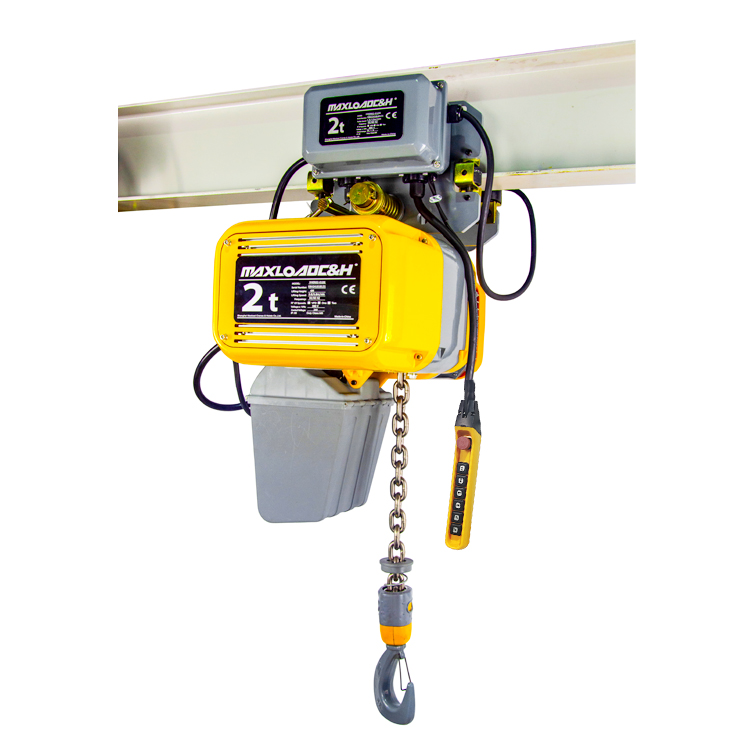
Chain Electric Hoist: Due to its compact structure, light self-weight, and small chain bending radius, it is particularly suitable for installation on the slewing track of a jib crane. Its lifting speed often adopts two-speed or variable frequency control, enabling precise positioning at micro-speed, which is crucial for precision assembly, mold maintenance, and similar scenarios.
Wire Rope Electric Hoist: Suitable for heavy-load conditions with high lifting heights and high duty cycles. Although its volume is relatively larger, the heat dissipation performance and impact resistance of the wire rope structure are superior when paired with a jib crane for frequent heavy load lifting.
In collaborative operations, the selection of the electric hoist should consider not only the lifting capacity but also its duty cycle, which determines the equipment's durability when facing high-frequency operations.
2. Jib Crane: The Geometry of Space Utilization
The core value of a jib crane lies in its "slewing + linear" motion. Its structural form determines the coverage logic of the working area:
Pillar-Mounted Jib Crane: This is the most common structure. The pillar bears all the bending moments, and the jib arm rotates 300° or 360° around the pillar. Its advantage lies in its small footprint, requiring only a base plate, making it very suitable for "one-to-one" auxiliary handling in tight workstations or next to machine tools.
Wall-Mounted Jib Crane: Uses the factory's pillar or wall as support, with the jib arm moving transversely along the wall or rotating from a fixed point. This structure completely frees up floor space and is suitable for continuous feeding operations along an assembly line.
Portable/Mobile Jib Crane: Equipped with heavy-duty casters, primarily moved manually. Although its lifting capacity is relatively small, it is highly mobile, suitable for maintenance areas without fixed crane coverage or outdoor operation scenarios.
II. Typical Application Scenarios and Technical Logic
In process layout, the combination of an electric hoist and a jib crane primarily solves the "last meter" handling challenge. The following are several typical application models:
1. Workstation: Precise Docking for Machine Tool Loading/Unloading
In workshops dense with CNC machine tools and machining centers, production efficiency is often limited by the waiting time for loading and unloading.
Application Logic: Install a light-duty jib crane directly above or beside the working area of each machine tool, paired with a chain electric hoist. The operator simply uses a pendant or wireless remote control to lift the workpiece from the material rack and directly feed it into the machine tool's chuck using the jib's slewing function.
Technical Advantages:
Micro-motion: Modern variable frequency electric hoists can reduce lifting speed to below 0.8 m/min. Combined with the smooth slewing of the jib, this prevents the load from swaying in confined spaces, protecting the workpiece surface from damage.
Ergonomics: Significantly reduces the operator's physical exertion, preventing occupational back strain caused by manual handling, and complying with ergonomic design standards.
2. Assembly Line: Mobile Support for Non-Standard Equipment
In assembly lines for construction machinery, wind power equipment, or large motors, there is often a need for pre-assembly and flipping of numerous components.
Application Logic: Configure a twin-arm jib crane (A-frame) or a large-span jib crane at the assembly station. Two electric hoists can achieve interlocking through mechanical synchronization.
Technical Advantages:
Coordinated Flipping: Two electric hoists working in conjunction with a spreader beam can achieve in-air posture adjustment of long or irregularly shaped components. Synchronous control technology ensures consistent lifting speed at both ends, enabling safe flipping.
Dead Angle-Free Coverage: The slewing radius of the jib can be customized based on the dimensions of the assembly cell, ensuring that the lifting point can accurately cover the workpiece regardless of its angle within the workstation, avoiding the efficiency loss caused by the travel movement of an overhead crane.
3. Precision Machining and Mold Maintenance: Fine Operation Under Heavy Loads
In die-casting, injection molding, or forging industries, the disassembly, maintenance, and installation of molds are high-risk, high-precision operations.
Application Logic: Utilize a heavy-duty wire rope electric hoist paired with a heavy-duty pillar-mounted jib crane. The jib's span is typically designed to cover both the mold storage area and the mold chamber of the die-casting/injection molding machine.
Technical Advantages:
Anti-Sway Design: For high-value loads like molds, high-end configurations incorporate anti-sway mechanisms between the electric hoist and the jib trolley, or employ electronic anti-sway algorithms. This ensures that during jib slewing start and stop, the mold does not create a dangerous pendulum effect.
Overload Protection: Equipped with high-precision electronic overload protectors that display the lifting weight in real-time, preventing overload accidents caused by mold jamming.
III. Key Considerations in Specialized Selection
When drafting technical proposals or procurement specifications, the following dimensions determine whether the system is truly "user-friendly":
1. Structural Mechanics and Foundation Design
Unlike overhead cranes, all load bending moments acting on a jib crane ultimately transfer to the pillar or wall.
Slewing Method: Distinguish between "manual slewing" and "electric slewing." For workstation-level applications, manual slewing is often sufficient due to its quick response and controllable cost. However, for heavy loads (>2 tons) or extremely high-frequency operations, electric slewing ensures the operator remains in a safe, effortless position.
Anchor Bolts: Foundation construction for pillar-mounted jib cranes is crucial. The specifications and depth of embedded bolts must be calculated based on the on-site concrete grade and thickness. If the site floor is already cured and drilling is not possible, a base plate with counterweight structure must be considered, though this sacrifices some floor space.
2. Intelligent Interface of the Lifting Mechanism
With the advancement of Industry 4.0, the electric hoist is no longer an isolated device. During selection, consider:
Variable Frequency Control: Not only for speed regulation but also to reduce impact loads on the jib beam, extending the lifespan of structural components.
Data Interface: Does the control system of the electric hoist have reserved PLC interfaces? Can data such as the number of lifts, load weight, and operating duration be uploaded to the workshop's MES system for predictive maintenance?
3. Safety Redundancy and Protection Class
Dual Braking System: For jib crane combinations used in areas with dense personnel or for handling high-value loads, the electric hoist should be equipped with a dual braking system ("working brake + safety brake") to prevent load drops caused by gearbox failure.
Environmental Adaptability: If used in foundries, grinding workshops, or chemical environments, the motor protection class of the electric hoist and the surface anti-corrosion treatment of the jib crane must be specified with priority.
IV. Summary of System Integration Value
Compared to traditional overhead cranes, the combination of an electric hoist and a jib crane offers irreplaceable advantages in terms of "workstation specialization," "flexibility," and "economy."
From a Return on Investment perspective, jib cranes have a simple structure, low civil engineering costs, and a short installation period. For a new assembly workstation, the investment cost is typically only 30%-50% that of an overhead crane with a comparable span, yet it achieves 100% coverage efficiency for the workstation.
From a Production Efficiency perspective, it transforms "shop-floor shared" crane resources into "workstation-dedicated" equipment. Operators no longer need to wait for crane dispatching, drastically reducing auxiliary time. Data shows that in workstations with high-frequency repetitive handling, the introduction of this combination can reduce cycle time by an average of 15%-20%.
From a Safety Culture perspective, replacing manual handling with mechanical arms eliminates potential safety hazards like muscle strains and load tipping. Precise mechanical limits and electrical interlocks ensure that the jib arm does not collide with surrounding equipment or personnel during slewing.
Conclusion
The synergistic application of electric hoists and jib cranes reflects the dual pursuit of "precision" and "efficiency" in modern industrial design. They are more than just combinations of steel components; they represent a technical implementation born from a deep understanding of production processes.
When selecting equipment, it is recommended that companies move beyond solely focusing on "price" and "lifting capacity." Instead, they should conduct a comprehensive evaluation from four dimensions: duty cycle, control precision, structural rigidity, and system scalability. Only by perfectly matching the dynamic characteristics of the electric hoist with the geometric coverage capabilities of the jib crane can the automation upgrade of the material handling link be truly achieved, laying a solid foundation for the efficiency improvement of the entire production line.
 0086 156 1824 5535
 0086 156 1824 5535