The Core Combination and Selection Logic for Industrial Material Handling
In the material handling systems of industrial production, electric hoists and overhead cranes are two indispensable types of lifting equipment. They are tightly coupled in function, yet each has its own focus in terms of technical parameters, application scenarios, and selection logic. Understanding the synergy between them is of direct practical significance for optimizing factory lifting solutions and improving material flow efficiency.
Ⅰ. Electric Hoist: A Compact and Flexible Lifting Core
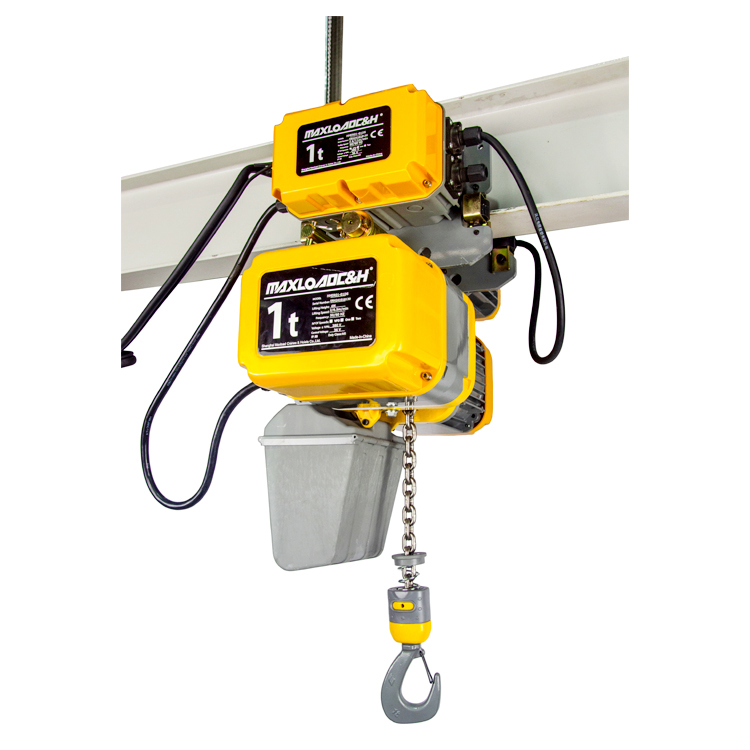
An electric hoist is a light and small lifting device driven by an electric motor to achieve vertical lifting and horizontal movement of heavy loads. It is widely used in machinery manufacturing, warehousing and logistics, construction and installation, and other scenarios. Its core advantages include a compact structure, low self-weight, and ease of operation. It can be installed independently on an I-beam as a fixed lifting tool or serve as the lifting mechanism for larger crane systems such as overhead cranes and gantry cranes.
Based on the load-bearing medium, electric hoists are mainly divided into wire rope electric hoists and chain electric hoists. Wire rope hoists are more suitable for long-stroke, large-span, and heavy-load lifting tasks, offering advantages in lifting speed and capacity. Chain hoists, on the other hand, are more applicable in situations requiring high flexibility and limited installation space.
In practical engineering selection, several key parameters deserve special attention:
Duty class is the primary consideration. It comprehensively reflects the frequency of use and load intensity of the equipment. The domestic standard ranges from M3 to M8. M3 is suitable for occasional use, such as equipment maintenance and light warehouse handling, with fewer than 10 operations per day. M5 to M6 are suitable for frequent lifting scenarios like assembly lines and port loading/unloading, with 30 to 80 operations per day. M7 to M8 are intended for continuous heavy-duty environments such as metallurgy and foundries. Selecting based only on lifting capacity while ignoring duty class can lead to frequent equipment failure, shortened lifespan, or even safety hazards.
Lifting speed is not simply faster-is-better; it should match the process cycle. Conventional single-speed hoists have a lifting speed of about 8 m/min, suitable for rough handling of large parts. Two-speed hoists add a slow speed of about 0.8 m/min for precise positioning. Variable-frequency stepless speed control hoists are suitable for ultra-high precision tasks such as automotive parts assembly. In addition, control mode, protection rating, and lifting height should be matched to actual working conditions.
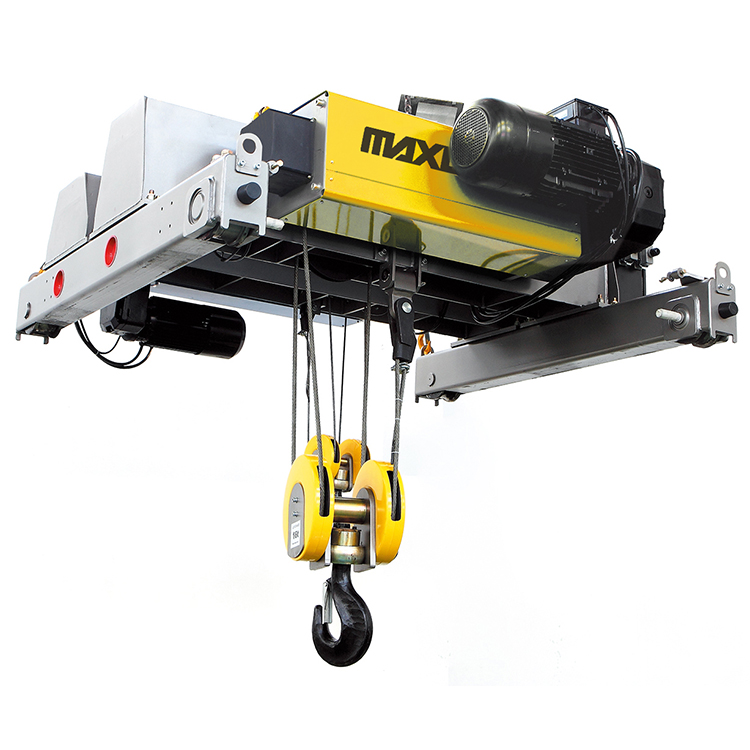
Ⅱ. Overhead Crane: A Comprehensive Lifting Solution Covering Large Spans
An overhead crane, or bridge crane, is a material handling device that runs along overhead tracks in a workshop. It consists of a lifting mechanism, a trolley travel mechanism, a bridge travel mechanism, and a metal bridge structure. Its core value lies in its ability to perform vertical lifting, transverse movement, and longitudinal transport of heavy loads within a three-dimensional space, making it the foundational equipment for systematic lifting operations in factories.
Key technical parameters of an overhead crane include lifting capacity, span, duty class, and lifting height.
The selection logic for the duty class is similar to that for electric hoists. The FEM standard A1 to A8 for bridge cranes corresponds to the domestic standard M1 to M8. Light duty is suitable for intermittent operation, medium-heavy duty for daily industrial production, and heavy duty for continuous high-intensity operation. Selection should incorporate actual operating frequency and load intensity to avoid a mismatch.
Ⅲ. Synergistic Operation: From Single-Point Lifting to Systematic Handling
In actual production scenarios, the relationship between electric hoists and overhead cranes is not simply "subordinate" or "substitutable" but rather one of functional layering and synergistic complementarity. The electric hoist solves the "lifting" problem, while the overhead crane extends the "movement" dimension—through the coordination of bridge and trolley mechanisms, the hoist's lifting capability is extended to the entire workshop space.
A typical application mode is: the electric hoist is installed on the crane as the lifting mechanism; the crane performs large-scale horizontal movement along the tracks, while the hoist performs precise vertical lifting. Together, they form a complete lifting system. In automated warehousing, cranes equipped with two-speed or variable-frequency hoists enable seamless integration of batch pallet transfer and fine sorting. In automotive manufacturing workshops, cranes transport the body-in-white from welding to painting stations, while hoists handle the lifting and positioning of core components such as engines and transmissions.
In specific configurations, for rated lifting capacities not exceeding 16 tons, an electric hoist can typically be used as the crane's lifting mechanism, balancing economy and reliability. For heavier applications with larger capacities, a winch-type lifting mechanism is required to meet higher load and speed demands.
Ⅳ. Industry Trends and Selection Insights
The lifting equipment sector is undergoing a profound technological evolution. Several trends deserve attention during selection and upgrades:
Intelligent upgrading is the primary direction. Next-generation electric hoists and overhead cranes are commonly equipped with PLC control systems, variable-frequency speed control technology, and remote monitoring functions, achieving millimeter-level positioning accuracy and automatic path planning. For manufacturing scenarios with high requirements for positioning accuracy and production cycle times, intelligent configurations are shifting from "optional features" to "standard equipment."
Energy efficiency and lightweight design are other key trends. Permanent magnet synchronous motors combined with vector control have become mainstream. Intelligent energy feedback systems convert braking energy into electricity for reuse, achieving measured energy savings of up to 28%. The application of lightweight designs, such as carbon fiber composite materials, reduces equipment self-weight by about 20% without compromising structural strength. These technologies not only lower operational energy consumption but also reduce load requirements on building structures, providing more options for new plant construction and retrofitting existing plants.
Refined selection is increasingly becoming an industry consensus. The crude procurement approach that once focused solely on lifting capacity is being abandoned. Fine-tuned matching of parameters such as duty class, lifting speed, protection rating, and control mode directly affects the total cost of ownership and operational effectiveness. A properly configured piece of equipment can reduce overall operating costs by more than 30% compared to a "bigger is better" crude selection approach.
Conclusion
As core industrial material handling equipment, the value of electric hoists and overhead cranes lies not in the stacking of individual specifications, but in deep alignment with specific production scenarios. From lifting to movement, from single point to system, from coarse to precise—careful consideration of every technical parameter and forward-looking selection decisions will continually pay off in daily production efficiency, safety, and cost.
 0086 156 1824 5535
 0086 156 1824 5535