Systematic Solution for Industrial Material Handling
In industrial production and logistics operations, the efficiency of material handling directly impacts the rhythm and cost of the entire production line. The electric hoist is the most fundamental lifting device, while the JIB crane and the overhead crane are two typical working platforms. The proper selection and coordination among these three are key to determining whether the handling system can operate efficiently.
Electric Hoist: The Core Lifting Unit of the System
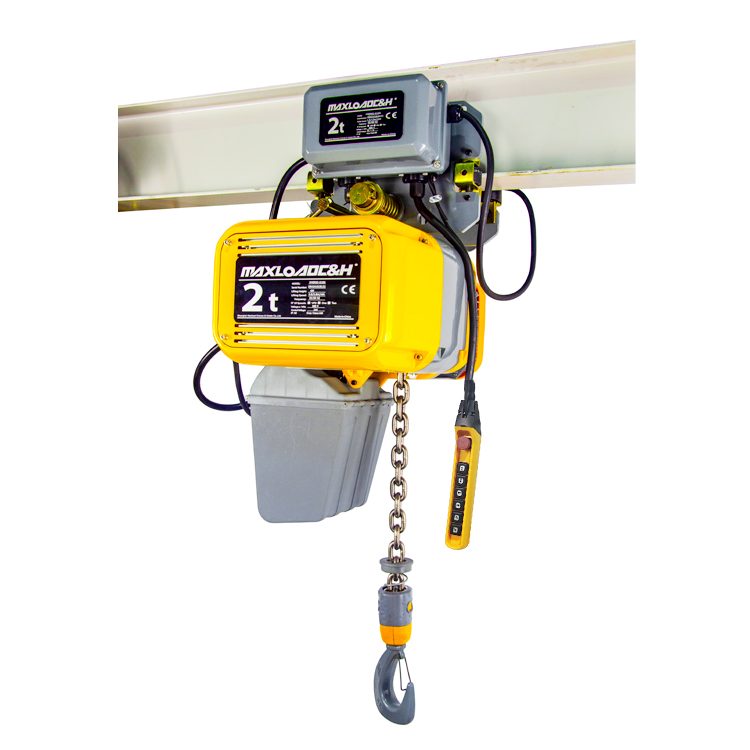
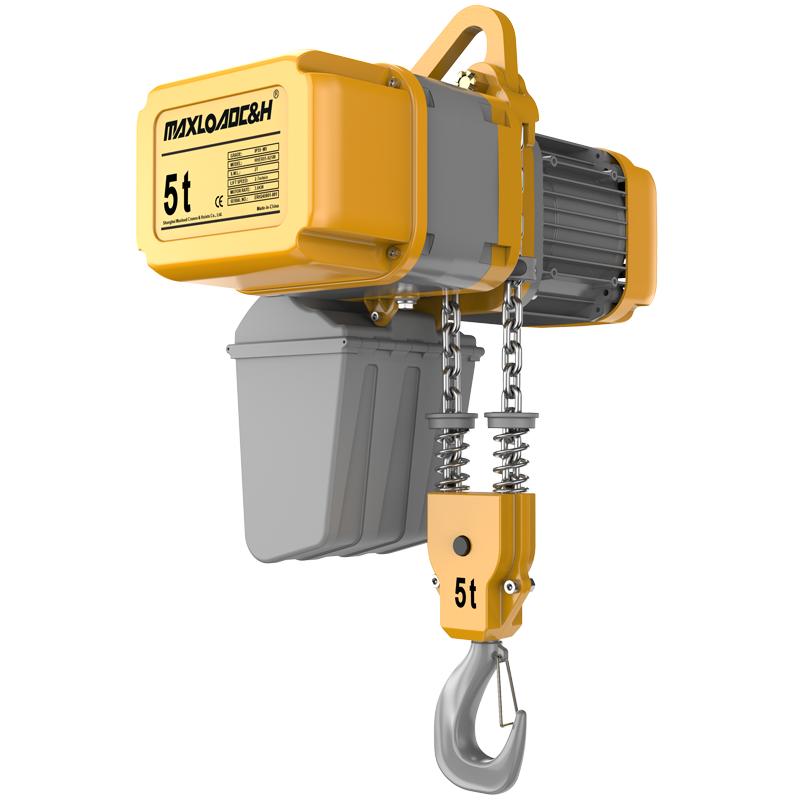
The electric hoist is the execution terminal in the entire material handling system, directly responsible for lifting and lowering loads. By structural type, it is mainly divided into wire rope and chain electric hoists. Wire rope hoists operate smoothly and offer high lifting heights, making them suitable for conventional workshops and storage areas. Chain hoists are compact and lightweight, often used with jib cranes and light suspension systems. In terms of duty classification, Class M3 is suitable for occasional use such as equipment maintenance and light warehouse handling; Class M4 corresponds to medium-frequency operations in general factory workshops; Classes M5-M6 are suitable for frequent lifting scenarios like assembly lines and port loading/unloading.
The choice of lifting speed is also important. Single-speed hoists offer a lifting speed of about 8 m/min, suitable for rough handling; two-speed hoists add a slow speed of about 0.8 m/min, balancing lifting efficiency and positioning accuracy, making them ideal for machine tool maintenance, precision assembly, and other scenarios requiring fine movements.
JIB Crane: Efficient Coverage for Fixed-Point Operations
A JIB crane consists of a column, a jib arm, and a slewing drive. The lower end of the column is fixed to a concrete foundation with anchor bolts. A cycloidal pinwheel reducer drives the jib to rotate, and the electric hoist travels linearly along the I-beam of the jib to lift loads.
The prominent advantage of this equipment lies in its working coverage. With a column and a rotatable jib, it can form a circular working area of more than 270 degrees. The operator simply rotates the jib to accurately deliver the load to the target position without moving the entire machine. Jib cranes are particularly suitable for: first, material transfer around fixed workstations, such as machine tool loading/unloading and assembly station assistance; second, dense lifting in confined spaces — the equipment occupies little floor space and does not interfere with other operations; third, scenarios requiring frequent short-distance movements — both manual and electric slewing can respond flexibly.
Jib cranes are often used in conjunction with chain electric hoists. The three actions — lifting, traveling, and slewing — can all be electrically controlled, or manual slewing and manual travel can be selected according to actual needs. In practice, fixed-post jib cranes are suitable for fixed-station operations, while portable jib cranes offer greater mobility and adaptability.
Overhead Crane: The Mainstay for Large-Span Area Handling
The overhead crane achieves large-area coverage with a bridge spanning the workshop. The crane bridge travels along rails in the length direction of the workshop, while a trolley carrying the electric hoist moves transversely along the bridge, enabling lifting operations at any position in three-dimensional space.
Selection of an overhead crane requires attention to three key parameters: span, lifting capacity, and duty class. Span refers to the distance between the centerlines of the two rails on which the crane bridge travels. It should be determined based on workshop width; if the span is too small, it cannot cover the entire working area, affecting handling efficiency. Lifting capacity should not only cover the daily maximum load but also include a safety margin of 10% to 20%. For duty class, if the operation involves continuous lifting of heavy loads (e.g., port cargo handling), a high-duty-class crane should be selected to withstand high-intensity loads and ensure a long service life; for intermittent operation, the appropriate class can be selected based on actual frequency to avoid over-investment.
In engineering practice, overhead cranes can be configured flexibly. For example, in a hydropower plant powerhouse, a 100-ton double-girder overhead crane is often installed, equipped with a main hook, an auxiliary hook, and multiple electric hoists, enabling full-coverage lifting in the erection bay and main generator area. In pipe lifting scenarios, a double-girder overhead crane can be equipped with multiple electric hoists fitted with electromagnetic chucks to achieve smooth lifting of long pipes.
Coordination of the Three: Building a Complete Material Handling System
The relationship among the electric hoist, jib crane, and overhead crane can be understood as a three-level system of "end effector — workstation — backbone network": the electric hoist is the actuator that directly performs gripping and lifting; the jib crane is a local working unit around a fixed station; the overhead crane is the large-span transport channel throughout the workshop.
In actual selection and configuration, the following logic is generally followed: for material supply around fixed stations, a jib crane is preferred to take advantage of its flexible slewing for rapid response; for long-distance transport across areas, the overhead crane undertakes the main handling task; the electric hoist is then matched to the two platforms according to load characteristics, working frequency, and precision requirements. A typical combination scheme is: jib cranes handle station loading/unloading, overhead cranes handle transfer between stations and between stations and warehouses, and both use the same specification of electric hoist to simplify spare parts management and maintenance.
Key Considerations in Selection
In practical selection, the working environment must be taken into account. In high-temperature environments, the motor needs a forced cooling system; in low-temperature environments, low-temperature compatible grease should be used; in corrosive environments, stainless steel chains and corrosion-protected motors are required; in dusty environments, enhanced sealing protection is necessary.
The configuration of safety devices is equally important. Overload protection should provide a warning when the load reaches 90% of the rated capacity and automatically cut off power when it exceeds 110%. Upper and lower limit devices ensure that the hook operates within a safe travel range. The braking system should preferably adopt a normally closed dual-brake design to ensure reliable braking even if one brake fails.
Regarding control methods, fixed stations can use wired control; for remote operations requiring flexible handling, wireless remote control is suitable. It is advisable to choose a remote control with signal encryption to avoid interference. In scenarios where multiple electric hoists operate synchronously, a synchronous control system can keep the lifting and traveling speed error within a millimeter range, suitable for horizontal lifting of extra-long components.
Conclusion
The combined application of electric hoists, jib cranes, and overhead cranes is essentially about rationally allocating the three basic actions — lifting, slewing, and translating — in space according to the actual material handling needs. Jib cranes solve fixed-point coverage, overhead cranes enable large-span transfer, and electric hoists ensure precise execution — each performing its own role and complementing the others. By focusing on the three dimensions of working frequency, load characteristics, and spatial layout during selection, an efficient and reliable material handling system can be built.
 0086 156 1824 5535
 0086 156 1824 5535