From Basic Operations to Adaptation Logic for Complex Working Conditions
In the family tree of lifting equipment, the electric hoist is often an underestimated player. Many people think it's nothing more than a "motor driving a steel wire rope or chain to lift things up and down." But engineers who have truly worked on factory floors, construction sites, and warehouses know that a properly selected and correctly used electric hoist can often solve a series of efficiency bottlenecks and safety concerns along a production line.
Ⅰ. Why an Electric Hoist is Not Just a "Miniature Overhead Crane"
Let's first clear up a common misconception: some believe an electric hoist is simply a simplified version of an overhead crane. That's only half true. The core characteristic of an electric hoist lies in its integration – the lifting motor, gearbox, drum or sprocket, brake, and control system are all combined within a compact metal housing. This means it can function as an independent module, directly suspended from an I-beam rail, jib crane, or gantry frame, without needing the complex traveling mechanisms and dedicated machine room required for an overhead crane.
The practical benefit of this structure is deployment flexibility. In a machine shop, you often see a simple straight rail above workstations, with an electric hoist traveling along it, handling billets and finished parts for three CNC machines. Using an overhead crane to cover the same area would cost several times more in civil works and equipment.
Another easily overlooked feature is the directness of operational feedback. A skilled operator can use the push-button controls on the pendant to raise or lower the hook with millimeter precision – a necessity for die assembly or precision workpiece alignment. While overhead cranes offer large coverage with their bridge and trolley联动 movements, they are less intuitive for fine adjustments than a handheld controller.
Ⅱ. "Non-Typical" Applications in Several Typical Scenarios
Mold Changing – Time is Profit
In industries like injection molding, stamping, and die-casting, mold change time directly determines production capacity. Using a forklift to change molds? The forks can't reach under the mold base, and forklifts often lack sufficient lift height. Using an overhead crane? If the workshop wasn't originally equipped with one, adding a dedicated crane for a mold change station is cost-prohibitive.
The solution of an electric hoist paired with a jib crane has become the standard answer here. The jib crane is fixed next to the injection molding machine, with its boom covering the mold change area, and the electric hoist handles vertical lifting. A skilled operator can go from loosening the mold clamping bolts to having the old mold on the floor and the new one in place within ten minutes. Doing it manually with pry bars and a hand chain hoist might take half an hour or more.
Bolt Tightening Inside Wind Turbine Towers
This is not conventional lifting work but a very specific condition. During wind turbine installation or maintenance, the tower interior is narrow, with a vertical drop of over a hundred meters. High-strength bolts at the tower flange connections require precise pre-tightening force. Workers must carry hydraulic or electric torque wrenches to various platforms; the tools themselves weigh 10-15 kg or more. Carrying them up manually is inefficient and causes worker fatigue.
A small, low-headroom electric hoist plays a role here – it can be installed on a temporary rail on the inner tower wall or directly hung from a lifting lug below the flange to lift tools from the bottom to various platforms. A more professional approach uses a two-speed controlled hoist: the slow speed for precise tool positioning and the fast speed for empty hook travel. This scenario requires the hoist to have adequate protection ratings due to possible condensation and oil residue inside the tower.
Subassembly Turnover in Shipyards
In shipbuilding, there is a high-risk, difficult process – subassembly turnover. A subassembly may be over ten meters long and weigh over a hundred tons, needing to be flipped from its front side to its back during welding. The mainstream solution involves multiple overhead cranes working in tandem, which requires extremely precise command and synchronized control – any slight mistake can cause the subassembly to tilt dangerously.
Some small and medium-sized shipyards and repair companies have found another path: installing a large-capacity electric hoist at each end of the subassembly, using specialized turning slings. The hoist's low lifting speed and reliable braking allow operators to perform the turnover with a "slow, alternating lift" technique. In this process, the hoist's overload protection is critical – because the center of gravity shift during turnover creates an impact load exceeding the static weight. While this solution isn't suitable for very large subassemblies, it's far more economical for dozens-of-ton subassemblies than calling in two large overhead cranes.
Tunnel Segment Lifting
After a tunnel boring machine excavates, precast concrete segments must be assembled into the tunnel lining. Each segment weighs 3 to 5 tons. The short-distance handling from the transport flatbed to the erector's pick-up point is often overlooked but consumes significant time.
Installing a rail-mounted electric hoist on the TBM backup gantry is a mature technique. Due to confined space, dust, and water spray in the tunnel, a chain hoist is typically chosen over a wire rope hoist – chains have better resistance to bending and wear, and unlike wire rope, they don't suffer from rust and broken wires in damp environments. More importantly, the hoist here needs low-voltage control and an emergency mechanical manual release function, in case of a sudden power outage that leaves a segment hanging in mid-air.
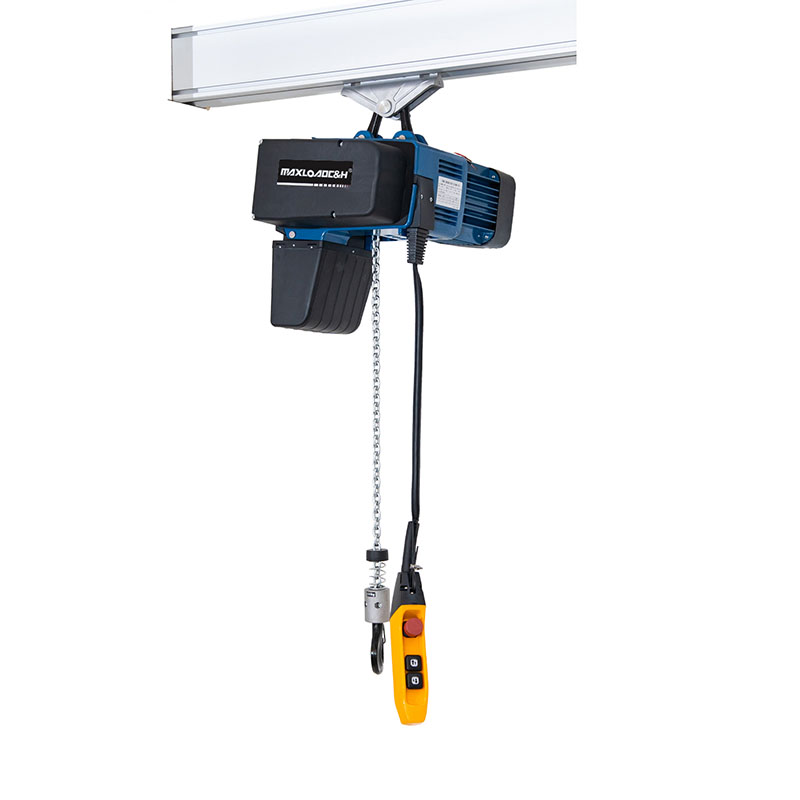
Ⅲ. Those Easily Overlooked Parameters During Selection
Many procurement personnel only look at the rated lifting capacity, but in practice, issues often arise from several "supporting parameters":
Duty Cycle (ED rating): This indicates the motor's thermal capability. A hoist rated at 25% ED means it can operate continuously for at most 2.5 minutes out of every 10 minutes before needing a rest. If the production line has a fast pace and frequent lifts, a mismatch in this parameter will cause frequent thermal overload trips. For heavy-duty applications, 40% ED or higher is recommended.
Lifting Height and Rope/Chain Reeving: Single-fall reeving offers higher speed but limited capacity; multiple-fall reeving halves the speed but multiplies the capacity. Some users find their hoist won't lift the rated load because they didn't adjust the reeving.
Brake Type: The axial brake integrated into the conical rotor motor is standard on most domestic hoists. Its advantage is simplicity; its disadvantages are relatively high impact during braking and the need for periodic gap adjustment after prolonged use. For applications requiring smooth handling of precision workpieces, an electromagnetic disc brake – though more expensive – offers much softer starting and stopping.
Chain Grade: Grade 80 is the minimum requirement for lifting chains. Grade T8 or higher offers significantly better tensile strength and fatigue life. In dusty environments, chain wear accelerates; using case-hardened or nickel-plated chains can dramatically extend service life.
Ⅳ. Practical Maintenance Experience
Electric hoist failures are rarely "sudden death" – most have warning signs. Unusual noise during lifting might indicate low oil in the gearbox or worn gears. Stiff hook rotation suggests a lack of lubrication in the thrust bearing. Longer braking distance indicates worn brake pads or excessive axial clearance of the motor shaft.
The most problematic component is the limit switch. Whether pendulum or screw type, both rely on the reliability of mechanical contacts. In damp or dusty environments, contact oxidation or sticking can cause limit switch failure, resulting in the hook pulling the wire rope to the drum's end and breaking it. Professional operators develop the habit of manually testing the limit switches before each use, rather than relying on them as normal stopping devices.
Another common issue is cracked power cable insulation. As the hoist's power cable travels back and forth with the trolley on the rail, repeated flexing eventually cracks the insulation. If fine cracks are observed, the cable should be replaced promptly to prevent electric shock hazards. Adding a cable carrier system or using flat cable can alleviate this problem.
Chain hoists require special attention to chain lubrication. Running a chain dry not only reduces efficiency but also accelerates wear at the pin joints, increasing pitch length and potentially causing the chain to jump off the sprocket. Use dedicated chain lubricant, not regular engine oil or grease – the former penetrates the link joints, while the latter just cakes on the surface and attracts dust.
Ⅴ. Recurring Old Problems in Safe Operation
Among all accident records involving electric hoists, off-angle pulling (side pulling) ranks first. Electric hoists are designed for vertical lifting. When the wire rope or chain deviates from vertical, not only does the lifted weight create a horizontal force that misaligns the trolley on the rail, but more dangerously, the wire rope can jump out of its groove on the drum and wrap around the drum shaft, causing mechanical jamming, followed by continuous motor output that can snap the rope.
Another frequent issue is sling selection. Many people like synthetic slings for being gentle on workpieces, but a sling cut by a sharp edge can lose significant strength without visible external damage. Steel wire rope slings, on the other hand, can scratch workpiece surfaces. A compromise is using slings with anti-cut sleeves or nylon plate-type hooks.
Overloading goes without mention, but many overlook "dynamic overload" – the shock load during lift-off is often much larger than the static weight. For example, abruptly taking up slack in the rope at high speed can create an impact factor of 1.5 or higher. This is why some 2-ton hoists feel underpowered when lifting a true 2-ton load – not because the hoist is mislabeled, but because the operating method causes momentary overload.
Ⅵ. Where Are Electric Hoists Heading?
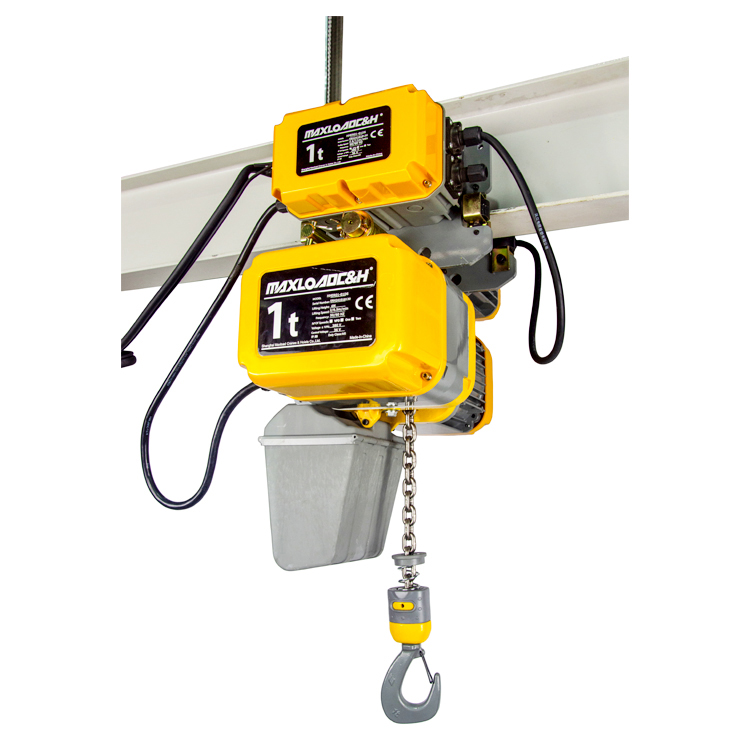
From a technology trend perspective, variable frequency drive (VFD) control is penetrating from medium-large capacities down to small capacities. In the past, a 1-ton or 2-ton hoist seemed unnecessary for VFD, but now with increasing demands for low noise and low impact, VFD lifting enables "soft start, soft stop," which is kinder to both the workpiece and the mechanical structure.
On the intelligence front, some hoists integrate load cells to display real-time weight and set overload alarm thresholds. While not exactly artificial intelligence, it at least gives the operator clear awareness.
Remote control is also increasing, especially for work in high-temperature, radioactive, or toxic environments, using wireless remote controls to remove operators from hazardous areas. However, wireless remotes have a practical issue: battery depletion or signal interference can lead to loss of control, so standards still require a manual emergency stop and a mechanical emergency lowering device.
At its core, an electric hoist is a device that converts electrical energy into mechanical energy and applies that mechanical energy precisely to a load. It doesn't involve flashy technology, but in any industrial scenario requiring "moving a heavy object from point A to point B," its presence means liberating human labor from strenuous, dangerous manual work. Selecting the right hoist, using it correctly, and maintaining it well can sometimes solve immediate practical problems more effectively than spending a fortune on an automated warehouse.
 0086 156 1824 5535
 0086 156 1824 5535