From Selection Matching to Workstation Efficiency Improvement
In the field of industrial material handling, the combination of an electric hoist and a jib crane is a widely adopted but often underestimated configuration. Unlike large overhead cranes, it may not be eye-catching, yet it plays an indispensable role at every production workstation. To truly understand the value of this combination, one must consider it from a system synergy perspective rather than treating the two as isolated components.
Ⅰ. Understanding the Logic of the "Hoist + Jib" Combination
The combination of an electric hoist and a jib crane is more than a simple addition. The jib crane's column, slewing mechanism, and boom form a support and guidance system, while the electric hoist, as the lifting actuator, gives the system vertical handling capability. The two are structurally interdependent: without a hoist, the jib crane is just a stationary steel frame; without the jib's runway, the electric hoist loses its horizontal movement path.
The working coverage of a jib crane is typically a sector or ring centered on its rotation axis. A pillar-mounted jib crane can achieve 360° full slewing, while a wall-mounted type is limited by wall position, usually offering slewing angles between 180° and 220°. Within this area, the electric hoist travels back and forth along the jib rail, lifting loads vertically and transferring them between workstations. The inherent advantage of this combination is that it does not occupy runway beam space or require extensive modification to the plant structure, yet it achieves complete three-dimensional material flow in the localized space of a single machine tool or assembly line.
Ⅱ. Electric Hoist Selection: Chain or Wire Rope?
Selecting the electric hoist is the first critical decision in the combination, centering on the technical differences between chain and wire rope as the lifting medium.
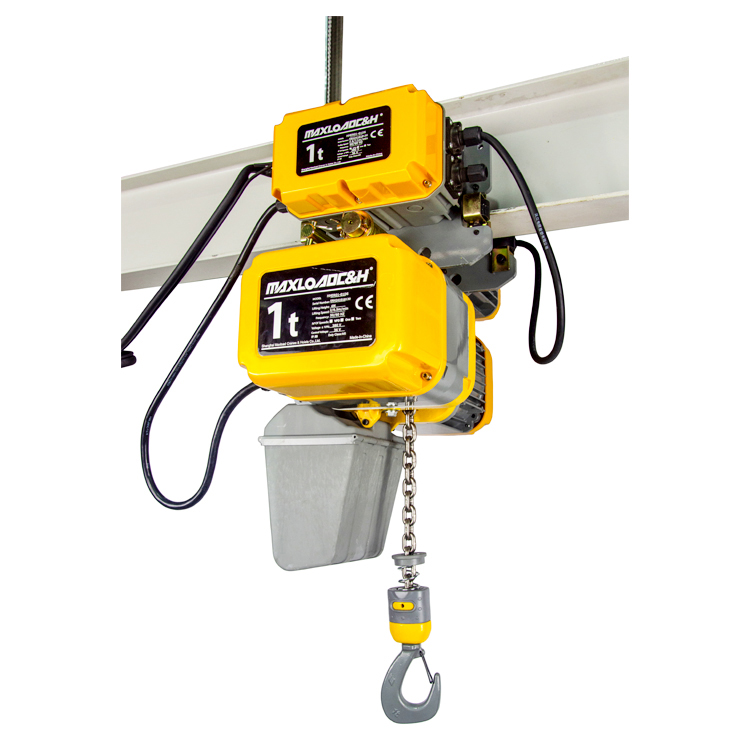
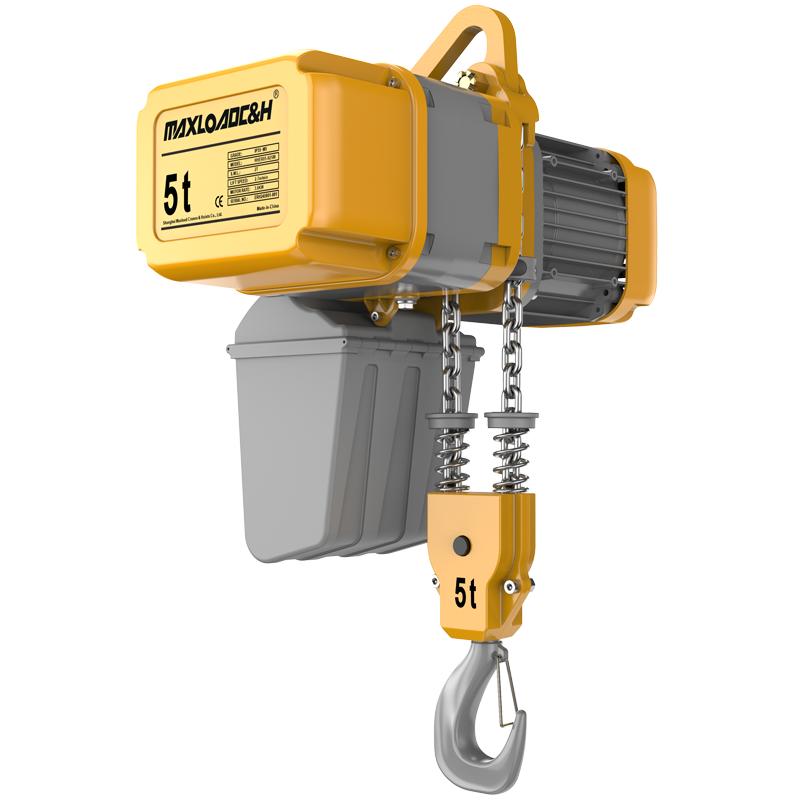
Chain electric hoists use high-strength alloy chain as the transmission medium, offering a compact structure and small size. For the same capacity, their overall dimensions are typically a fraction of those of a wire rope hoist, because the chain-sprocket engagement avoids the volume constraints imposed by drum diameter. More importantly, during lifting, the hook of a chain hoist always moves along the vertical line of the chain, with no horizontal offset caused by wire rope winding axially along the drum, resulting in significantly better positioning accuracy than wire rope solutions. Another prominent advantage of wire rope hoists is their lifting height – by increasing drum diameter and length, wire rope hoists can achieve lifting heights of tens of meters or more, whereas chain hoists, limited by chain length, are generally suitable only for lifting operations within a few meters.
Translating these differences to the jib crane match: For workstation-level applications – such as machine tool loading/unloading and assembly line material transfer – the chain electric hoist is the more economical and operationally flexible choice. Its lightweight and low operating noise allow it to be easily mounted on the jib rail and operated by a single person via a pendant or remote control. Jib cranes themselves typically use manual slewing and horizontal movement; electric drive is considered only for larger lifting capacities. In scenarios such as die handling or heavy component transfer, a wire rope hoist paired with a heavy-duty pillar-mounted jib crane is the more reasonable solution.
Ⅲ. Jib Crane Structural Selection: Space Dictates the Form
Jib cranes are not a single shape; the structural choice directly affects the operational efficiency of the combined system. In terms of installation type, jib cranes fall into three categories: pillar-mounted, wall-mounted, and mobile.
Pillar-mounted jib cranes are the most common configuration. The column is anchored to a concrete foundation via foundation bolts, and the boom can slew 360° around the column, making it suitable for material handling at fixed workstations. Their disadvantage is that they occupy floor space and require preparation of installation conditions during foundation construction.
Wall-mounted jib cranes fix the slewing mechanism to a wall or column structure, taking up no floor space but having a limited slewing range, suitable for production line workstations arranged along walls.
Mobile jib cranes offer greater mobility; they can be moved around the workshop to different workstations for temporary use, making them ideal for intermittent lifting tasks or multi-workstation sharing scenarios.
Selection requires comprehensive consideration of three core parameters: working radius, lifting height, and slewing angle. The effective boom length determines coverage – conventional pillar-mounted jib cranes have slewing radii ranging from 2 to 10 meters and lifting capacities from 125 kg to 10 tons. In practice, note that slewing radius and boom length are two different concepts: the former is the distance from the rotation center to the farthest hook point, while the latter is simply the length of the boom itself – there is a structural difference between them.
Ⅳ. Synergistic Performance in Typical Working Conditions
In different industrial scenarios, the electric hoist and jib crane combination demonstrates distinct application values.
In machining workshops, jib cranes are often deployed next to CNC machine tools, paired with chain electric hoists for workpiece loading and unloading. Previously, manual handling of workpieces weighing tens or even hundreds of kilograms was not only inefficient but also carried significant injury risk. After introducing the jib crane combination, workers only need to control hoist lifting/lowering and boom slewing, reducing single material handling time by over 40% while greatly lowering labor intensity.
In assembly processes, the advantage of the combined system lies in precise positioning. Articulated jib cranes, through their multi-joint structure, can bypass obstacles between workstations. Paired with a chain hoist, they deliver components precisely to the assembly position, avoiding collisions – especially suitable for assembling core components such as engines and transmissions.
In warehousing and logistics, the jib crane combination replaces some functions of overhead cranes. Wall-mounted jib cranes arranged along warehouse walls complete goods loading/unloading in narrow aisles, occupying no aisle space while quickly responding to high-frequency, short-distance lifting demands.
Ⅴ. Key Reminders for Installation, Commissioning, and Daily Operation
Whether a jib crane combination system performs effectively depends largely on installation quality and daily operating discipline.
During installation, foundation stability is the foremost prerequisite. The foundation bolts of a pillar-mounted jib crane must be anchored in solid concrete, and the column verticality deviation must be controlled within 1/1000. After positioning, conduct no-load trial runs several times to confirm that all transmission mechanisms operate normally and that limit devices are sensitive and reliable. Then perform a static load test at 125% of rated capacity – lift the test load about 100 mm off the ground and hold for 10 minutes; inspect for any structural abnormalities before putting into service.
In daily operation, several principles must not be ignored:
Overloading is strictly prohibited.
Never pull or lift at an angle – this accelerates wear on the hoist's rope guide and can cause dislodging.
After work, raise the hook to at least 2.5 meters above the floor and disconnect the power supply.
The electric hoist should be operated by trained, designated personnel.
Establish a regular inspection schedule, documenting the wear condition of the chain or wire rope and the reliability of the brake.
From a system perspective, the electric hoist and jib crane combination is by no means a simple "just good enough" assembly. Only when load characteristics, spatial conditions, and operational frequency are fully considered during the selection phase, and when installation and usage follow the specifications, can this system deliver its intended workstation efficiency. For production-oriented enterprises facing short-distance, high-frequency material handling needs, this is undoubtedly a technical path worth serious evaluation.
 0086 156 1824 5535
 0086 156 1824 5535