Modularisation and Combined Application of Industrial Crane Systems
In the field of modern industrial material handling, a single piece of equipment is rarely sufficient to form a complete lifting system. As the core lifting component, the electric hoist typically needs to be combined with different types of load‑bearing steel structures to create an integrated handling solution tailored to specific working conditions. Among the most common combinations are those with overhead cranes and KBK modular crane systems. This article examines the system composition and selection logic, outlining the applicable scenarios and technical key points of these combination methods.
Ⅰ. Electric Hoist: Role of the Lifting Core and Selection Essentials
The electric hoist undertakes the vertical load lifting task within the entire crane system; its performance parameters directly determine the basic lifting capacity of the system. The most widely used type is the wire rope electric hoist. Standard models offer either constant lifting speed or constant/slow dual speed, with the dual‑speed version being advantageous in applications requiring precise positioning, such as machine tool maintenance and precision mould closing. With duty classes M3 to M5, these hoists meet the light‑to‑medium lifting demands of most industrial workshops.
Key parameters to consider during selection include:
Rated lifting capacity – determines the safe load upper limit.
Lifting height – must cover the maximum distance from the rail plane to the working floor, with some margin.
Duty class – must be consistent with the overall machine’s frequency of use and load condition to avoid premature wear of individual components, becoming the system’s weak point.
Additionally, the connection dimensions and mounting method of the electric hoist must precisely match the structure of the carrier trolley; the wheel gauge of the hoist trolley must align with the track gauge of the crane girder, otherwise problems such as rail jamming or uneven wear may occur during operation.
Ⅱ. Electric Hoist Combined with Overhead Crane: Classic Combination under Bridge Architecture
An overhead crane (bridge crane) consists of four parts: the bridge metal structure, the long‑travel drive mechanism, the lifting trolley, and the electrical control system. The bridge travels longitudinally along rails on both sides of the workshop, while the trolley carrying the electric hoist moves transversely along the girder. The orthogonal motion paths allow the system to cover any point within a rectangular working area.
Depending on the number of girders, overhead cranes are classified into two main configurations: single‑girder and double‑girder.
Single‑girder electric overhead crane: compact structure, low self‑weight, cost‑effective; rated capacity typically between 1t and 20t, widely used for conventional lifting tasks in small‑to‑medium‑span workshops.
Double‑girder electric overhead crane: features a box‑section bridge and dual‑rail trolley, offering higher rigidity and stability; rated capacity can range from 5t up to 50t or more, with spans exceeding 35 m; suitable for demanding scenarios such as metallurgy and heavy manufacturing.
It is worth noting that under the double‑girder configuration, there is also a “twin‑hoist” arrangement – two independently controlled electric hoists installed on the same girder, equipped with a main hook and an auxiliary hook. This method allows coordinated lifting of long workpieces via two lifting points or parallel operation within the same bay to improve efficiency. However, in terms of duty class, such twin‑hoist double‑girder cranes are generally not recommended for extremely intensive continuous operation; the load spectrum and frequency of use must be objectively evaluated during selection.
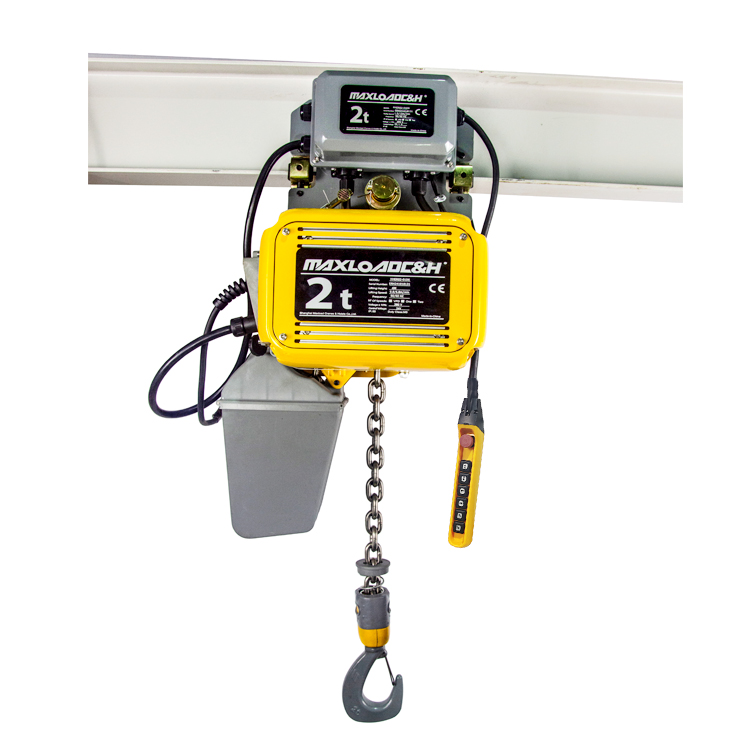
Ⅲ. Electric Hoist Combined with KBK: Flexible Track and Light‑Weight Handling
A KBK crane is essentially a modular suspended track system, assembled from standard straight track sections, suspension devices, travelling trolleys, and functional components using bolted connections. Its rated capacity is typically limited to 2t. The core advantage is not “large” but “flexible” – the track can be arranged as straight lines, curves, loops, or even branched networks according to the workshop layout, passing through dense equipment areas or around obstacles like columns – something that is difficult to achieve with a bridge crane.
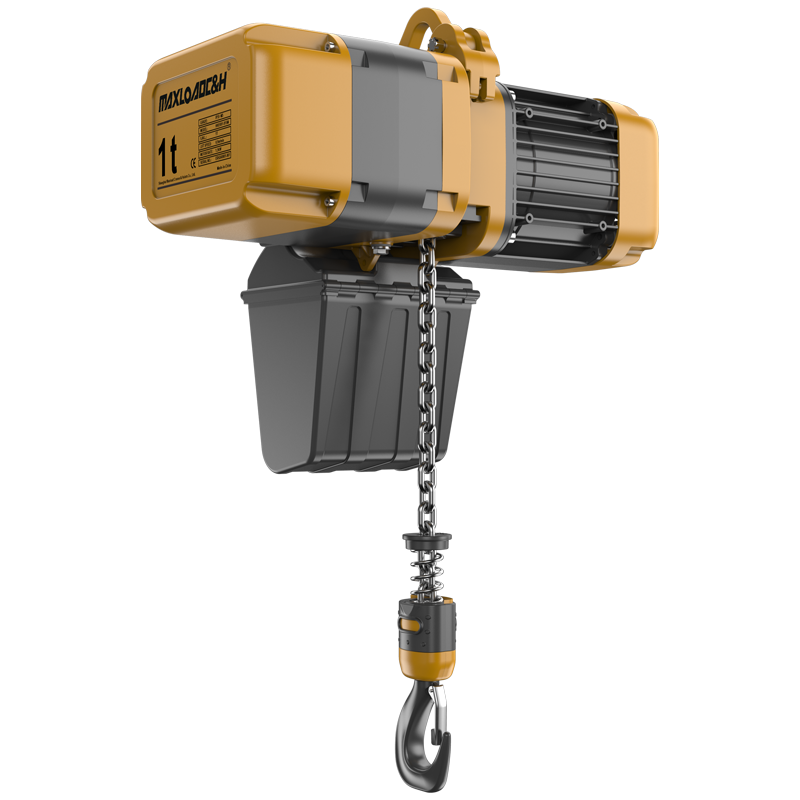
In a KBK system, the electric hoist is mainly of the chain type. Compared to wire rope hoists, chain hoists offer better chain flexibility, stronger adaptability on small‑radius curved tracks, and lower self‑weight, which helps reduce the load on suspension points. In a single‑girder KBK configuration, trolleys at both ends of the main beam run on two parallel suspended tracks, and the electric hoist moves along the main beam direction. The double‑girder configuration further increases the load capacity of the main beam, making it suitable for higher capacities or applications requiring greater travel stability.
Typical application scenarios for this system include:
Lifting engine blocks and gearboxes on automotive assembly lines, with multi‑station flow operations.
Handling precision components in electronics workshops, using low‑inertia travel mechanisms to reduce swing and collision risks.
Building suspended handling networks along shelf areas in warehousing and logistics, without occupying floor aisles.
In short, the KBK mainly addresses the flexible transfer of light materials between multiple workstations. Its combination with an electric hoist emphasises “fast yet orderly, light yet controllable” operation.
Ⅳ. How to Determine the Matching Logic for the Combined Solution
From a holistic perspective, matching the electric hoist with the supporting structure requires consideration of four dimensions:
Load and span correspondence
The rated capacity of the electric hoist must fall within the permissible load range of the supporting steel structure. The larger the span, the higher the stiffness requirement for the main beam. Never judge system capacity by the nameplate parameters of the hoist alone.
Coordination of travel speeds
The hoist’s lifting speed and trolley travel speed must be matched to the long‑travel speed of the crane. Excessive speed differences can lead to increased load swing during handling, affecting positioning accuracy and safety.
Adaptability of mounting interfaces
The connection between the electric hoist and the overhead crane girder involves multiple dimensional chains, such as bolt hole positions, wheel gauge, and clearance height. Any deviation may affect travel smoothness. Unified design should be carried out from the initial manufacturing stage.
Customisation for environmental factors
Special conditions such as dust, moisture, corrosive media, or cleanliness requirements necessitate corresponding choices – dust‑protected motors, stainless steel tracks, special coatings, or food‑grade lubrication solutions.
Regarding standard references, the overall design of cranes in China follows GB/T 3811 Code for design of cranes, which provides systematic regulations on load combinations, structural strength, mechanism design, and safety protection. Type testing and life assessment of electric hoists follow the JB/T 9008 series of standards, with some technical requirements having been aligned with international standards in recent years. Referring to these specifications when developing a technical solution helps ensure equipment compliance and service life.
Ⅴ.Conclusion
Electric hoists, overhead cranes, and KBK crane systems are not three competing products in parallel – they are functional modules that together constitute an industrial lifting and handling system. Overhead cranes provide a rigid bridge‑type supporting platform, KBK systems build flexible suspended track networks, and the electric hoist serves as the power core embedded within both. Whether this combination is used correctly and effectively depends on a comprehensive trade‑off of load characteristics, spatial conditions, work rhythm, and economic factors – and that is precisely the value of a technical solution, not merely equipment procurement.
 0086 156 1824 5535
 0086 156 1824 5535