What Kind of Workstation Suits This Combination?
The greatest feature of a jib crane is its independent working area. With just a single column or a wall, it can establish a slewing operating sector with a radius of several meters. The electric hoist, paired with its handles, vertical lifting and horizontal travel along the jib arm. In this way, operations such as loading, die changing, part flipping, and loading/unloading cleaning tanks can all be completed in a compact workstation.
Not having to wait for an overhead crane and not occupying logistics aisles are the true competitive strengths of this combination. Especially when the workshop has limited headroom, the height required by a jib crane is often much lower than that of a bridge crane, making it a viable lifting solution for low-clearance spaces. But the flip side of these advantages is strict selection requirements — details such as bending moment, foundation, and hoist headroom, if overlooked, can turn the combination from ineffective to a potential safety hazard.
Jib Type Determines the Load-Bearing Framework
The three common structures of jib cranes — freestanding (pillar-mounted), wall-mounted, and portable — lead to completely different workstation layouts, depending on the choice.
A freestanding jib crane relies on an independent column and foundation for support. Its rotation range can typically reach 270° or even achieve continuous 360° rotation by using a slip ring. Since it does not need to attach to the building structure, it is suitable for placement in the middle of a workshop or in areas away from walls and columns. It is important to note that the column requires a concrete foundation; the ground bearing capacity, anchor bolt group, and secondary grouting must all be verified by load calculations. The longer the jib arm and the higher the lifting capacity at the tip, the more significant the bending moment on the foundation, which in turn raises the requirements for base plate thickness and reinforcement.
A wall-mounted jib crane transfers horizontal reaction forces and bending moments to a load-bearing building column or wall. The advantage is zero floor space occupation — carts and personnel can pass underneath without obstruction — but the wall or column must undergo a strength check. When using chemical anchors or post-installed through-wall bolts on site, dynamic loads, fatigue, and concrete edge distances must be considered. In many plant renovation projects, wall-mounted jibs are installed directly onto steel structure columns, which requires verifying whether the column flange and stiffeners can withstand the additional torsion and local bending.
A portable jib crane comes with a counterweight base, requires no foundation fixings, and can be repositioned at any time. It is suitable for light capacities and temporary workstations, with a relatively limited jib arm length. It does, however, require a certain level of floor flatness; otherwise, it may become heavy to rotate or even tip over during movement. Some workshops lay local steel plate runways for these cranes to reduce floor damage.
Key Points for Matching the Electric Hoist
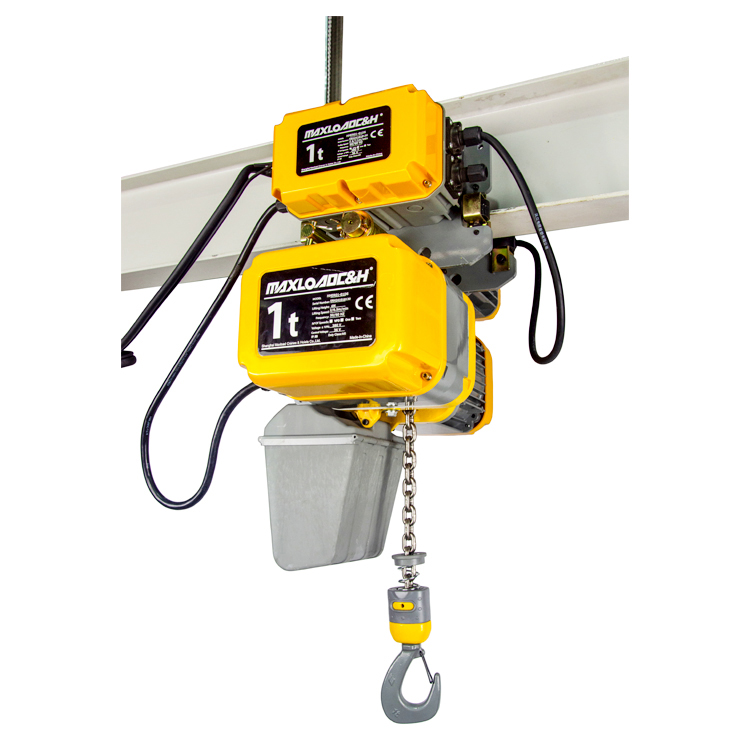
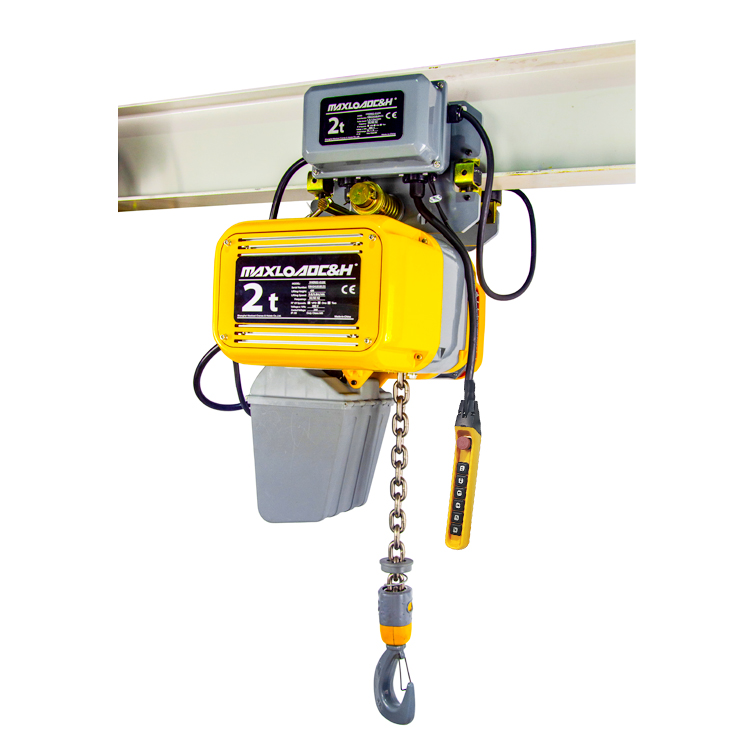
The lifting capacity of the jib is not the same as the rated capacity of the hoist. The rated load must also account for the hoist's own weight, the lifting attachment, and possible impact factors. When the jib arm is long, a heavy hoist can significantly reduce the effective lifting load. Therefore, in compact spaces, a lighter-weight electric chain hoist often has an advantage over a wire rope electric hoist.
A chain hoist uses chain links engaging with chain pockets, resulting in a small axial dimension and allowing for lower headroom. This makes it particularly suitable for low-clearance workshops or when a sufficiently effective lifting height is needed under the jib. The chain does not rotate, so the hook twist is minimal, and in combination with a shaped chain pocket, it can achieve precise inching positioning. For workstations requiring frequent mold closing or alignment — such as die repair or precision assembly — a two-speed chain hoist is almost the default choice.
Wire rope electric hoists remain the mainstay for applications requiring high lifting speeds, long travel, and high work duty classifications. Lifting speeds can easily reach several meters or even over ten meters per minute, helping to increase efficiency in fast-paced handling. The flexibility of the wire rope makes it less prone to excessive swinging during cross travel, and when paired with a variable frequency drive, it can achieve smooth starting/stopping and anti-sway functions. However, note that when the wire rope hoist travels along the jib, sufficient travel allowance must be reserved for the cable management system and power supply festoon to avoid snagging at the end of the arm.
The work duty classification is often overlooked. The steel structure of the jib is designed for a specific duty class, and the hoist's duty class should match it. A light-duty workstation may only need an M4 class, but if frequent lifting or load-slewing is involved, both the hoist and the jib should reach at least M5 or even M6. Different duty classes mean different design stress cycle numbers, allowable deflection limits, and fatigue details. A mismatch between the two will significantly shorten the service life of the entire assembly.
Slewing and Power Supply: Enabling an Uninterrupted Range of Motion
The slewing range of a jib is limited by the limit stop arrangement and the power supply method. If a simple cable drag chain is used, the rotation angle is usually restricted to under 300° to prevent cable twisting and breakage. For 360° continuous rotation, a slip ring collector can be used, feeding all power and control signals into the slip ring cavity. The slip ring unit itself needs an ingress protection rating suitable for the environment; for dusty or outdoor workstations, models with sealed structures should be selected.
In terms of control, independent workstations are generally equipped with a pendant push-button station or a wireless remote control system. Using a remote control reduces fatigue damage to trailing cables and allows the operator to stay away from the load, but it is essential to ensure that emergency stop buttons and automatic stop functions upon signal loss are in place. For jibs with motorized slewing, it is advisable to install slewing limit switches and shock-absorbing stops to prevent accidental collision with surrounding equipment.
A rarely mentioned but crucial detail — jib deflection. Under load, the jib will sag downward. This tip deflection shifts the hoist's lifting center, which can cause the hoist to operate on an incline, leading to uneven wear on the travel wheels or slide pads. To address this, the arm cross-section is often designed with an upward camber or built up from I-beams welded with reinforcement plates, rather than simply using an arbitrary cut of a standard section. For long jibs under heavy loads, some designs even employ variable cross-section box girder arms or truss arms.
Several Typical Application Examples
Die Maintenance Area
1-ton lifting capacity, 4m jib arm length. A wall-mounted jib is installed on a load-bearing column, equipped with a two-speed electric chain hoist. The low-headroom design allows the die to be lifted above the workbench without hitting the ceiling. The two-speed operation provides fast lifting/lowering and slow-speed mold closing and positioning, allowing operators to work frequently without fatigue.
Machining Center Loading
For a horizontal machining center requiring frequent changes of heavy fixtures or workpieces, with a lifting capacity of about 500 kg and a 3-meter reach. A portable jib crane with a wire rope hoist is used to serve two machine tools. The jib features motorized slewing with wireless remote control; when not in use, it can be pushed aside, occupying no machine maintenance space. Since this workstation is not a continuous operation, the power supply is connected through a quick-connect industrial socket.
Precision Assembly Line
For assembling engine sub-assemblies, a zero-gravity floating manipulator needs precise positioning at any point within the sector area. A freestanding jib crane with 360° continuous rotation via slip ring power supply is used. It is paired with a variable frequency wire rope hoist, featuring variable frequency control for both lifting and travel motions, achieving millimeter-level alignment. After pre-camber eliminates deflection, the hoist's levelness changes very little at any position along the arm, significantly reducing travel wheel skewing.
Installation and Subsequent Inspection
A freestanding jib crane must be installed with an embedded foundation; civil conditions do not permit simply anchoring it onto a thin surface floor slab. Before secondary grouting, the base plate must be leveled to a tolerance within 1/1000. When installing a wall-mounted jib, the anchor bolts must be pre-tensioned with a torque wrench to the design value. After installation, a dynamic load test at 1.25 times capacity and a static load test at 1.5 times capacity must be performed, and residual deflection must be measured. Routine inspection focuses on abnormal jib deflection, slewing bearing clearance, lubrication and deformation of the hoist chain or wire rope, limit switches, and signs of arcing on slip ring contacts.
The inescapable core logic of this combination is: the jib provides a stable and reliable load-bearing framework and motion constraint, while the electric hoist performs vertical conveyance and fine control. These two parts must be considered as a single system, from structural deflection to the center-of-gravity shift of the load handling device, from duty class to power supply method. Missing any link will compromise the smoothness of on-site operations. Spending more time during the planning stage on load spectrums and geometric constraints is far better than post-installation rework. Workstations that follow this approach quietly become the most handy and frequently used corners of the workshop.
 0086 156 1824 5535
 0086 156 1824 5535