Collaborative Application in Overhead Crane Systems
Ⅰ. Matching Hoists and Cranes from a Practical Working Condition Perspective
In the field of material handling, overhead cranes serve as core equipment, and their performance largely depends on the selection of the hoisting mechanism. As the hoisting component of the crane, the electric hoist directly determines the user experience and production efficiency. Many users, when selecting equipment, often focus only on the structural parameters of the crane itself, neglecting the matching between the hoist and the crane, leading to various issues in actual use.
Wire rope electric hoists and chain electric hoists are the two most common types used in overhead crane systems. Although both are called electric hoists, they differ significantly in structural characteristics, applicable scenarios, and interaction with the crane. Understanding these differences is essential for making sound selection decisions.
Ⅱ. Characteristics and Applicable Scenarios of Wire Rope Electric Hoists
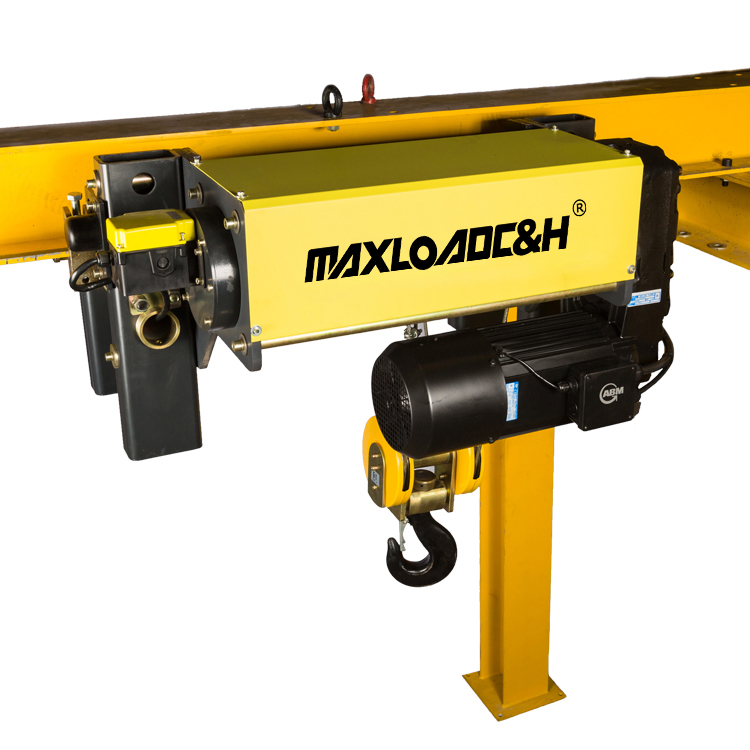
Wire rope electric hoists use wire rope as the load-bearing element, with a drum winding and unwinding the rope to raise and lower loads. These hoists offer large lifting heights, typically reaching over 30 meters, or even higher, which is their most significant advantage over chain hoists. In situations with high-bay facilities or when obstacles need to be cleared, wire rope hoists are nearly irreplaceable.
Structurally, the motor and gearbox of a wire rope hoist are arranged in-line, giving the hoist a slender profile that is well-suited for mounting on top of or alongside the crane’s main girder. The travel mechanism is usually independently driven, moving on wheels along an I-beam track. Wire rope hoists cover a wide range of lifting capacities.
The most prominent advantage of wire rope hoists is smooth operation. The wire rope is flexible, resulting in low impact during start and stop, significantly reducing shock damage to the hook and load compared to chain hoists. This is especially important in assembly stations or mold handling, where precise positioning is required.
However, wire rope hoists also have clear drawbacks. The wire rope itself requires regular lubrication and maintenance. In dusty, high-temperature, or corrosive environments, wire rope life is significantly shortened. Additionally, the lifting speed of wire rope hoists is relatively fixed, and while speed control can be achieved through later VFD retrofitting, this adds cost and system complexity.
Ⅲ. Characteristics and Applicable Scenarios of Chain Electric Hoists
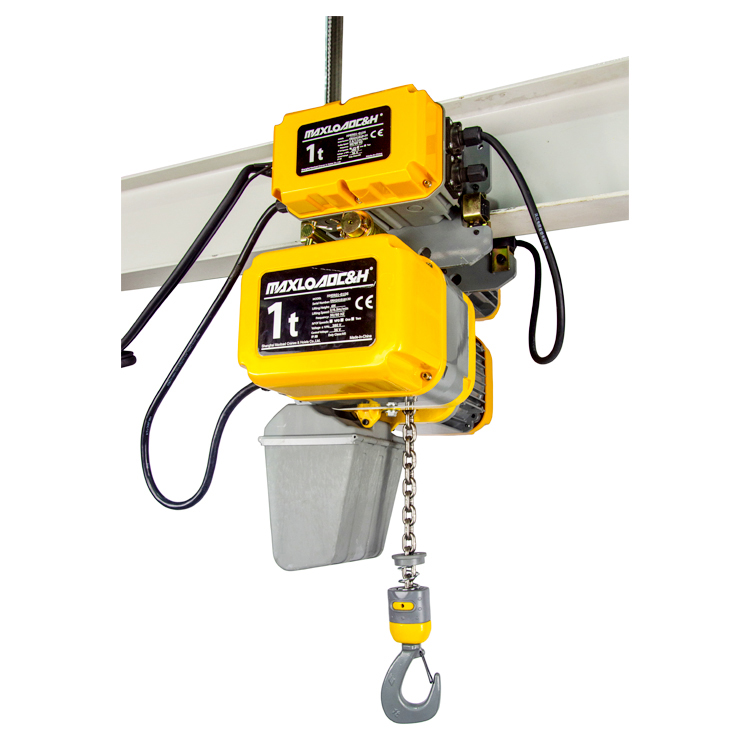
Chain electric hoists use a load chain as the load-bearing element, with a sprocket driving the chain to lift and lower. The chain is stiffer than wire rope, providing less lateral sway and offering advantages in low-headroom installations. Chain hoists have a compact overall structure, making them particularly suitable for confined spaces.
The most outstanding features of chain hoists are durability and low maintenance. The chain surface is hardened, offering much better wear resistance than wire rope, and in most conditions does not require frequent lubrication. For dusty or corrosive environments such as cement plants, foundries, or chemical facilities, chain hoists are often the safer choice.
In terms of price, a chain hoist of the same capacity is typically 20% to 30% cheaper than a wire rope hoist. However, at larger lifting heights, the increasing weight of the chain leads to higher energy consumption, eroding the cost advantage. The lifting height of chain hoists generally does not exceed 30 meters; beyond that, the chain’s self-weight becomes too large, seriously affecting efficiency and safety.
Chain hoists generally have slow lifting speeds, and the engagement between the chain and sprocket produces noticeable periodic vibration. This vibration is transmitted through the hook to the load, making chain hoists less suitable for precision assembly or handling fragile items.
Ⅳ. Selection and Matching Principles for Overhead Cranes
When installing a hoist on an overhead crane, several key matching points need special attention.
Lifting capacity distribution is the primary consideration. The crane’s own load-bearing capacity includes the main girder, end trucks, and rail system. The hoist’s rated capacity must match the crane’s rated load. It is unacceptable for the hoist to be overloaded while the bridge has excess capacity. The proper approach is to base the design on the hoist’s capacity while allowing a 10–15% margin in the load capacity of the crane’s various components.
Gauge and mounting dimensions directly affect retrofit feasibility. Different brands and series of hoists have widely varying travel mechanism gauges. If the gauge does not match when replacing a hoist, the rail or the bottom flange of the girder may need modification—a significant undertaking. For new projects, this flexibility can be used to optimize the hoist gauge according to the building span, improving overall layout.
The coordination between lifting height and building clearance must be accurately calculated. This is the most common trouble spot. The sum of the hoist’s top height and the lowest position of the hook must be less than the effective space between the crane rail elevation and the floor. Many users have discovered after purchase that the hook cannot reach the floor, or that the hoist body hits the roof structure when raised to the limit, all due to insufficient prior calculation.
The control method also needs unified planning. The crane’s bridge travel, trolley travel, and hoist lifting/travel (three motions) typically require coordinated operation. When using a radio remote control, ensure that the remote can control all three crane motions while meeting safety interlock requirements. Some users, in an effort to save costs, purchase the crane and hoist separately, resulting in two incompatible remote systems that are extremely inconvenient to operate—a false economy.
Ⅴ. Typical Matches with Wire Rope Hoists and Cranes
In one typical application—a bridge crane with a span of 25 meters, a lifting capacity of 10 tons, and a lifting height of 12 meters—a wire rope electric hoist is used as the hoisting mechanism. This configuration is very common in machine shops. The crane covers material handling across the entire workshop, while the wire rope hoist, with its large lifting height advantage, easily moves loads from the floor to high racks or machine operating levels. The smooth lifting characteristics of the wire rope hoist enable operators to precisely position loads, reducing the risk of collisions and damage.
Another common match is a dual-hoist collaborative operation. When handling extra-long or irregularly shaped loads, a single lifting point cannot ensure balance. Two hoists mounted on the same trolley frame, with electrical interlocks for synchronized lifting, are used. Here, the flexibility of the wire rope becomes an advantage because the two ropes can absorb some of the misalignment-induced offloading, requiring less synchronization precision compared to chains.
Ⅵ. Typical Matches with Chain Hoists and Cranes
In more demanding environments, such as the cleaning section of a foundry—where dust is heavy and temperatures are high—a chain electric hoist is often more appropriate. A bridge crane with a span of 18 meters and a capacity of 5 tons, using a chain hoist for feeding a heat treatment furnace. The chain does not require frequent lubrication, avoiding sludge formation from dust, and chain performance degrades more slowly than wire rope at high temperatures. Although the lifting speed is slow, precise positioning is more important than speed in loading, and the low-speed stability of the chain hoist becomes an advantage.
Another typical scenario is paint spraying lines. Paints and solvents strongly dissolve or corrode the lubricating grease on wire ropes. If a wire rope hoist is used, its rope life is typically only three to six months. Switching to a chain hoist, whose chain requires no surface lubrication, extends service life to over two years. Combined with automatic crane control, a fully unmanned conveyor system can be created.
Ⅶ. Common Selection Mistakes and How to Avoid Them
Mistake 1: "Greater lifting capacity is always better." Some believe it is acceptable if the hoist’s capacity exceeds the crane’s rated load, as long as they don’t lift that heavy weight. This is dangerous. Oversizing the hoist adds dead weight, possibly overloading the trolley rail and accelerating wear on the bridge drive due to increased wheel loads. The correct practice is to have the hoist capacity equal to or slightly less than the crane’s rated load; reverse oversizing is not allowed.
Mistake 2: Ignoring duty classification. Both hoists and cranes have duty classes determined by frequency of use and load conditions. A 5-ton crane used in a maintenance shop for two hours per day versus a production line operating sixteen hours per day requires completely different hoist and mechanism configurations. Mismatched duty classes lead either to waste or premature equipment failure.
Mistake 3: Replacing a hoist arbitrarily without calculation. After years of use, a hoist fails, and some users simply buy a hoist of the same capacity from another brand and install it. However, mounting dimensions and weight distribution vary among manufacturers. After replacement, issues such as altered wheel load distribution, skewed trolley travel, and abnormal rail wear may arise. Before replacing a hoist, it is best to consult the original manufacturer or a professional for verification.
Ⅷ. Comprehensive Recommendations
The final choice between a wire rope hoist and a chain hoist should be based on a balanced consideration of multiple factors: lifting height, environmental conditions, frequency of use, and positioning accuracy requirements. In the absence of special corrosive environments or height restrictions, wire rope hoists, with their smooth operation and height advantage, have broader applicability. However, in dusty, corrosive, high-temperature, or confined-space installations, chain hoists are often the more reliable choice.
The most critical point is to treat the crane and hoist as an integrated system from the planning stage, rather than purchasing and installing them separately. Holistic design, unified control, and centralized maintenance are what enable the entire equipment system to achieve optimal performance. As an independent article—not a technical manual—aimed at users with actual procurement and usage needs, explaining the matching principles clearly is more valuable than listing parameters.
 0086 156 1824 5535
 0086 156 1824 5535