The Efficiency Code of Workstation Material Handling
Among the many devices used for industrial material handling, the combination of a jib crane and an electric hoist is neither particularly large nor complex. However, when the working conditions demand single-operator workstations, limited spaces, and high-frequency, precise lifting and short-distance movement, the advantages of this combination become immediately apparent. It functions like a flexible arm—the jib covers radius coverage and rotation, while the hoist handles vertical lifting and lateral movement. Together, they create a lightweight, point-to-point handling solution for workshops and assembly lines.
Complementarity Creates a Complete Workstation
The core structure of a jib crane (also known as a slewing jib crane) is simple: a vertical column or wall bracket supports a rotatable jib, on which an I-beam track is laid. The electric hoist is suspended from this track via a traveling trolley, moving laterally along the track, while the hook handles lifting and lowering. When the jib rotates, the lifting area expands from a single point to a fan-shaped or even circular workspace.
Without the jib, an electric hoist is mostly confined to moving linearly along a fixed monorail, with its coverage limited by the track length, and modifications often require structural reinforcement. When paired with a jib, a radius of three to six meters around the workstation can be easily covered without adding extra tracks. This combination is ideal for operations that require frequent transfer of workpieces between machine tools, assembly tables, and loading rollers.
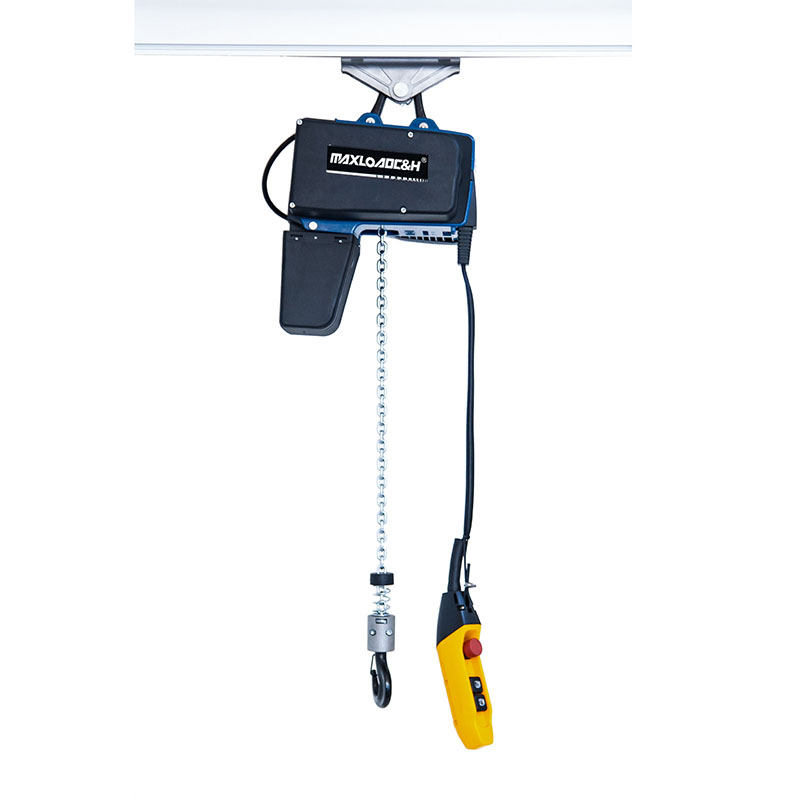
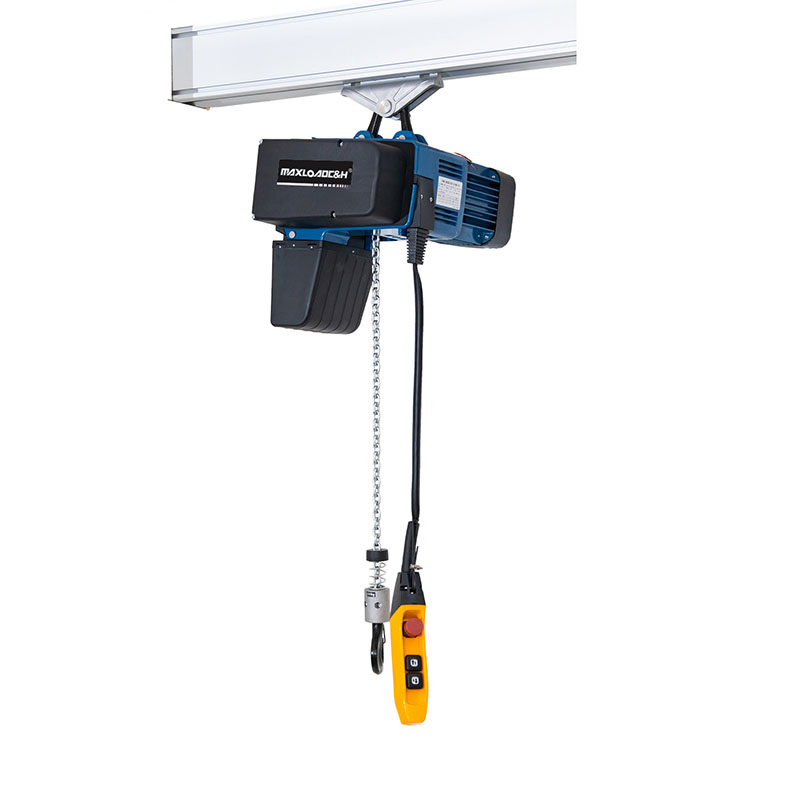
The type of electric hoist directly affects the performance of the combination. Due to their compact structure, low headroom, and flexible chains, chain electric hoists are the default pairing with jib cranes. Especially in workshops with height constraints where minimizing the hook's upper limit is critical, the adaptability of low-headroom chain hoists is hard to beat. For lifting capacities exceeding two tons or applications requiring longer lift heights, wire rope electric hoists are more suitable, as they typically offer higher duty ratings and more reliable duty cycles. Regardless of type, incorporating variable frequency control enables smooth starting and braking, which greatly helps suppress load swing and achieve precise positioning when operating with the jib system.
Tangible Efficiency Improvements
Workstation efficiency is the most direct benefit. Heavy loads are handled without manual effort; the operator can control the hoist with one hand using a pendant or wireless remote, with the hoist's slow speed enabling millimeter-level micro-movements. Changing a mold weighing nearly 200 kg on a machine tool—lifting, traversing, and positioning—takes less than a minute with a single operator, whereas it would previously require two people, take several times longer, and often result in collisions.
Space advantages are equally notable. Unlike overhead cranes that require long-span tracks and load-bearing corbels, a jib crane relies on just one column or a wall anchor point, without encroaching on floor travel paths. This makes it particularly suitable for adding lifting points in older workshops with limited overhead load capacity or tight aisles. A freestanding jib crane is independent of the building structure and flexible enough for future layout changes. A wall-mounted type eliminates even the column footprint, further freeing up workshop floor space.
From an ergonomic perspective, this equipment combination also plays a role in safety protection. The risk of muscle strain from frequently lifting heavy objects, as well as accidental dropping and injury, is significantly reduced. The hoist is equipped with upper/lower limit switches and overload protection; the jib rotation can be fitted with limit stops or damping buffers. Variable frequency models start and stop smoothly, greatly reducing load sway. The system's duty rating is typically M4 or M5, capable of easily handling hundreds of lifting cycles per day. With proper maintenance, its reliable service life can cover the main lifecycle of the production line.
Finding the Right Application Scenarios
In machining workshops, this combination is often deployed next to CNC lathes and machining centers. A freestanding jib crane with a two-speed chain hoist, with a jib long enough to cover two or three machines, allows rough blanks to be lifted from pallets, quickly traversed, and slowly positioned for chuck clamping, then finished parts to be moved away. Such continuous operation does not tie up the overhead crane and saves the operator from pushing carts or manual handling.
On assembly lines—for engines, gearboxes, pumps, and valves—the benefits are similar. Components are heavy and require precise alignment with holes. The operator holds a remote control in one hand to manage lifting and traversing, while the other hand can guide the workpiece or rotate the jib. Slow speeds allow stable micro-movements, and fast speeds allow quick empty-hook returns, balancing assembly quality and efficiency. Other applications include welding turnover, mold maintenance, and light-duty lifting in laboratories, where a wall-mounted jib crane with a small-tonnage chain hoist makes transferring bottles, jars, or precision fixtures effortless.
Selection cannot rely on "Estimation."
To make the system fit the actual working conditions accurately, upfront calculations and design must be rigorous. Lifting capacity should account not only for the workpiece weight but also for the weight of slings and gripping devices, with a safety margin—typically at least 25% above the actual maximum load. The effective jib length should be measured from the center of rotation to the farthest point reachable by the hoist hook, while also considering jib end deflection. For manually pushed/pulled hoists on a jib, it is recommended that the total weight of the sling and workpiece stay within 200 kg; otherwise, operation becomes strenuous, and a motorized traveling trolley is needed.
Rotation angle depends on workstation layout. Fixed-angle rotation simplifies power supply and limit switches; for 360° continuous rotation, slip rings or cable carriers must be designed to prevent cable twisting. The jib height must ensure the hook can lift the workpiece above the highest obstacle while maintaining a safe clearance from the ceiling. In such cases, low-headroom hoist specifications must be carefully checked to avoid discovering insufficient under-beam height after installation.
The lifting speed and travel speed of the electric hoist should be determined based on the duty cycle. For frequent operation, variable frequency stepless speed control, or at least two-speed (fast/slow) control, is a wise choice to prevent sway and aid positioning. A wireless remote control is recommended, allowing the operator to move freely from a safe perspective. Safety features must not be missing: upper/lower limit switches, overload limiter, emergency stop, rail end stops, and rotation limit buffers should all be provided as a complete set. The track uses an I-beam, and the width of its lower flange must precisely match the hoist trolley; any deviation will cause rail gnawing or jamming.
Precision in Installation and Maintenance
A solid foundation is the basis for safe lifting. A freestanding jib crane requires a poured concrete foundation, with anchor bolts precisely positioned and the column verticality controlled within 1/1000. For wall-mounted types, the wall's overturning resistance must be calculated; heavy loads cannot be mounted on masonry walls without verification. After installation, inspect the jib's camber, rotation smoothness, trolley-to-rail fit, and adjust the hoist's upper/lower limits and brake slippage.
Routine inspections cannot be perfunctory. Regularly check chain or wire rope wear and lubrication, wheel flange wear, slewing bearing for unusual noises, and the electrical cabinet for dust accumulation or moisture. If stopping/starting impacts increase, jib rotation becomes sluggish, or hoist brake slippage exceeds limits, repair immediately to prevent minor issues from escalating into safety incidents.
When workstation material handling demands precision, agility, and continuity, the combination of a jib crane and an electric hoist naturally comes into focus. It does not pursue massive lifting capacity but genuinely improves transfer efficiency in the details and reduces the physical burden on operators. Whether for a new workshop or an existing line retrofit, as long as the need involves frequent, lightweight, space-constrained transfer tasks, matching jib length, hoist specifications, and control characteristics from a holistic perspective will allow this "arm-and-wrist" system to fully unleash its workstation handling energy and become a long-lasting, reliable support on the production line.
 0086 156 1824 5535
 0086 156 1824 5535