Selection Guide from the Field
Walk into any industrial workshop, and you'll see electric hoists at work. But they all look pretty much the same – a motor, a drum, a wire rope, hung from a crane runway. The layperson sees only the surface; the expert sees the substance. Those who have dealt with real-world breakdowns know that choosing the wrong hoist means years of endless repairs, downtime, and part replacements.
The problem is never whether a hoist can lift its rated load. Almost all qualified products can do that. The real differentiator is: can it operate reliably over the long term in *your* specific environment?
Let's start with the most common scenario: the standard workshop
Clean indoor workshops with little dust, no corrosive gases, and temperatures between -5°C and 40°C. This is the most comfortable environment for an electric hoist.
In such conditions, a standard off-the-shelf hoist is perfectly adequate. A conventional wound-rotor or squirrel-cage motor, standard IP44 or IP54 protection, carbon steel drum and hook, and standard travel limit switches will do. The only critical factor to pay attention to is the duty class. Lifting 5 tons ten times a day versus two hundred times a day places vastly different demands on the hoist. Many users focus only on lifting capacity and ignore duty class, leading to premature fatigue and failure.
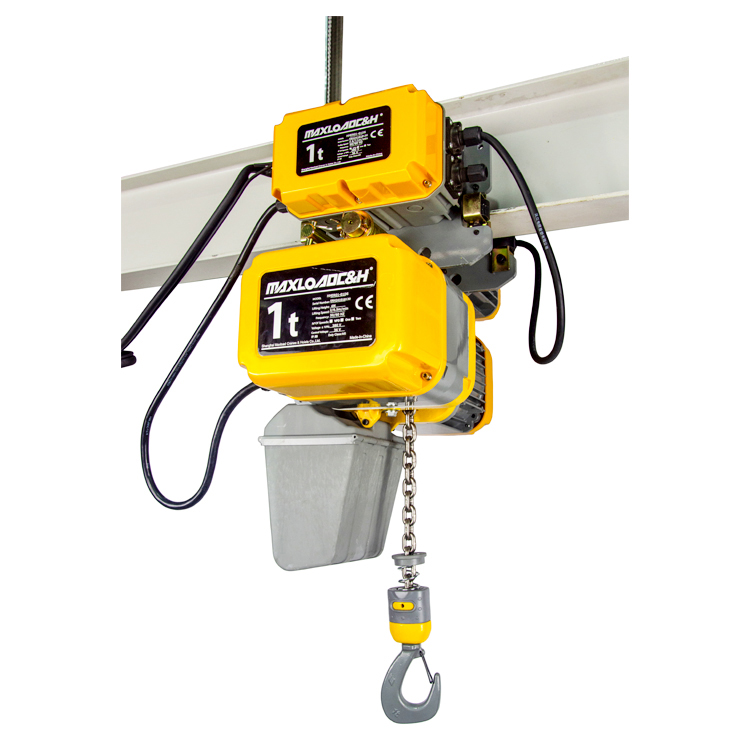
Dusty environments: the silent killer
Feed mills, cement plants, grain silos, and woodworking shops. The main characteristic of dust is that it gets everywhere.
Dust entering the motor will clog cooling vents, causing overheating and burnout. Dust getting into the brake friction surfaces will cause brake failure and load-drifting accidents. Dust inside the limit switches will cause poor contact or jamming. Dust in the gaps between the wire rope and drum accelerates wear.
For dusty environments, the most critical factors are motor and brake sealing. A standard motor won't work. Do you need a dust-ignition-proof motor? Not necessarily. Explosion-proof motors are designed for combustible dusts, such as flour, wood dust, or coal dust. If the dust is non-combustible – like cement dust or mineral powder – a standard motor with high sealing integrity (minimum IP65 protection) is sufficient.
Ideally, the brake should be an external type with a dust cover, or internally mounted within the motor's end bell – the latter naturally offers better dust protection. If an external brake is used, check that it has effective sealing.
Wire rope and drum wear accelerate in dusty conditions. Consider increasing lubrication frequency or selecting a rope with a harder surface. Chain hoists have an advantage here, too: the chain's movement is less likely to pull dust into the drive system.
High-temperature environments: metal fatigue
Steel mills, foundries, glass plants, heat-treatment lines. Radiant heat and high temperatures are the most severe challenges.
Standard electric hoist motors typically have a duty rating of S3 40% or S4 25%, meaning they cannot run continuously. In high ambient temperatures, the motor's cooling capacity decreases, so the actual permissible duty cycle must be derated. For example, when ambient temperature exceeds 40°C, motor output torque begins to drop, requiring derated use.
The most immediate problems are often with electrical components. Contactors, relays, and the electrolytic capacitors inside VFDs typically have an upper operating temperature of 40–50°C. If ambient temperatures are higher, you need components rated for high temperatures, or you should mount the control panel away from the heat source, connecting it to the hoist body with extended cables.
Wire rope loses strength at high temperatures. Standard wire rope should not be used above 100°C. Above 200°C, a high-temperature rope with a graphite-based lubricant is required. Hoists in foundries often handle red-hot castings; the rope must not only resist high temperatures but also protect against radiant heat – sometimes a heat shield is needed.
Another often-overlooked issue is lubricants. Gear oil in the reducer will thin out at high temperatures, reducing lubrication performance and potentially leaking. High-temperature greases or synthetic gear oils are required. Bearing greases also need to be high-temperature rated.
Hazardous (explosion-proof) environments: no joke
Paint shops, chemical plant process areas, natural gas treatment stations, and coal mines. These places contain flammable gases or vapors, and sparks from ordinary electrical equipment can trigger an explosion.
An explosion-proof electric hoist is a complete system – not just a motor swap. The entire electrical system – motor, limit switches, pendant controller, terminal boxes – must meet the required explosion protection level. Choose the appropriate Ex mark based on the type of explosive substances present and the frequency of their occurrence.
One common point of confusion: explosion protection types include flameproof (Exd), increased safety (Exe), non-sparking (Exn), etc., each suited to different scenarios. Flameproof is the most stringent – the enclosure can withstand an internal explosion and prevent flame propagation. Increased safety adds extra measures to prevent sparks. These cannot be used interchangeably.
Mechanical parts also have special requirements. Hooks may need to be made of copper alloy or given an anti-sparking coating to prevent mechanical sparks during operation. Wire ropes must be static-dissipative. Chains need non-sparking treatment. Surfaces where two metal parts may strike each other are typically clad with copper or stainless steel.
Explosion-proof hoists cost significantly more than standard units, but this is not an area to skimp. Using non-Ex equipment in a hazardous atmosphere – if something goes wrong, it's catastrophic.
Clean environments: particles are the enemy
Electronics plants, pharmaceutical manufacturing, food packaging lines, and precision assembly areas. These places are extremely sensitive to dust and particles.
Standard electric hoists generate wear particles during operation – metallic dust and lubricant volatiles – which can contaminate the environment. In cleanrooms, specially designed low-particle-generating hoists are required.
Stainless steel housing is a basic requirement. Ordinary painted surfaces may flake. Moving parts must be sealed to prevent wear debris from escaping. Lubrication systems use food-grade or low-volatility specialty greases. Chains or wire ropes need surface treatments to reduce friction-related shedding. The motor brake is best enclosed, because standard brake pad wear generates significant dust.
Cleanroom hoists are technologically sophisticated, and not every supplier can deliver them. When purchasing, you must specify the cleanroom class – different classes have vastly different allowable particle emission limits.
Ask yourself these questions before selecting
Put the technical parameters aside for a moment and answer a few simple questions. How many hours per day does the hoist run, and how many lifts per hour? What is under the hook – hot, corrosive, or ordinary? What surrounds the hoist – water, dust, or flammable gases? Is maintenance convenient, and is there trained staff to perform regular inspections?
The answers to these questions matter more than rated capacity and lift height. If you undersize the capacity, you can move up a size – but if you get the environmental adaptability wrong, the entire equipment may need to be scrapped and replaced.
An electric hoist is essentially a machine that converts electrical energy into mechanical motion, and this conversion is inevitably affected by the environment. Temperature affects lubrication and cooling, humidity affects insulation and corrosion, dust affects wear and electrical reliability, and flammable gases determine the entire design basis.
The simple measure of a correctly chosen hoist: after installation, aside from regular maintenance, you no longer have to worry about it. Conversely, if your maintenance crew is constantly having to fix that hoist, don't just blame poor product quality – first ask whether the problem was seeded in the original selection.
 0086 156 1824 5535
 0086 156 1824 5535