How to Scientifically Match an Electric Hoist with a Jib Crane
On the factory floor, you often see this scenario: a jib crane is installed, an electric hoist is hung on it, but the operator finds it awkward to use. Either the crane’s rotation range can’t reach the material storage area, or the hoist’s lifting height is either too high (wasting space) or too low (insufficient). Even worse, the column ends up being an obstacle in the workstation. These problems can actually be avoided during the selection stage—the key is not how expensive the equipment is, but whether you have carefully examined your own workstation environment.
First, look at the working radius, then determine the jib length
Many procurement personnel, when they see a jib crane selection table, first think about the lifting capacity. That’s certainly important, but a more fundamental question than capacity is: how large is your working range?
Actually measure the length and width of your workstation. Identify three key positions: the material storage point, the processing station, and the finished goods temporary storage area. Use a tape measure to find the distance from the column’s center point to the farthest point among these. Add 200–300 mm to that value—that is basically the effective jib length you need.
However, a detail often overlooked: during the jib’s rotation, the motion path of the end hook is an arc. If your workstation is tight against a wall or next to another production line, when the jib rotates to certain angles, the end might not reach where you want to place the material. In that case, either shorten the jib or consider an eccentric base that shifts the column away from the workstation center to gain more effective coverage.
Clear height determines two selection directions.
The vertical space in a workstation is often more constrained than the horizontal space. Measure the height from the floor to the underside of the roof. Then subtract the hoist’s own profile height and the safety distance from the hook at its highest point to the underside of the jib. The remainder is the actual usable lifting height.
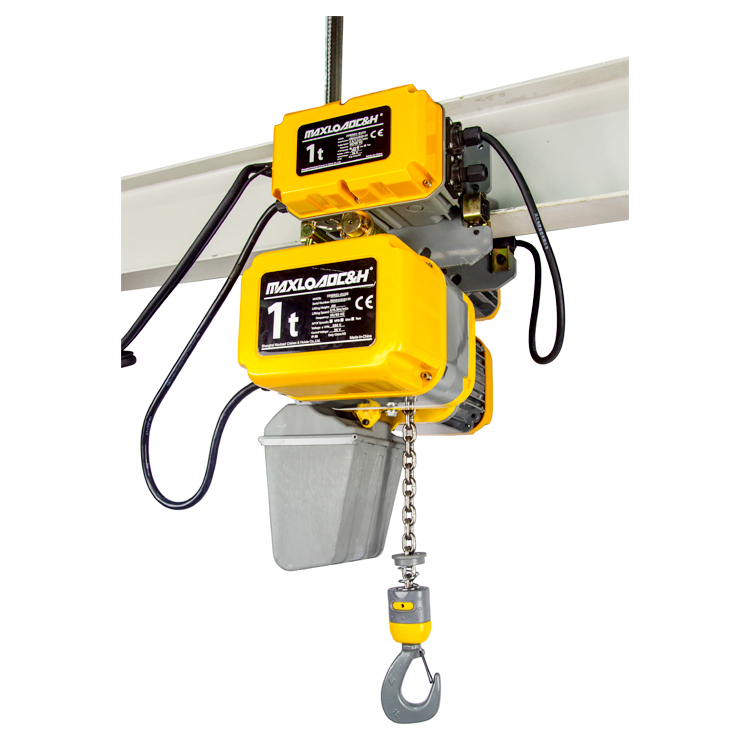
We have encountered many cases: the workshop roof has fire pipes, cable trays, lighting fixtures, and the actual clear height is only a little over three meters, but the user chose a standard hoist configuration. When the hook rises to the top, there is still nearly half a meter of clearance, so workpieces that could theoretically be lifted end up not fitting into the equipment because of insufficient height. In such cases, either switch to a low-headroom electric hoist, where the hoist body and the trolley are arranged side by side rather than stacked vertically—this can reduce the profile height by more than 30%—or reconsider the type of jib crane: a wall-mounted jib crane does not take up floor space with a column, but the wall bracket itself consumes some height, which also needs to be calculated.
Workpiece shape affects the hoist’s operation mode
This part is a blind spot for many people. They think selecting an electric hoist is just about picking the tonnage, but the aspect ratio and center of gravity of the workpiece directly determine what kind of operational functions you need.
For example: lifting a six-meter-long shaft. If you use an ordinary single-hook electric hoist, the shaft will be crooked when lifted, requiring manual assistance for alignment, which is not only laborious but also dangerous. In this case, you would need a hoist with dual hooks or one that can be equipped with a balancing beam, giving the hoist two lifting points. That sounds simple, but many standard electric hoists cannot be fitted with a second lifting point; you must decide during the selection stage whether you need this feature.
Now consider the lifting path. If the workpiece needs to be lifted from point A to point B, passing around equipment or columns, the jib’s rotation alone may not suffice. You might need the electric hoist to have trolley travel capability, or even consider whether the chain length of a chain hoist can cover the entire path. If the workstation only requires point loading/unloading within the jib radius, a manual trolley plus a manual chain hoist may be sufficient—no need for fully electric equipment.
Frequency of use is a dividing line
Thirty lifts per day versus three hundred lifts per day—the selection logic is completely different.
For intermittent use workstations, such as maintenance areas or sample trial-production areas, selecting an electric hoist with duty class M3 or M4 is entirely adequate, and the jib crane can be rotated manually, significantly reducing costs. But for continuous operation on an assembly line—e.g., forty lifts per hour—you need to calculate carefully. In such cases, the electric hoist should be at least duty class M5, with higher specifications for motor insulation class, brake life, and safety factors for the chain or wire rope. Similarly, the slewing mechanism of the jib crane will require a geared motor; pushing it by hand every day will strain workers’ shoulders and cause premature failure of the slewing bearing.
The most common pitfall is: normally, the workload is light, but there is an occasional month of rush production with continuous high-load operation. If you buy according to the normal standard, that one month might wear out the hoist. A safe approach is to ask about the maximum duty class of the equipment and allow a margin in advance.
Environmental factors are hidden killers
Discussing environmental conditions is not just a formality; it directly affects whether the equipment will last.
In humid environments or where corrosive gases or dust are present, the electric hoist should have at least IP54 protection. For explosive atmospheres, the entire hoist must have explosion-proof certification. But these are not the most hidden problems. In high-temperature workstations—e.g., lifting heat-treated workpieces where the ambient temperature exceeds 60°C—the motor cooling of a standard electric hoist becomes insufficient, and the friction pads of the brake will age faster. In low-temperature environments (below -20°C), ordinary wire ropes become brittle, and the lubricating grease on chains solidifies; special low-temperature configurations are needed.
Another easily overlooked situation is where cleanliness requirements are high, such as in food workshops or clean rooms. The surfaces of the jib crane column and jib need special coatings, the hoist chain must not shed debris, and even the lubricating oil must be food-grade. Installing standard equipment in such places will quickly be flagged during inspections and shut down.
Final steps before implementation
Once the parameters are determined, do not rush to place an order. Take a layout drawing of the workstation, draw the rotation range of the jib crane, mark the highest and lowest positions of the hoist hook, then simulate using software or make a cardboard model to check whether, when lifting the rated load at maximum radius, the jib’s deflection will cause the hook to hit adjacent equipment. If you skip this step and find a 5 mm interference after installation, it may be too late to modify.
Another point: leave room for maintenance. The base of the jib crane column and the access path to the electric hoist are often minimized during selection, but after installation, workers need to replace chains, motors, apply grease, etc. If there is no space to turn around, you will regret skimping on those two meters for years to come.
Ultimately, an electric hoist plus a jib crane is not a high-tech product, but it is a tool that must interact with the workstation, the people, and the workpieces. Choose correctly, and you’ll have smooth operation, improved efficiency, and easy maintenance. Choose incorrectly, and you’ll face daily frustrations, frequent breakdowns, and safety hazards. Don’t let attractive data sheets blind you—bend down, take your tape measure, use a stopwatch, and stand in the workstation. The answers lie in those real-world conditions.
 0086 156 1824 5535
 0086 156 1824 5535