More Important than Tonnage is the "Working Condition Profile"
Most people only provide one number when specifying requirements: the lifting capacity in tons. But lifting the same 1 ton for loading/unloading a CNC machine tool versus feeding an engine assembly line imposes vastly different demands on the equipment.
Before selecting equipment, it is advisable to create a detailed "working condition profile" for the workstation, covering at least the following dimensions:
Actual Load and Lifting Tackle Weight: Do not only consider the workpiece's own weight; all attachments below the hook must be accounted for—spreader beams, chains, dedicated fixtures, and even residual material that adheres. This part often weighs over a hundred kilograms; ignoring it leads to long-term overload.
Frequency and Rhythm: Is the workstation used once every few days like a maintenance bay, or does it need to complete a lift cycle every 90 seconds? For the former, working class 1Bm is more than sufficient; the latter must be at least M4 or even M5, otherwise the hoist motor, gearbox, and even the steel structure will suffer premature fatigue.
Material Shape and Eccentricity Issues: Long, irregular parts, or loads with an off‑center center of gravity not only affect lifting point design but also generate additional lateral forces on the hoist during travel. This imposes hidden requirements on the structural rigidity of the jib and the anti‑eccentric‑load capability of the hoist trolley.
Operational Precision Requirements: Does the job only require moving the workpiece near the workstation, or does it need millimeter‑level positioning accuracy? Assembly stations often need a micro‑speed inching function on the hoist, allowing operators to guide the workpiece precisely with both hands.
Once these conditions are clearly listed, the outline of the required equipment begins to emerge.
Jib Crane: Determine the "Skeleton" First, Then the Coverage Area
The jib crane is the load‑bearing skeleton of the entire system. Its structural form must start from the available space and foundation conditions.
When space is limited, first check whether walls can be used. If the workstation is next to a solid column or a solid wall, a wall‑mounted jib crane can eliminate the floor‑standing column and free up space below. Special attention: not every block wall can be used arbitrarily – the wall's bending and shear resistance must be verified, and the calculations for embedded or chemical anchors are essential. The rotation range is usually limited to 180°, which fits well with a workstation against a wall.
When the floor is open and the workstation is independent, a freestanding jib crane is a common choice. It provides a circular coverage area, rotates up to about 270°, and offers strong adaptability. However, the foundation must be prepared in advance. In some older workshops, the floor is only a thin layer of reinforced concrete that cannot withstand the overturning moment of the jib. In such cases, the base plate must be enlarged or a counterweight base added – ordinary floor expansion bolts are not acceptable.
If the workstation needs to be moved or the workshop floor cannot be excavated, a portable jib crane can be considered. It comes with its own counterweight base and can be pushed over short distances on a flat, hardened floor. However, it is not suitable for high‑frequency or fast operation because it needs to be re‑locked after moving, and once the floor has slopes or potholes, the risk of tipping increases significantly. Many companies buy one and use it as a fixed station, only to find that positioning is unstable and moving is laborious – that is the result of not defining the working conditions clearly.
Additionally, if there are pipes, cable trays, or overhead cranes interfering above the workstation, a knuckle jib crane can be used, allowing the arm to fold and retract to avoid obstacles. The boom length should be selected with 200–300 mm of operational margin, rather than exactly equal to the farthest workstation radius, so that the hoist trolley does not hit the end stop and still come up short.
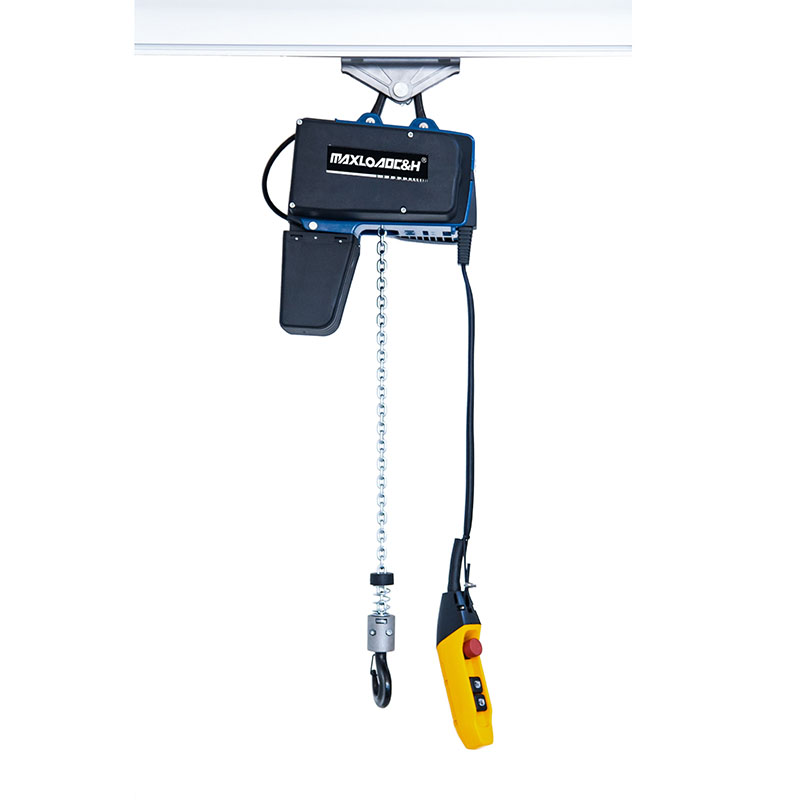
Electric Hoist: More than Just Tonnage – Operating Characteristics
The jib crane defines the coverage area, while the hoist determines the efficiency and safety of vertical material movement. Chain hoists and wire rope hoists have no absolute superiority; it is only a matter of suitability.
Chain hoists have a compact structure, small headroom, and the chain container can discharge chain in any direction. They are almost the only solution on low‑clearance mezzanines or workstations with insufficient overhead space. Their lifting speed is usually not high, but various lifting speeds can be achieved by changing the chain sprocket. They are suitable for small to medium tonnages and low‑to‑medium frequency precision work. The chain can also tolerate a certain amount of side pull, offering flexibility when used with a rotating hook.
Wire rope hoists have clear advantages in applications requiring large lifting heights, high speeds, and heavy tonnages. However, their drum takes up lateral space and requires more headroom, and the trolley size is larger. If the distance from the underside of the jib to the floor is limited but the maximum possible lift height is required, the headroom must be carefully calculated. In some cases, a low‑headroom hoist, where the hoist body is offset to one side of the rail, can be used – but this adds new verification points for the jib's torque.
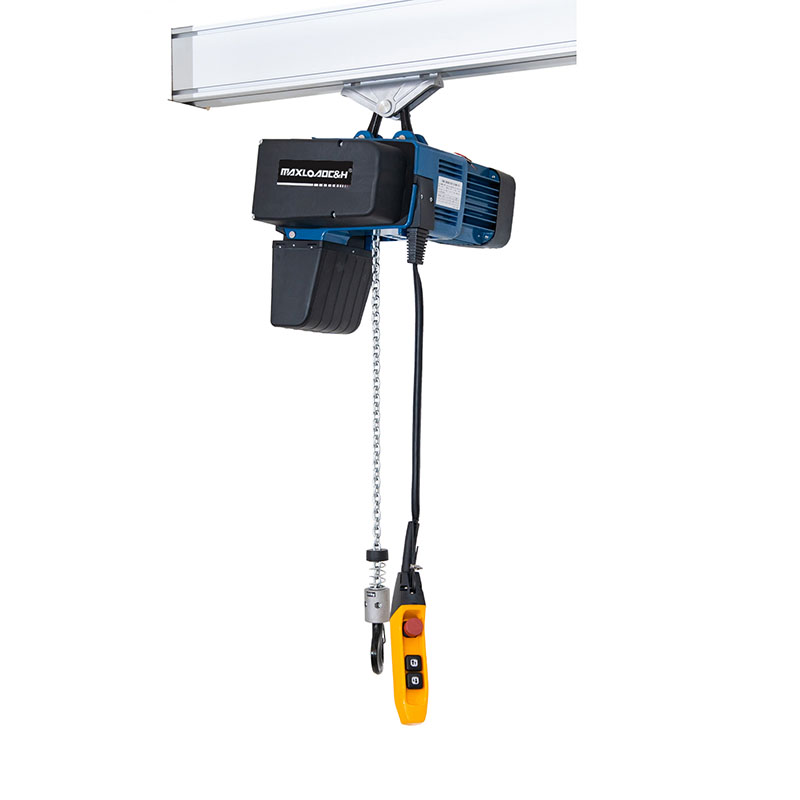
The travel method also needs consideration. For light‑load stations with a jib length under 4 meters, a manual trolley with a hand chain or push rod is economical and robust. Once the jib exceeds 5 meters, or if the operator needs both hands free to handle the workpiece, an electrically driven trolley with a wireless remote control should be used – it saves effort and is safer. Adding a variable‑frequency drive (VFD) then eliminates starting/stopping sway, which is of great significance for precision assembly.
Easily Overlooked "Combination Matching" Details
Many pieces of equipment look fine individually, but problems emerge when they are put together – and this is where selection skill is truly tested.
First is the headroom chain. A stacked diagram from floor to the underside of the jib must be drawn: maximum workpiece height + rigging height + the limit dimension from the hoist’s fully raised hook to the underside of the beam – the sum must be less than the available net height. A few centimeters missing can prevent installation, forcing on‑site solutions like lowering the foundation or shortening the chain, resulting in cramped lifting space.
Second is the rail/trolley wheel match. The jib beam commonly uses either an I-beam or a box‑section beam. The lower flange of an I‑beam has a slope that requires matching wheel tread profiles. The flat rail surface of a box beam requires a different wheel type. Mixing them causes, at best, rail gnawing; at worst, the hoist can slide off the rail, leading to an accident.
Power supply following is also critical. When the jib rotates, the hoist’s power cable must be able to turn with it. For a freestanding jib with up to 270° rotation, a slip ring collector is typically used to bring main power to the top of the column. If the rotation range is larger, a cable reeling rotating system or wireless power transfer device is required. Ignoring this means the cable will be twisted and broken in a matter of time.
Then there is the effect of jib deflection on operation. When the jib is loaded, it deflects downward, creating a slight slope in the rail. On a manual trolley, the slope can cause the trolley to slide toward the low point on its own – if the operator needs to position at the high point, it becomes very strenuous. Standards impose strict limits on jib deflection, but for precision assembly stations, a stricter stiffness requirement may be needed than the general standard.
Special Environments Require Special Language
The selection logic above works well for ordinary assembly shops, but when encountering special environments, additional protection measures must be layered in.
Dust and metal debris: In foundry, grinding, and welding stations, fine particles enter motors, gearboxes, and electrical control boxes. The hoist needs motors with higher protection ratings, double‑sealed electrical enclosures, and filters on all ventilation openings. The jib’s slewing mechanism also needs dust-sealing.
Explosion‑proof areas: In paint spray booths or beside chemical reactors, all electrical components must be selected according to the classified hazardous area rating – including the hoist’s lift motor, travel motor, remote control, slip rings, and even limit switches. If the jib rotation is motorized, that motor also needs explosion‑proof certification. In addition, contact surfaces of the hook and rail must avoid mechanical sparks; sometimes copper alloys or stainless steel cladding are used.
Clean rooms: In semiconductor and pharmaceutical industries, no oil mist or particle shedding is allowed. Hoist lubrication must be changed to food‑grade or maintenance‑free types, and the chain or wire rope should be fully enclosed to prevent grease drip. The jib rail surface is best made from a closed‑profile extrusion with a smooth, easy‑to‑wipe exterior.
Every workstation in a workshop has its own character. Spending time squatting down and taking more measurements is more valuable than ticking parameters on a catalog. A good lifting configuration is ultimately “sculpted” by understanding the working conditions.
 0086 156 1824 5535
 0086 156 1824 5535