Worksite Environment Determines Hoist Selection
In factory workshops, maintenance bays, or outdoor work sites, hoists are indispensable tools for lifting operations. However, many people focus only on the rated load capacity during selection, ignoring the actual conditions of the worksite environment. The result: the hoist works, but not well, and does not last long.
Ⅰ. Chain Hoist: Flexible Choice for Compact Workspaces
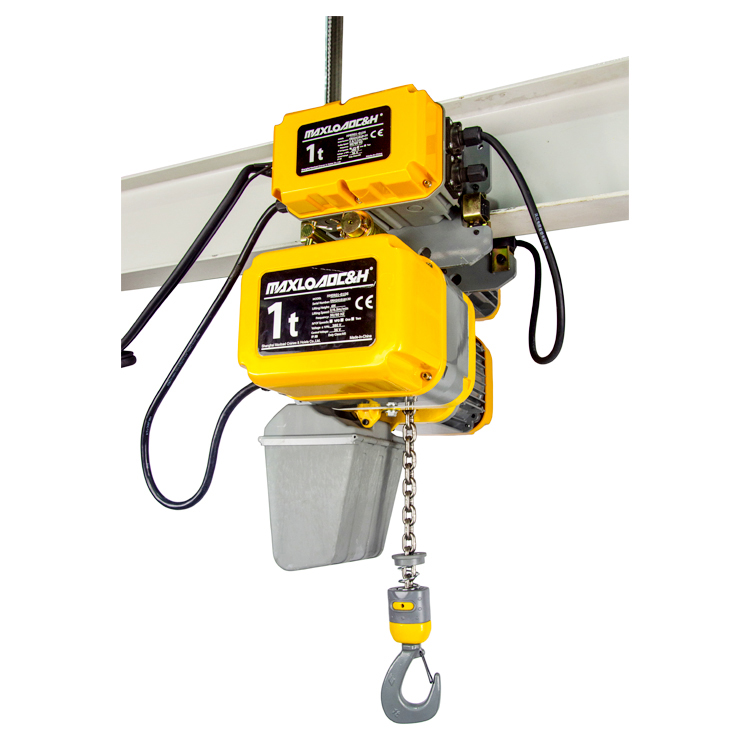
The core advantage of a chain hoist lies in the flexibility of the chain. Compared with wire rope, the chain has a much smaller bending radius, allowing the hoist body to be designed more compactly. Chain hoists have clear advantages in the following worksite environments:
Low-headroom worksites: Some factory buildings have dense overhead pipelines or limited floor height. When a standard hoist is installed, the lifting height of the hook is reduced. The reducer and chain container of a chain hoist are compact, and the overall hoist height is typically 15% to 25% lower than that of a wire rope hoist of the same capacity. When combined with a dedicated low-headroom trolley, it can maximize lifting height within limited space.
Multi-directional lifting worksites: A chain hoist, paired with a manual or electric trolley, can travel straight or in curves along an I-beam track. If a single hoist needs to cover multiple workstations, the chain of a chain hoist has better maneuverability on curved tracks and is less prone to angular wear compared to wire rope.
Portable maintenance worksites: Machine repair shops and equipment maintenance points often require hoists to be moved between different locations. Chain hoists are relatively light; two people can carry a 1-ton electric chain hoist. The chain is also easy to store and does not tangle or coil like wire rope. For worksites without fixed tracks that require temporary suspension, a chain hoist is more suitable.
Chain maintenance reminder: The chain of a chain hoist wears out. When the chain elongation exceeds 5% of the original length or the diameter wear of a chain link reaches 10%, the chain must be discarded. This inspection can be done with calipers and requires no specialized instruments. Many worksites overlook this, and chain breakage often occurs suddenly without the warning signs of wire rope breakage, such as broken wires.
Ⅱ. Wire Rope Hoist: First Choice for Heavy Loads, High Frequency, and High Lift Height
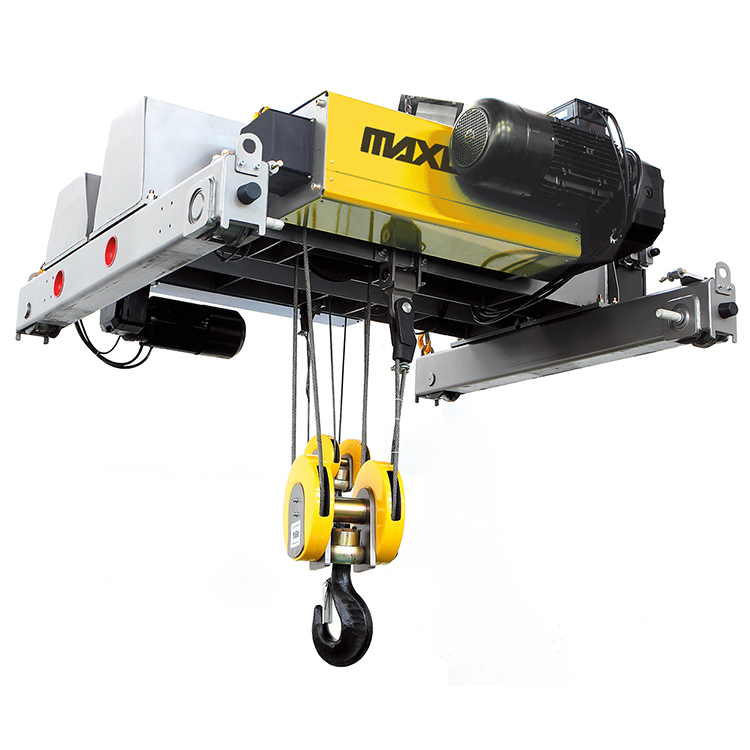
The core advantages of a wire rope hoist are the high tensile strength, wear resistance, and large drum storage capacity of the wire rope. In the following environments, wire rope hoists are more reliable than chain hoists:
High-lift-height worksites: When the lift height exceeds 9 meters, the chain of a chain hoist becomes very heavy, the chain bag is bulky, and the chain is prone to stacking and jamming during operation. The drum of a wire rope hoist can accommodate much longer wire rope, achieving lift heights of 30 meters or even 50 meters without issue. For vertical lifting in high-bay warehouses or multi-story factories, prioritize wire rope hoists.
Heavy-load and high-frequency worksites: Wire rope is constructed from many small steel wires twisted together, each strand sharing the load, resulting in better fatigue resistance than a chain. In heavy-load worksites with more than 150 operation cycles per day, the service life of the wire rope is significantly longer. Each link of a chain is a rigid stress point; repeated stretching can cause fatigue cracks at the link roots, which are difficult to see with the naked eye.
Dusty or sandy environments: Wire rope has surface grease that can trap dust to form a protective layer, and the rope is neatly layered on the drum, making it difficult for dust to penetrate. When a chain hoist's chain engages with the sprocket, dust and sand can be squeezed into the sprocket pockets, accelerating wear on both sprocket and chain. In foundries, cement plants, and sand/gravel handling stations, wire rope hoists are more durable.
Rope diameter and safety factor: Special attention: The safety factor for wire rope hoists is typically required to be at least 5 times. Do not use a thinner wire rope in pursuit of higher lifting speed. Inspect for broken wires before each use – if more than 10% of the wires are broken within one lay length, the rope must be replaced.
Ⅲ. Explosion-Proof Hoist: No Compromise in Hazardous Environments
In petrochemical plants, paint shops, flour mills, and dust-explosive areas, sparks or high temperatures generated by standard hoist motors, switches, and moving parts can ignite combustible gases or dust in the environment. Selecting an explosion-proof hoist is not a performance issue – it is a legal requirement.
Gas explosion-proof worksites: In areas with combustible gases such as methane, propane, or hydrogen, you need Ex d flameproof or Ex e increased safety explosion-proof hoists. The difference: Flameproof enclosures completely seal components that could produce sparks inside a housing that can withstand internal explosions without transmitting flames to the outside. Increased safety hoists prevent sparks and dangerous temperatures through additional measures. Selection is based on the gas classification (IIA, IIB, IIC) and temperature class (T1 to T6) at the site.
Dust explosion-proof worksites: Environments with combustible dusts such as aluminum/magnesium dust, flour, wood dust, or coal dust require Ex tD housing-protected explosion-proof hoists. The key factors for dust explosion-proof hoists are surface temperature control and dust-tight sealing. Aluminum and magnesium dust are particularly dangerous because even a thin layer of dust can spontaneously combust when damp. The maximum surface temperature of hoists in such worksites is typically limited to below 135°C.
Common misconceptions about explosion-proof hoists: The first misconception is that replacing only the motor with an explosion-proof one makes the whole hoist explosion-proof. In reality, friction between the chain or wire rope and the sprocket or drum during operation can also generate sparks. Genuine explosion-proof hoists use copper alloys or non-sparking materials for these contact components. The second misconception is neglecting the lifting limit switch. Standard limit switches are exposed; in hazardous areas, encapsulated or flameproof limit switches must be used. The third and most dangerous misconception: some people wrap a standard hoist in rubber or plastic and use it as explosion-proof – this does not provide any explosion protection and instead hinders heat dissipation.
Dangers of modification: Never modify a standard hoist for use in an explosion-proof worksite on your own. Explosion-proof certification is a complete hoist certification – changing even a bolt can compromise the flameproof gap. When purchasing, check the hoist's complete explosion-proof certificate and confirm that the explosion-proof marking matches the hazardous area classification of the site.
Ⅳ. Easily Overlooked Worksite Details
Trolley track matching: A properly selected hoist is useless if the track is unsuitable. A chain hoist can operate on tracks with a radius of curvature as small as 1 meter, while a wire rope hoist generally requires a radius greater than 2 meters. For worksites with many curves, chain hoists are more suitable.
Operating position: If operators need to stand directly under the load for extended periods, controlling the hoist, chain hoists typically come standard with low-voltage pendant controls, allowing unlimited operating distance. When a wire rope hoist's rope is wound in multiple layers on the drum, the lifting speed may be uneven, making inching control less precise than with a chain hoist.
Maintenance convenience: If a chain wears out, individual links can be replaced, resulting in lower maintenance costs. A worn wire rope must be replaced entirely, but the replacement is quick. For worksites with their own maintenance staff, choosing a chain hoist can save on spare parts costs. If relying on external maintenance services, wire rope hoists are more standardized and can be serviced faster.
Final Reminder
All the selection advice above assumes that the hoist itself is of good quality, properly installed, and regularly inspected. No matter how good the hoist, if it is used in the wrong worksite environment, or if the installation deviation from the worksite centerline exceeds the specified value, it will lead to eccentric wear and shortened life. The worksite environment is not static – reassess changes in operating conditions every six months: added dust, increased operation frequency, modified building height – any of these could make a previously suitable choice no longer optimal.
 0086 156 1824 5535
 0086 156 1824 5535