Workshop Environment Dictates Hoist Selection: Practical Trade-Offs
A maintenance veteran with twenty years on the shop floor knows one thing: no matter how impressive a hoist’s data sheet looks, if it doesn’t fit the workspace, it’s a pile of scrap. Over the years, I’ve seen countless procurement cases – buyers fixated on lifting capacity, only to find that a chain hoist can’t fit into a low-clearance bay, a wire rope hoist seizes up within three days in a dusty environment, or an explosion-proof hoist turns out to be only component-level protected and needs retrofitting on site. The bottom line is that selecting a hoist isn’t about picking parameters – it’s about matching the application.
Chain Hoist: Maximum Flexibility, but with Hard Limits
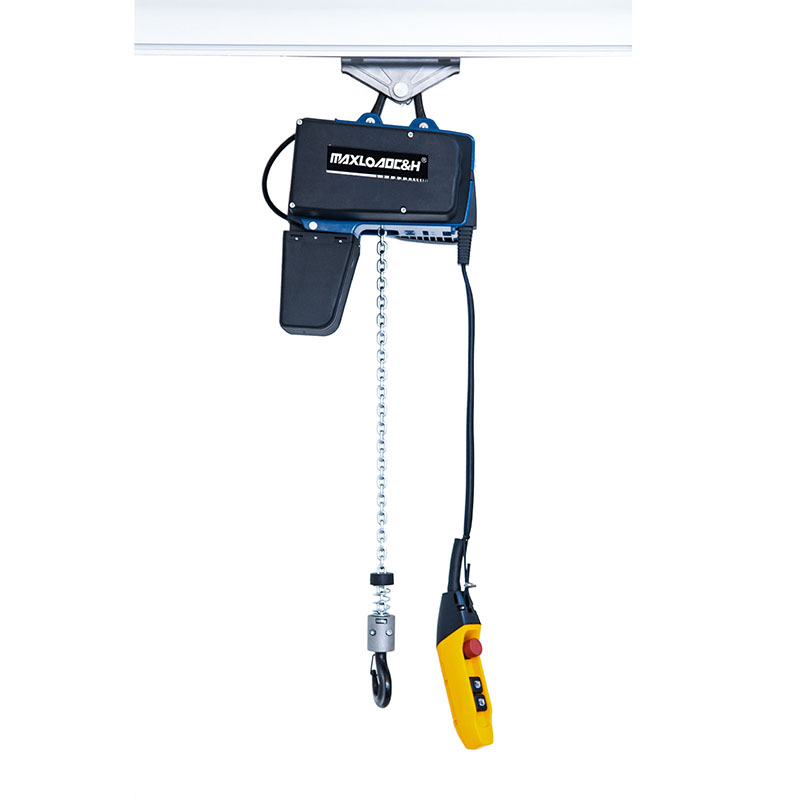
The biggest asset of a chain hoist is the chain itself. Compared to wire rope, chain has a much smaller bending radius, which means that for the same lift height, the overall headroom of a chain hoist can be significantly lower. For restricted-clearance workstations – such as inside containers, ship holds, or mezzanine platforms in low-ceiling workshops – a chain hoist is often the only solution.
But chains have their Achilles’ heel. Chain hoists generally operate at slower speeds, especially lifting speed, typically only 60–70% that of a wire rope hoist. If your application demands high-frequency, fast-paced lifting – for example, assembly line work with tight cycle times – a chain hoist may become a bottleneck. Moreover, chain wear is visible to the naked eye. Although maintenance is straightforward, in dusty or sandy environments, accelerated wear between chain links significantly shortens service life.
Which applications suit a chain hoist? Mobile lifting – especially scenarios where the hoist frequently moves between workstations via a push or motorized trolley. Chain hoists are lightweight, move briskly, and impose lower loads on the runway beam. Also, for applications requiring inclined lifting, chain handles angular pull and side-pull much better than wire rope.
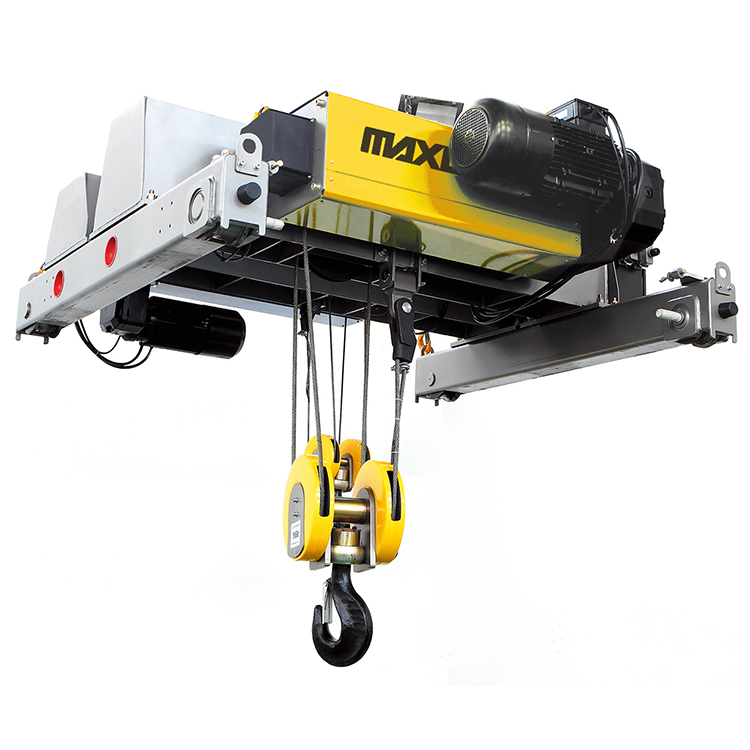
Wire Rope Hoist: The Workhorse for Heavy-Duty, Long-Cycle Operations
The advantages of a wire rope hoist are straightforward – it can take a beating. For the same rated load, wire rope hoists offer higher lifting speeds, higher duty classifications, and can withstand more intensive work cycles. If your workstation has high lifting frequency, heavy single lifts, and long continuous operation, a wire rope hoist is the inevitable choice.
However, wire rope hoists have a large space footprint. The presence of a drum makes the overall headroom significantly higher than that of a chain hoist, making them generally unsuitable for low-clearance applications. More troublesome are the inherent characteristics of wire rope: it is prone to uneven spooling, slack, and excessive fleet angles. Many poorly designed workstations cause the rope to wind irregularly on the drum, requiring replacement within months. Wire rope is also vulnerable to corrosive and high-temperature environments – acid mist, moisture, and molten metal splash are its natural enemies.
The true domain of a wire rope hoist is fixed, heavy-duty workstations – such as lifting on mechanical assembly lines, mold changes, or heavy part loading/unloading. These workstations are characterized by relatively fixed lifting points, predictable travel paths, and high duty cycle requirements. Under such conditions, the heat dissipation and fatigue resistance of wire rope hoists shine.
Explosion-Proof Hoist: Don’t Gamble with Safety
Selecting an explosion-proof hoist is where buyers are most easily misled. Many assume that buying an “explosion-proof” hoist covers all bases. In reality, explosion-proof hoists come in multiple levels and categories – IIA, IIB, and IIC are designed for very different environments, and temperature classes T1 through T6 correspond to widely varying ignition temperatures.
The first step in selecting an explosion-proof hoist is not looking at the hoist, but analyzing what is actually present in the workspace. The explosion-protection requirements for gasoline vapor versus hydrogen dust differ by two full levels. A common mistake: the workspace contains aluminum or magnesium dust, yet the user buys a gas-explosion-proof hoist. Dust explosion protection and gas explosion protection use different housing structures and sealing methods – getting it wrong means no real protection.
Another heavily overlooked point: the difference between a complete hoist that is integrally explosion-proof versus one that only has explosion-proof components. Some so-called explosion-proof hoists only treat the motor and electrical parts, while the mechanical components – such as the chain or wire rope and the hook friction points – have no explosion protection whatsoever. In a truly hazardous workspace, the spark from the hook striking the load’s lifting lug, the friction spark between chain links, or the arcing of limit switch contacts – each is a potential ignition source. A fully integrally explosion-proof hoist covers these areas with copper-alloy cladding, non-sparking coatings, or special limit switch designs.
The workspace adaptability of explosion-proof hoists also carries a hidden cost: explosion-proof motors are generally larger and have higher heat dissipation requirements than standard motors, meaning the overall hoist dimensions and weight increase. In low-clearance or narrow-aisle workstations, this difference can be fatal – you might squeeze the explosion-proof hoist in, but the hook’s upper limit height is compromised, eating up a large portion of the lifting travel.
Practical Selection Logic for Three Typical Environments
Dense, Low-Clearance Workstations: Chain hoist is the first choice – the bending flexibility of the chain is a physical advantage. If an explosion-proof rating is also required, choose a chain-type explosion-proof hoist, making sure the chain surface has a non-sparking treatment. Wire rope hoists are largely ruled out unless you are willing to invest in expensive inverted mounting or special drum configurations.
Heavy-Duty, Long-Cycle Workstations: Wire rope hoist wins. Duty class can reach M5 or even M6, while chain hoists typically top out at M4. However, check whether the workstation is damp or dusty – if yes, the wire rope hoist will need additional protective covers and automatic lubrication devices.
Chemical, Paint Spray, or Dusty Environments: An explosion-proof hoist is a mandatory requirement – no room for negotiation. Determine the explosion-proof rating first, then choose the hoist type. Paint booths often contain solvent vapors, typically requiring IIB or IIC, T4 or higher. For dust environments, distinguish between conductive and non‑conductive dust – conductive dust demands higher ingress protection (IP) ratings. In terms of hoist type, a chain-type explosion-proof hoist is recommended – the friction risk of the chain is theoretically lower than the sliding friction of a wire rope drum, provided the chain is treated for non-sparking.
In the end, hoist selection is all about matching the workspace.
The best hoist is not necessarily the most expensive – it’s the one that best fits your operating conditions. Before starting the selection process, honestly lay out five indicators: available headroom, working frequency, single lift weight, environmental agents, and explosion-proof rating. Take that checklist and then compare hoist lifting speed, duty class, overall dimensions, explosion-proof marking, and chain/wire rope specifications. Spending more time measuring the actual workspace on site is far more useful than flipping through a dozen catalogues.
 0086 156 1824 5535
 0086 156 1824 5535