KBK Crane and Electric Hoist Selection Guide
Walk into any machining workshop, assembly line, or storage area, and you’ll quickly realize one basic truth: no two workstations have the same lifting needs. Some have dense overhead piping, some have crowded floor equipment, some require frequent lifting of precision parts, and others operate in humid or dusty environments. For this reason, buying a standard KBK crane package often fails to solve actual site problems—and may even create new ones.
The combination of a KBK crane and an electric hoist is essentially a flexible material handling system. Its strengths lie in modular design and adjustability, but that also means selection cannot be based solely on rated load capacity and span. What truly determines whether the system performs well is the actual conditions of the workstation. Below, we break down key dimensions to help you make the most suitable match based on your site conditions.
Space constraints determine rail layout and hoist selection
The height above the workstation is the first data point to measure. In many older plants, the clear height under the crane girder is only about 3 meters. If you follow a standard solution—single-rail KBK plus an electric hoist—the hoist’s own height plus the lower limit of the hook often severely reduces lifting travel, leaving operators feeling the hook “can’t reach.” In such cases, you should choose a low-headroom electric hoist combined with a flat-beam KBK rail. By altering the hoisting mechanism layout—offsetting the motor from the drum—a low‑headroom hoist can save 200 to 300 mm of height compared to a standard hoist of the same capacity. Do not underestimate that difference; in practice, it determines whether workers have to bend over or stand on tiptoe to hook or unhook a load, and whether workpieces can be accurately placed on the second shelf of a low rack.
The floor plan shape also affects rail routing. L‑shaped or U‑shaped workstations require curved rails and turntables. In such cases, the bending radius of the KBK rail must match the travel wheels of the hoist. Some sites are forced to use small‑radius curves to accommodate existing columns. If you then choose a double‑wheel hoist with a long wheelbase, you risk jamming, rail‑gnawing, or even derailment at the curve. The correct approach is to first determine the curve radius, then work backwards to select the hoist’s wheel spacing and model—rather than forcing a mismatch.
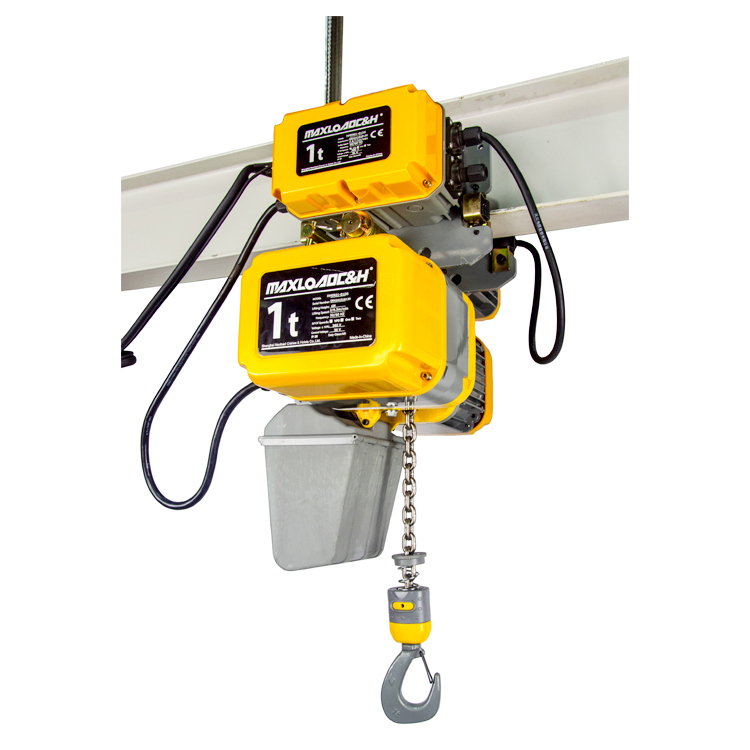
Lifting frequency and speed determine the hoist duty class
One easily overlooked fact: electric hoists also come with different duty ratings. Many users only look at lifting capacity—buying a 2‑ton hoist for a line that makes more than 300 lifts per day, only to have the motor burn out from overheating within six months, accompanied by pitting on the gear teeth. This is not a quality problem; it’s a failure to consider the duty class.
To determine the correct duty class, you need to count the number of full‑load lifts per shift, the average lifting height, and the travel distance. For example, a KBK workstation on an auto parts assembly line lifts a complete assembly every two minutes, accumulating over 200 lifts per day. This requires at least an M5 or even M6 class hoist with a variable frequency drive to reduce start/stop impacts. In contrast, a KBK in a die repair shop may be used only a few hundred times a year—an M3 class hoist with a single‑speed motor is perfectly adequate; spending more on a high‑spec unit would be wasteful.
Lifting speed must also match the application. Precision assembly work requires slow, micro‑movements—preferably hook movement of just a few millimeters per button press. That calls for a two‑speed or variable frequency hoist with a sufficiently large gear reduction ratio. At a cutoff station, workers want the empty hook to move up and down quickly to save time. In that case, the fast speed of a two‑speed hoist should be at least 8 m/min. If a single KBK rail must serve both needs, consider installing two separate hoists or a single hoist with two‑speed switching.
Environmental factors directly rewrite the configuration list
Standard KBK rails and electric hoists are designed for normal indoor environments, but real‑world workstations are often far from “standard.” Foundries and grinding stations are filled with conductive dust. Once this dust enters the hoist’s motor fan cover or control box, it can cause short circuits or contact sticking. The solution is not simply adding protective covers; you need motors and electrical components with at least IP55 or IP65 protection, plus denser sealing brushes on the rail to prevent dust from falling in through the gap between the hoist wheels and the rail.
Corrosive environments—such as electroplating shops or areas near pickling lines—quickly degrade standard galvanized KBK rails and carbon steel hoists. Even with daily wiping, the rail web and bottom flange of the I‑beam will rust within months, posing a fracture risk if used further. Full stainless‑steel rails and aluminum alloy hoists solve the problem, but at high cost. A compromise is to use stainless‑steel rails only in the most corrosive sections, with heavy‑duty anti‑corrosion coating on the carbon steel rail elsewhere, while also using stainless steel for the hoist housing, hook, and wire rope.
Operation mode must match worker habits and safety requirements
The KBK‑hoist combination is ultimately operated by people. How it is operated directly affects productivity and safety. A pendant push‑button station is the most common form, but pay attention to cable length and suspension points. A cable that is too short prevents the worker from reaching far racks; one that is too long drags on the floor, risking forklift crushing or being trapped under workpieces. It is advisable to install a nylon cable carrier or a spring‑driven cable reel on the KBK rail to take up excess cable. Radio remote control is increasingly popular—clean and convenient—but you must check whether wireless signals are blocked by strong on‑site interference from welding equipment or variable‑frequency drives. There have been many cases where, during an emergency, the remote signal failed and the operator had to run to pull the emergency stop cord. In such workstations, a wired pendant should be kept as a backup.
A fixed control station suits large KBK systems, integrating control functions on a panel next to the workstation, eliminating the need for workers to carry a pendant. However, this requires a suitable layout: the control station must be within the worker’s line of sight and within easy reach of the emergency stop. Another scenario involves workers walking alongside the hook—for example, along a long rail moving long workpieces. In this case, a follow‑the‑operator mode works best: the pendant is attached to the side of the rail via a trolley, so as the worker pushes the hook, the pendant moves with it, eliminating the need to constantly pick up a trailing cable.
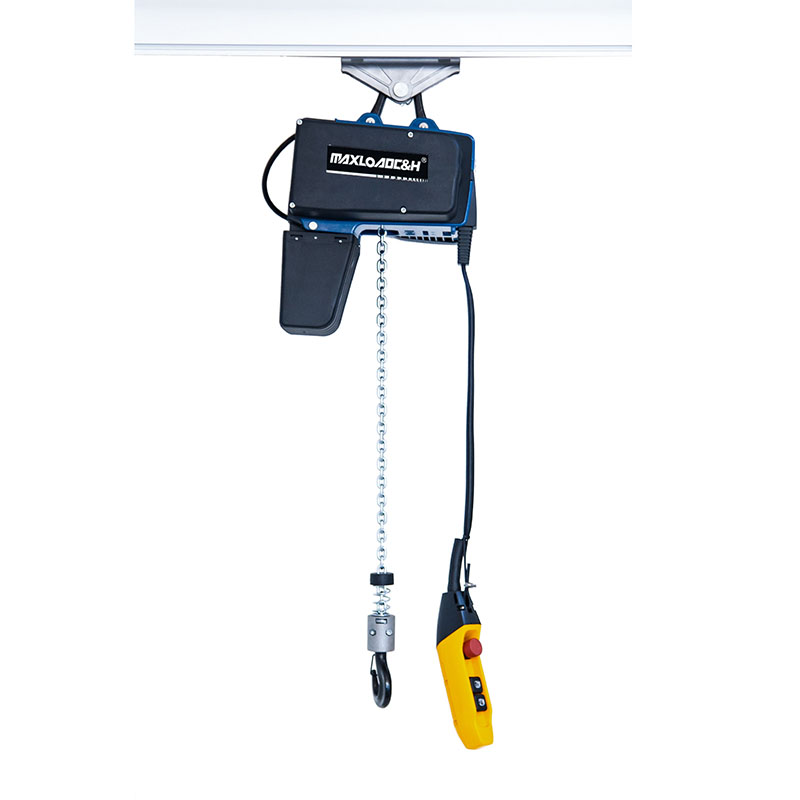
Load characteristics affect hoist mechanism selection
What you are lifting—its shape, material, and whether it has designated lifting points—often matters more than the rated capacity. For bulk materials or workpieces with flexible slings, a standard hook‑and‑wire‑rope hoist suffices. But if the workpiece is a precision machine tool component or a die that is sensitive to levelness and shock, you need a chain hoist combined with a rigid spreader bar. Chain is less flexible than wire rope, but precisely because of that, the load swings less during lifting, providing more accurate positioning. In some cases, an anti‑sway device or dual‑point lifting must be added between the hoist and the hook.
Long workpieces—such as steel sections, pipes, or door frames—naturally tilt when lifted from a single point, requiring workers to steady them by hand for alignment. Such workstations should use a dual‑point electric hoist or two single hoists working in tandem, synchronising the two lifting points via parallel KBK rails. However, this adds electrical complexity: the lifting motors of the two hoists must be synchronised—otherwise one faster and one slower will twist the workpiece. If the budget allows, consider electronic synchronising controllers or a mechanical synchronising shaft.
Hot workpieces—e.g., just after heat treatment—cannot be lifted with ordinary wire rope, because the heat destroys the rope’s lubrication and strength. In such cases, the wire rope needs a special heat‑resistant coating, or be replaced entirely with a heat‑resistant chain. At the same time, the hoist’s limit switches and rope guides must be changed to heat‑resistant versions; ordinary plastic parts quickly deform and fail under thermal radiation.
Conclusion
Selecting a KBK crane and electric hoist combination may seem straightforward, but achieving smooth, long‑lasting performance depends on a thorough investigation of the workstation environment during the selection phase. From spatial dimensions to lifting frequency, from ambient temperature to load characteristics, every detail determines the final configuration. Do not be misled by the word “modular”—modularity offers flexibility in adjustment, not a ready‑to‑use template. Take the time to clarify your site conditions, then work backwards to define the technical parameters. Only then will the system become a tool that improves efficiency, rather than a source of endless future trouble.
 0086 156 1824 5535
 0086 156 1824 5535