Choosing the Most Suitable Jib Crane Based on Your Workstation Environment
In many factory workshops, the combination of a jib crane and an electric hoist is one of the most common material handling solutions. The reason for its popularity is simple: it solves the problem of frequent lifting and moving tasks around a fixed workstation while occupying minimal floor space. With a jib crane and the right electric hoist, a single operator can easily handle workpieces weighing from several tens of kilograms to several tons for tasks such as transport, loading/unloading, and positioning.
But when it comes to actual selection, problems often arise. Many purchasers or workshop supervisors simply copy what another factory has bought, only to find that the jib arm bumps into obstacles, the hoist lifting speed is inappropriate, or worse, after six months, the column foundation loosens, or the arm deforms. The root cause of these issues is a failure to carefully analyse their own workstation environment.
First, Understand the Four Key Elements of Your Workstation
Before deciding which jib crane to buy, you must fully understand your workstation conditions. The first thing to look at is the shape and dimensions of the space. The ceiling height of the workshop directly determines whether you choose a floor-mounted column type or a wall-mounted bracket type. For ceilings lower than 3.5 meters, installing a standard floor-mounted jib crane will severely limit the hook travel — the load will barely lift off the ground before the hoist hits the jib arm. Conversely, in a workshop with a very high ceiling, if the chosen jib crane’s lifting height is insufficient, the operator will have to stand on tiptoes or even climb a ladder to attach the rigging, which is both dangerous and inefficient.
Second, consider the lifting frequency and single lifting weight. Lifting ten times a day versus ten times per hour results in completely different wear and tear on the equipment. Some workstations may only need to lift 200 kg, but if that is repeated 200–300 times per day, the fatigue damage to the slewing mechanism and the hoist is more severe than lifting one ton just a few times a day.
Third, the working radius requirement. The jib arm length determines the coverage area. Some workstations need to cover three or four operating points along a production line. If the arm is too short, workers will have to frequently push the jib or move the workpiece, reducing efficiency. However, longer is not always better — doubling the arm length increases the bending moment at the arm root by far more than double, leading to a geometric rise in strength requirements for the column and foundation.
Fourth, environmental conditions. Dust in foundries, corrosive gases in electroplating shops, low temperatures in cold storage, and sun/rain exposure in outdoor areas — these factors directly determine material selection and protection ratings. A standard coated jib crane will rust and seize within months in an acid-mist environment, and a standard electric hoist will have brittle plastic parts and solidified lubricating oil at sub-zero temperatures.
Types of Jib Cranes and Suitable Applications
The mainstream jib cranes on the market can be divided into three types based on mounting method: column-mounted, wall-mounted, and portable (mobile). Based on arm structure, they can be divided into fixed-column and slewing types.
The column-mounted jib crane is the most common. A column is fixed to the ground, and the arm rotates around the column. This structure is stable, has good load capacity, and is widely applicable. However, if there are underground pipelines exactly where the column needs to go, or if the ground hardening layer is too thin, making a foundation becomes troublesome. Foundation work involves digging, pouring concrete, embedding anchor bolts, and at least a week of curing time — many factories cannot wait that long due to tight schedules.
The wall-mounted jib crane is installed on the workshop’s load-bearing wall or steel column, leaving the floor completely unobstructed. This is an excellent solution for workstations with tight floor space but good wall conditions. The prerequisite is that the wall or steel column must have sufficient load capacity and stiffness. In some workshops, walls are merely enclosure structures, not load-bearing — if you mount a jib crane on such a wall, the entire wall will shake when lifting heavy loads.
The portable (mobile) jib crane has wheels on its base and can be pushed around. This offers high flexibility, suitable for multiple workstations sharing one crane or for applications where the lifting point is not fixed. The downside is that the base must be very heavy to maintain stability, making it not easy to push, and the lifting capacity generally does not exceed one ton.
Regarding arm structure, there are also fixed-column and column-slewing types. In the fixed-column type, the column stays still while the arm rotates via a slewing bearing at the top of the column. In the column-slewing type, the entire column rotates together with the arm. The former is more complex but rotates smoothly; the latter is simpler but requires a larger slewing support at the column base.
Key Points for Selecting the Electric Hoist
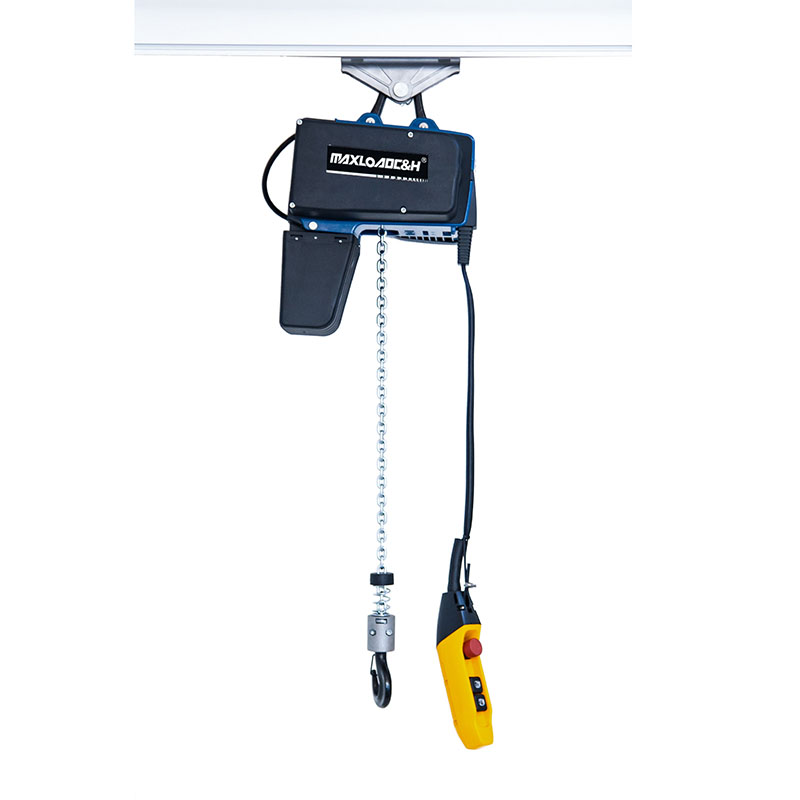
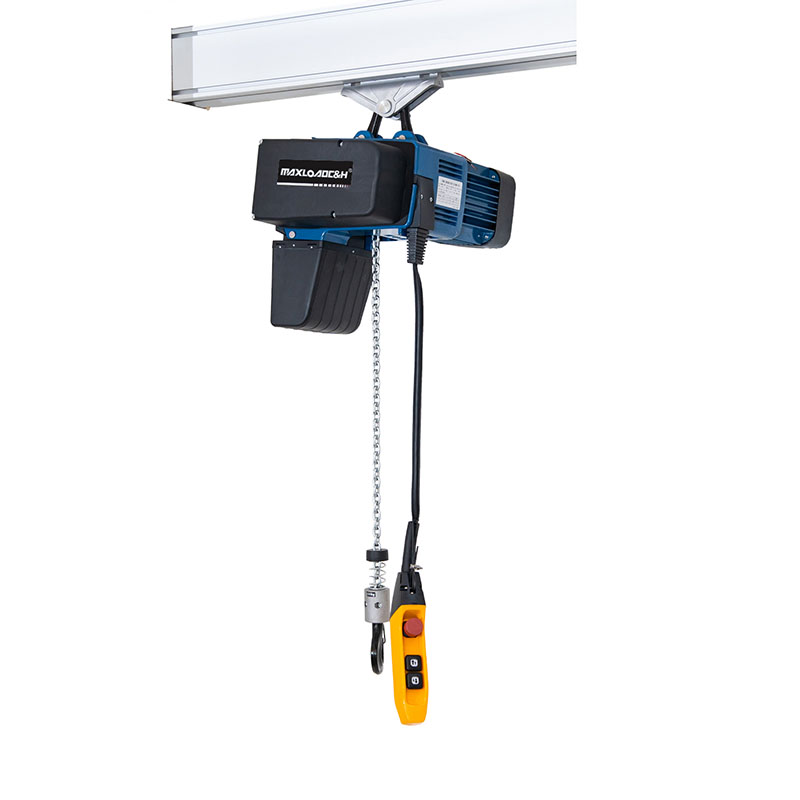
Once the jib crane is chosen, matching the electric hoist is equally critical. Common electric hoists come in two types: chain hoists and wire rope hoists. Chain hoists are compact, lightweight, and ideal for small capacities. Moreover, the chain hangs down a shorter length from the jib arm than the wire rope, giving a clear advantage in low-headroom workstations. Wire rope hoists offer faster lifting speeds and higher duty cycles, suitable for heavy loads and frequent operation.
The most easily overlooked factor when selecting a hoist is the match between lifting speed and travel speed. Some jib crane configurations come with a hoist lifting speed of only two meters per minute — it would take a full minute to lift a load up and down. Workers may become impatient and overload or yank the equipment, creating serious safety hazards. Conversely, too fast is also problematic: fine positioning during precision assembly becomes difficult, and the hook swings around, making alignment hard.
The choice between a trolley-mounted hoist and a fixed hoist is also frequently confused. A fixed hoist hangs directly at the end of the jib arm — simple structure, lower cost, but it can only lift points directly under the arm end, limiting coverage. A trolley-mounted hoist can move left and right along the jib arm’s track, greatly expanding coverage. Many workstations that clearly need a trolley-mounted hoist end up with a fixed one, making operation extremely awkward.
In terms of control, the pendant control station is the most common. If the cord is long enough, it offers flexible operation. For workstations requiring fine positioning, a wireless remote control can be considered, allowing the operator to stand in the best observation position. However, remote controls are prone to being dropped, damaged, or running out of battery in a workshop environment — they are not suitable for every situation.
Important Details When Combining Jib Crane and Hoist
When combining a jib crane and an electric hoist, several issues are particularly prone to problems.
The smoothness of the slewing mechanism depends on many factors. The jib crane’s slewing bearing requires regular lubrication, but in dusty workshops, grease attracts dust and turns into an abrasive paste, accelerating wear. Some factories solve this by adding a dust cover to the slewing bearing — very effective. Additionally, if the electric hoist’s power cable is routed along the jib arm, the cable will be pulled during slewing. This must be addressed with a slip ring or by leaving sufficient slack and protective measures.
The stiffness of the jib arm directly affects the operating feel. Some jib cranes use small-profile beams to reduce cost. With no load, they look fine, but when a rated load is applied, the arm sags noticeably and moves in fits and starts during slewing. Under such conditions, workers cannot position accurately and have to push forcibly, creating a vicious cycle.
Safety devices should never be omitted. Overload limiters are often treated as optional in many factories, but with jib cranes, the forces on the column and foundation vary dramatically with different load radii. Lifting rated load at the arm root versus at the arm tip imposes completely different demands on the equipment. Without an overload limiter, operators can easily overload the arm tip without realising it.
Guiding Principles for Decision-Making
Returning to the fundamental question of selection, several principles can help you avoid common pitfalls.
Don’t look only at the rated lifting capacity. Rated capacity is measured under optimal conditions. In actual use, factors such as load size and shape, rigging weight, and lifting angle must be considered. Choosing a larger capacity than needed is generally safer, but you cannot blindly oversize because the equipment weight and cost will increase accordingly.
Allow some margin, but not too much. Too much margin makes the equipment heavy, expensive, and inconvenient to operate.
Treat installation conditions as equally important as the equipment itself. Many jib crane problems arise not from poor equipment quality, but from inadequate foundations, unlevel installation, or loose anchor bolts. If installing a column-mounted jib crane on a thin hardened floor layer, it is better to spend extra on a thick steel base plate to distribute the pressure rather than risking direct placement on weak flooring.
Ease of operation often matters more than parameter specifications. Whether a jib crane feels convenient for workers directly determines whether it will be used or misused — or simply left idle. Details such as smooth slewing, proper hook height, and easy-to-press control buttons should be thought through during the selection phase.
Combining a jib crane and an electric hoist is not a highly sophisticated technology, but it is indeed an equipment selection task that requires serious attention to the workstation environment. By thoroughly sorting out the space conditions, load characteristics, usage frequency, and environmental factors, and then selecting the appropriate type and specifications accordingly, you can turn this equipment into a truly effective tool at your workstation — rather than a nuisance that feels awkward without being clearly identifiable as wrong.
 0086 156 1824 5535
 0086 156 1824 5535