KBK Systems and Electric Hoist Applications
In manufacturing workshops, the choice of material handling equipment directly affects production rhythm and worker physical workload. When purchasing, many companies tend to ask directly, "What size do I need?" In reality, however, the most suitable crane is not determined by tonnage alone, but by how well it matches your specific workstation environment. The combination of KBK light crane systems and electric hoists has become increasingly common in workstation-level handling scenarios in recent years. Yet improper selection can lead to equipment sitting idle or even create safety hazards—cases of which are not rare. This article provides a practical selection logic based on actual workstation conditions.
Four Dimensions for Evaluating the Workstation Environment
Before selecting equipment, first get a clear picture of the workstation environment. The following four dimensions are essential baseline information:
Load characteristics.
This is not about "average weight" but about "the heaviest single piece." For example, if most workpieces in the workshop weigh 200 kg but occasionally a 500 kg casting needs to be lifted, the load rating must be based on 500 kg, plus a safety margin. Industry practice is to select the rated lifting capacity by multiplying the maximum single-piece weight by a factor of 1.1 to 1.25.
Space conditions.
Ceiling height is the first threshold. KBK systems are suspended and must satisfy the formula: lifting height + hoist body height + top installation/service clearance. For example, an electric chain hoist with a 3 m lifting height has a body height of approximately 0.8–1.2 m, and about 0.5 m of service clearance should be reserved above it, so the indoor clear ceiling height needs to be at least 4.5 m. For workshops with insufficient ceiling height, low‑headroom solutions can be considered. Regarding span, measure the width of the area to be covered; larger spans demand higher track rigidity.
Operating frequency.
A few lifts per shift versus hundreds of lifts per shift impose completely different requirements on the equipment. A maintenance workstation used only occasionally and a production line running six to eight hours continuously each day call for vastly different duty classes for the electric hoist. Duty classes range from M3 to M8—the higher the frequency and load factor, the higher the duty class required.
Environmental special conditions.
This factor is often overlooked, yet it is where problems most frequently occur. Workshops with high dust levels require hoists with sealed housings to prevent debris ingress; cleanrooms need dust‑proof designs and easy‑to‑clean surface finishes; high‑temperature or corrosive environments demand heat‑resistant materials and anti‑corrosion coatings; and areas with explosion‑proof requirements must be equipped with corresponding explosion‑proof ratings.
How to Determine the Three Core Parameters
Once the workstation environment is understood, move on to the parameter‑setting phase. Lifting capacity, span, and headroom are the three unavoidable core parameters.
Lifting capacity follows the principle of "maximum load + safety margin." The rated lifting capacity should be 15% to 20% higher than the heaviest workpiece. If loads frequently approach the rated value, it is advisable to choose the next higher capacity grade directly, because overloading accelerates wear on track wheel assemblies.
Span refers to the centre‑to‑centre distance between two rails or columns. The larger the span, the greater the deflection of the track under load. Spans of 3–5 m suit narrow single‑station layouts; 5–7 m can cover two workstations side by side; and 7–10 m require reinforced tracks with intermediate supports. When the span exceeds 6 m, special attention must be paid to whether the track specification needs to be upgraded.
Headroom is the vertical distance from the bottom of the track to the floor (or to the top of obstructions). In calculations, ensure at least 200 mm of safety clearance between the lowest point of the lifting attachment and any obstacle below. Workshops with ceiling heights below 4 m are considered confined spaces—low‑headroom solutions with rigid main beams and aluminium end beams can be considered; standard workshops with heights of 4–6 m can use conventional suspended systems.
Rigid Track vs. Flexible Track
This is a decision that is easily overlooked but has a significant impact. The core difference between rigid KBK and flexible KBK lies in the track connection method and load‑bearing structure.
Rigid KBK uses bolted rigid connections; the track, hangers, main beam, and end beams form a closed rigid frame with no relative displacement. Its advantages are high load capacity (up to 3 t), high positioning accuracy (up to ±2 mm), and no swaying under heavy loads. The downside is that it is essentially non‑adjustable after installation, making it suitable for long‑term fixed heavy‑load workstations.
Flexible KBK uses universal articulated joints, allowing a certain angular swing and adjustment between tracks. Its advantages are layout flexibility—it can accommodate curved tracks and ring tracks—low push‑pull force (only 2–4 kg of thrust for a 500 kg load), and easy disassembly and reconfiguration. Its disadvantages are lower load capacity (typically no more than 500 kg to 2 t) and centimetre‑level positioning accuracy.
How to choose? In short: for heavy loads, high precision, and fixed workstations, choose rigid; for light loads, multiple workstations, and frequently changing production lines, choose flexible. If in doubt, look at what peers do—machine shops lifting dies and chucks with large load fluctuations and requiring precise alignment typically opt for rigid KBK; electronic component assembly, food and pharmaceutical sorting, and other light‑load, high‑variability scenarios are better served by flexible KBK.
Matching Logic for Electric Hoists
Once the track is selected, the next step is the electric hoist. Here are key points to consider:
Hoist type.
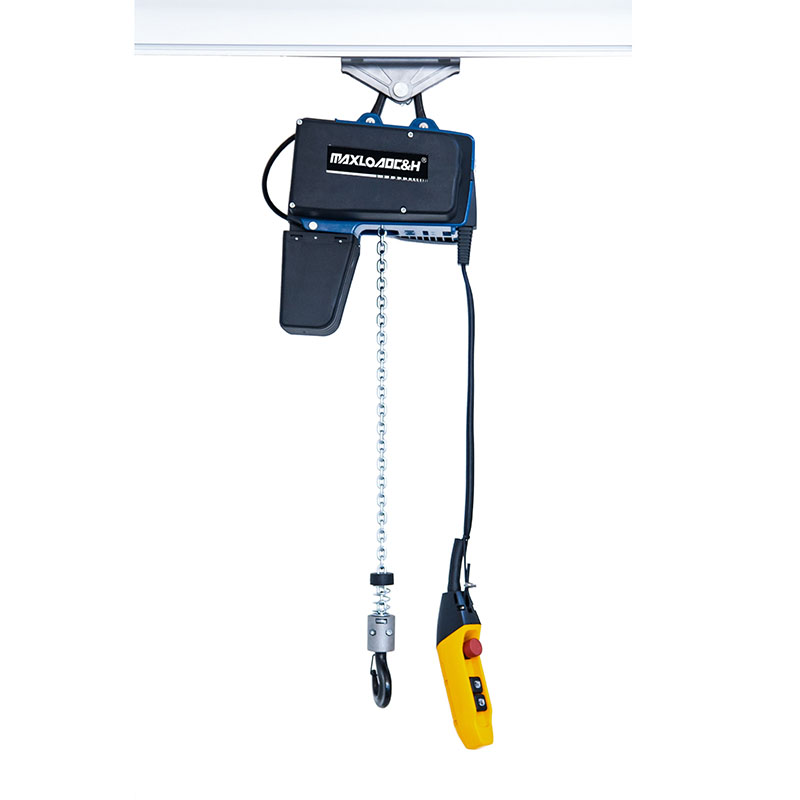
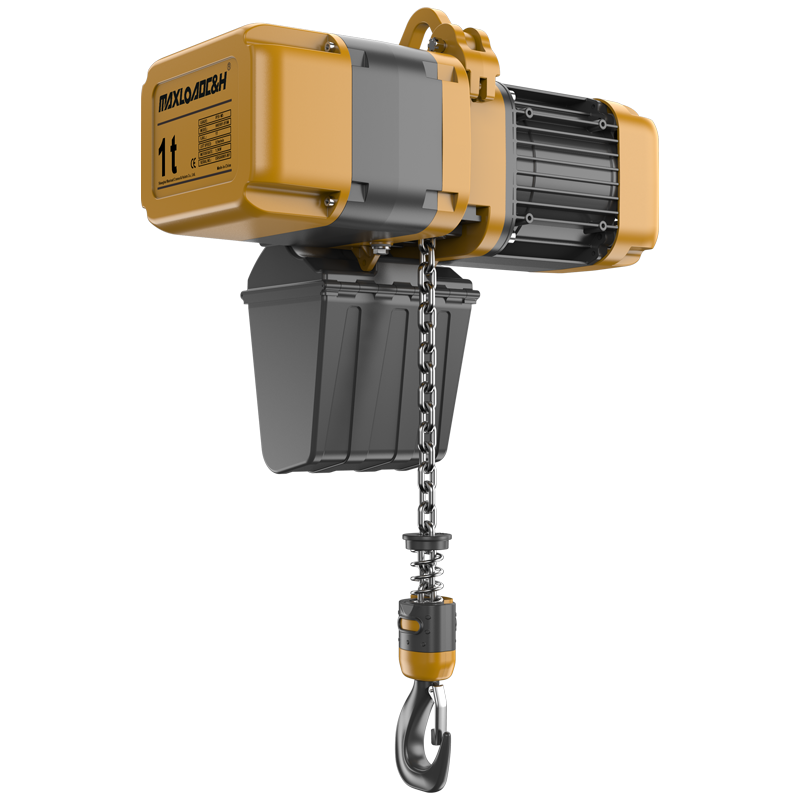
Fixed hoists can only lift at a single point, suitable for a single workstation; travelling hoists can move along the track, covering multiple workstations. Most KBK configurations use travelling chain electric hoists.
Speed control.
Single‑speed hoists have only one lifting speed—fine for general handling, but problematic when precise positioning is needed: pressing the button gives a jerky movement, and releasing it may cause slight drift. Two‑speed hoists include a slow speed, and when combined with a variable‑frequency drive, they can achieve millimetre‑level inching. If the workstation requires accurately placing workpieces into locating pins or mould closing, a two‑speed is a must.
Control method.
A hand‑held pendant is the most basic option; a wireless remote control suits applications with large operating ranges and the need for flexible manoeuvring. If the workshop is already automated, also confirm whether the hoist supports PLC integration and industrial communication protocols.
On‑Site Verification Before Installation
Once parameters are set and equipment selected, do not rush to place the order. There is one final step: on‑site verification.
Check the roof load‑bearing capacity.
KBK systems are suspended from roof steel beams, so verify that the beams can support the load. A 1‑tonne KBK system imposes a static load of approximately 0.3 to 0.5 tonnes per metre of span. If the bearing capacity is insufficient, additional reinforcement supports must be installed in advance.
Identify spatial obstructions.
Are there ventilation ducts, lighting cable trays, or compressed air lines above the track path? All these must be marked on the installation drawings in advance. Discovering obstructions during installation incurs high rework costs.
Reserve safety clearances.
Maintain a safety clearance of at least 1 m between the working area and pedestrian walkways or other production equipment. Floor load‑bearing capacity should also be confirmed; the working area floor is recommended to withstand no less than 2 tonnes per square metre.
The KBK crane plus electric hoist combination is complex to select—it requires balancing load, space, frequency, environment, rigid/flexible track, hoist configuration, and many other variables. Yet it is also simple: clarify the actual conditions of your workstation environment, then follow the logical sequence of "load determines capacity, space determines span, frequency determines duty class, and environment determines protection"—and the answer will emerge naturally. The greatest risk is making decisions by guesswork or blindly copying someone else's specification sheet. Every workshop has a different layout, material characteristics, and operating rhythm; the most suitable solution for you will always grow from the reality of your own workstation environment.
 0086 156 1824 5535
 0086 156 1824 5535