The Underlying Logic of Electric Hoist Selection
A common mistake made by equipment specifiers is starting with "How much does a 5-ton hoist cost?" Tonnage is certainly important, but it is far from the only deciding factor. Working environment, frequency of use, spatial constraints, special requirements—these variables, taken together, truly define the "most suitable" equipment. Electric hoists are not highly sophisticated technology, but the wrong choice can lead to inefficiency at best and safety hazards at worst.
I. Chain or Wire Rope? This Is Not a Choice, but a Judgment
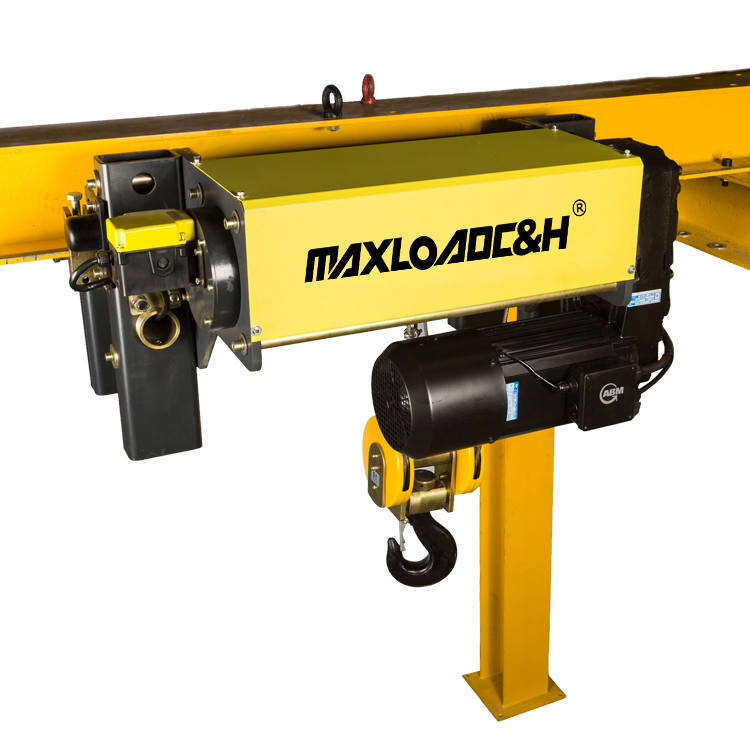
Electric hoists on the market are broadly divided into two categories based on the lifting mechanism: chain electric hoists and wire rope electric hoists. The core difference lies not in appearance, but in the load-bearing components and structural logic.
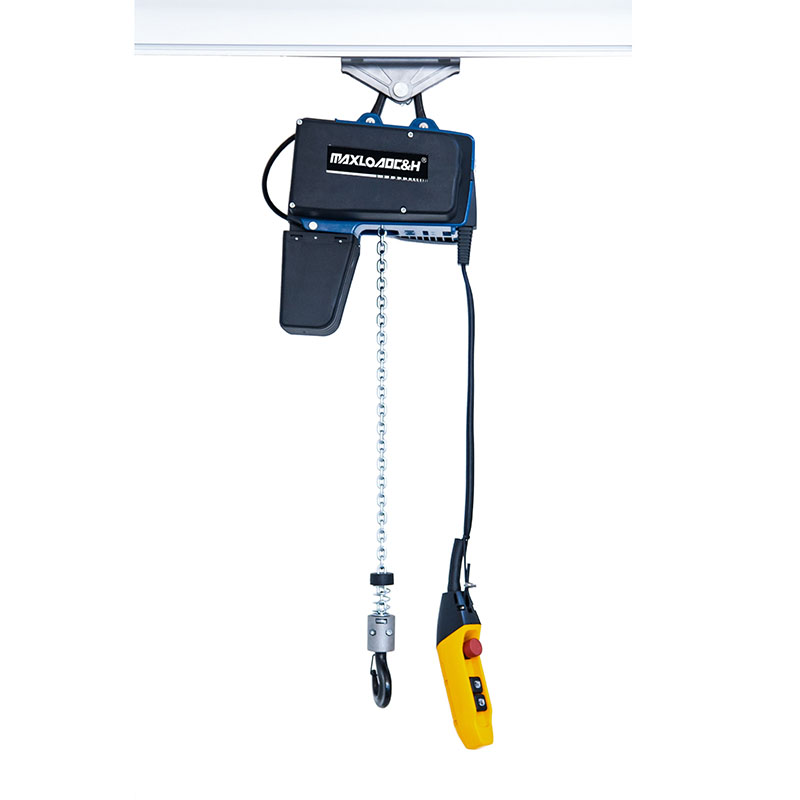
Chain hoists use an endless chain with sprocket engagement. Their dimensional advantage is very obvious—for the same tonnage, a chain hoist is significantly smaller in volume than a wire rope hoist. The reason is simple: wire rope must be wound onto a drum, and the higher the lift height, the longer the drum becomes; chain is folded and stored in a chain box, so changes in lift height have little effect on overall volume. Therefore, if the workshop has limited headroom and you want to achieve a relatively large effective lifting height, a chain hoist is often the more reasonable choice.
However, chain hoists have a load capacity limit. An industry rule of thumb is that chain hoists are commonly used below 5 tons; above 5 tons, wire rope hoists are generally preferred. This is not to say that chain hoists cannot handle larger loads, but from a structural strength and reliability standpoint, wire rope offers greater advantages under heavy loads.
Wire rope hoists typically offer faster lifting speeds and smoother operation, making them suitable for high-frequency duty cycles. But they have a "slack rope" issue—the wire rope may become tangled when unwinding from the drum, requiring additional rope-guiding mechanisms. Chain hoists do not have this problem, and their structure is simpler.
Another detail often overlooked is hook positioning accuracy. During lifting on a wire rope hoist, the wire rope winds axially along the drum, causing lateral displacement. The higher the lift height, the more pronounced this displacement becomes. On a chain hoist, the hook stays on the vertical line of the chain. For precision assembly stations where the lifting point position must be accurate, this difference may directly determine the selection direction.
II. Explosion-Proof Hoists: What Explosion, and How to Prevent It
The biggest misunderstanding in selecting explosion-proof hoists is treating "explosion-proof" as a single unified concept. In reality, gas explosion-proof and dust explosion-proof designs follow two entirely different logics.
Gas explosion-proof addresses explosive atmospheres formed by flammable gases or vapors mixed with air. The explosion-proof rating is expressed with markings such as Ex d IIB T4 Gb—where "d" stands for flameproof enclosure, "II" indicates industrial (non-mining) equipment, "B" is the explosion group (A, B, C in increasing severity), and "T4" is the temperature class (T1 to T6, with higher numbers allowing lower maximum surface temperatures). In locations such as chemical plants, paint shops, or gas stations, you must first identify what gases may be present, and then match the explosion-proof rating accordingly.
Dust explosion-proof addresses combustible dust environments. Flour mills, feed plants, and pharmaceutical milling workshops all fall into this category. The manufacturing requirements for dust explosion-proof hoists differ from those for gas explosion-proof hoists, with variations in sealing structures and material selection. If a workplace has both gas and dust explosion risks, a specific assessment is needed to determine whether a single hoist can cover both conditions.
The core safety logic of an explosion-proof hoist is "to prevent any spark from being generated." Housings are made of non-sparking materials; mechanical parts avoid frictional sparks through lubrication and bronze plating; all electrical components are independently flameproof. Travel mechanisms use fully enclosed oil-bath lubrication to prevent gear friction sparks. These are not optional extras—they are mandatory for explosion-proof compliance.
If the workshop already has low clear headroom and an explosion-proof hoist is still required, a low-headroom explosion-proof model can be selected—but low-headroom design inherently reduces lifting height, so the actual usable travel must be carefully calculated.
III. Cleanroom Hoists: Invisible Contaminants Are the Most Critical
The difference between cleanroom hoists and standard hoists lies in "what they do not generate." Ordinary electric hoists release fine particles during operation—gear friction, chain impact, oil vaporization, and wire rope wear—each is a source of contamination. In semiconductor, biopharmaceutical, and food processing applications, these invisible contaminants directly determine product quality.
The design logic of a cleanroom hoist is to "seal off the source." Fully enclosed housings prevent internal grease and particles from escaping; materials are stainless steel or specially coated with smooth, crevice-free surfaces for easy cleaning and disinfection; low-volatility special-purpose lubricants are used; wheel contact surfaces with the track are made of wear-resistant, low-particulate non-metallic materials; electrical components are sealed to IP65 or higher.
The cleanliness level dictates the depth of configuration. Capacities range from tens of kilograms to tens of tons, but larger tonnages increase the difficulty and cost of contamination-prevention design—not that it cannot be done, but whether it is worthwhile.
Another easily overlooked aspect of cleanroom hoists is noise. Cleanrooms typically require low ambient noise levels, and the quiet operation of drive equipment directly affects operator comfort and workplace compliance.
IV. Selection Cannot Look Only at Tonnage
The concept of duty class is grossly underestimated. M3 and M6 may just look like different numbers, but they represent vastly different service life and reliability. A maintenance station used a few times a day—M3 is sufficient; a production line with dozens of lifts per hour—M5 as a minimum. If you look only at tonnage and ignore the duty class, premature equipment failure is only a matter of time.
Installation configuration must also be decided upfront: a fixed hoist handles vertical lifting at a single point; a travel hoist moves along a runway to cover multiple workstations. In workshops with dense equipment and limited floor space, a KBK track with a travel hoist is a common solution.
Low-headroom hoists are designed for workshops with restricted ceiling height. Through side-mounted motors and compact gearbox designs, they can reduce the required headroom by 200 to 500 millimeters. Do not underestimate those few hundred millimeters—in many old-plant retrofits, that space is exactly the difference between fitting or not fitting the equipment.
Power supply conditions, ambient temperature, and corrosive media—these factors also affect selection. Outdoor use requires additional protective enclosures; corrosive atmospheres call for corrosion-resistant housings.
Tonnage is the starting point, not the end point. Every detail of the working environment, taken together, forms the complete picture for selection. Once you thoroughly understand the environment, the hoist choice naturally becomes clear.
 0086 156 1824 5535
 0086 156 1824 5535