How to Choose the Most Suitable Electric Hoist Based on Your Worksite Environment
Many people start the selection process by asking, "How much weight can it lift? How high can it go?" That is certainly not wrong—load capacity and lift height are the most basic requirements. But if you focus only on these two parameters, there is a good chance you will make the wrong choice. What really determines whether a hoist will serve you well and last long is often the subtle environmental details at the worksite: Is the headroom sufficient? Is there dust or corrosive gas in the air? What is the duty frequency? Are there special requirements for noise and cleanliness?
Selecting an electric hoist is essentially a matter of "matching the environment." Below, we break down the selection process for four common worksite scenarios.
First, understand the Two Basic Types: Chain vs wire rope
Before discussing any special environments, it is essential to clarify the difference between chain electric hoists and wire rope electric hoists—this is the most fundamental choice.
The core difference lies in the load‑bearing component: one uses a chain, the other uses a wire rope. Chain electric hoists are lighter in dead weight, simpler in construction, and more cost‑effective. The chain has good toughness and can even tolerate a certain degree of inclined pulling. However, their lifting speed is relatively slow. Wire rope electric hoists, on the other hand, are compact, run smoothly, and offer faster lifting speeds.
A very practical selection rule is: for capacities below 5 tons, give priority to chain hoists; above 5 tons, wire rope hoists are basically the only option. This is not an absolute dogma, but it does reflect the inherent differences in structure and cost between the two types.
For workspaces with limited space, where precise positioning is required and the capacity is under 5 tons, a chain electric hoist is often the more economical choice. For applications above 5 tons, with high frequency, heavy loads, or high lift heights, the advantages of a wire rope hoist become clear. In general, choose a chain hoist for light‑duty, daily workshop tasks and confined spaces; choose a wire rope hoist for high‑frequency, high‑lift, heavy‑duty applications, or where smooth operation and low noise are required.
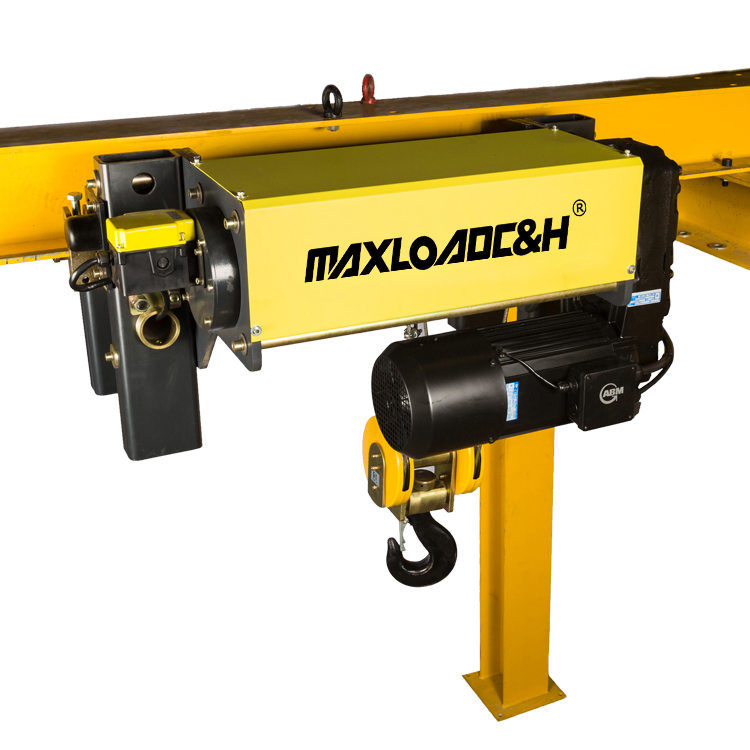
Low‑Headroom Worksites: Don’t Let Height Become a Bottleneck
In many old factory buildings or temporary workshops, the clear headroom is already limited. In such cases, when a standard electric hoist is installed, the effective hook travel is significantly reduced by the hoist’s own structural height—a 4‑meter building may offer only a little over 2 meters of usable lift height after installation.
Low‑headroom electric hoists are designed specifically for these situations. With a side‑mounted motor and a flat gearbox design, their headroom is reduced by 200 to 500 mm compared to standard models. They are compact, small in size, and use large‑diameter drums to effectively increase lift height while reducing left/right limit dead zones and crane blind spots, giving the operator more usable space.
This type of hoist is particularly suitable for low‑height environments where the ceiling is no more than 4 meters, or for temporary installations where major structural modifications are not desired. When selecting, two dimensions must be carefully checked: first, the actual occupied height after the hoist body is installed; second, the effective travel between the highest and lowest points the hook can reach. Looking only at the lift height parameter is far from enough—you need to measure the actual clearance from the runway to the floor and subtract the hoist’s structural dimensions; the remainder is what you can actually use.
Explosion‑Proof Environments: Safety Is Non‑Negotiable
In petrochemical plants, pharmaceutical production, paint manufacturing, oil and gas terminals, and similar sites, there may be flammable gases, vapours, or dust in the air. During operation, ordinary electric hoists can produce sparks from motor commutation, static electricity from friction, and high temperatures during braking—any of which could become an ignition source.
The core logic of explosion‑proof electric hoists is simple: eliminate all possible ignition sources at the source. However, this does not mean that any hoist with the word "explosion‑proof" will do—explosion protection has strict classification levels, and choosing the wrong level is more dangerous than choosing none at all.
Explosion‑proof ratings are mainly determined by two dimensions: first, the medium involved—gas environment or dust environment; second, the degree of hazard. For gaseous explosive atmospheres in chemical workshops, such as hydrogen or acetylene, an Ex d ⅡC T4 rating or higher is required. Let’s break this down: Ex stands for explosion‑proof; d means flameproof enclosure; Ⅱ indicates the industrial category; C means it can be used in Zone C hazardous areas; T4 indicates the temperature class, meaning the maximum surface temperature does not exceed 135°C. For dust environments at oil and gas terminals, a protection rating of Ex tD A21 IP65 is required.
One easily overlooked detail in selection: all components of the explosion‑proof hoist—motor, control box, push‑button pendant, remote control—must have the corresponding explosion‑proof certification; you cannot focus only on the main body. In addition, the choice of explosion‑proof level must be based on the actual hazardous area classification of the site, not on experience or guesswork. According to statistics, about 68% of safety accidents caused by improper selection of explosion‑proof levels are due to underestimating the temperature class of the explosive gases in the environment.
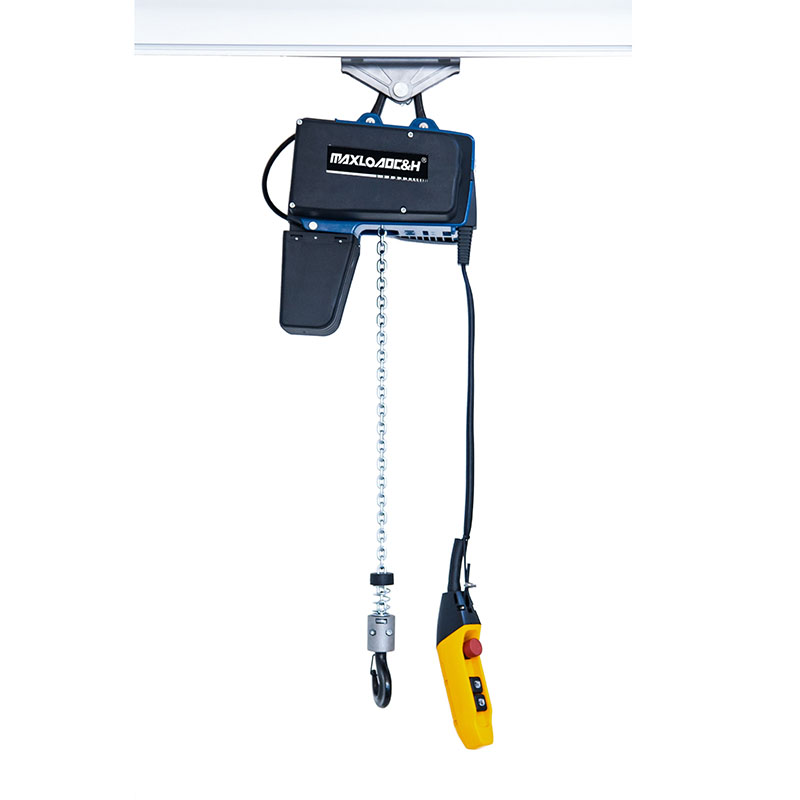
Cleanrooms: The Equipment Must Not Become a Contaminant Source
Industries such as semiconductors, biopharmaceuticals, medical devices, and food production have extremely high cleanliness requirements for the production environment. In an ordinary electric hoist, lubricating oil from the gearbox may leak, chain friction can generate metal particles, and the motor cooling fan can stir up airflow and raise dust—problems that are irrelevant in a normal workshop but are catastrophic in a cleanroom.
The design philosophy of cleanroom electric hoists is to "seal off everything that could generate contamination." The hoist body uses a fully enclosed housing to prevent internal grease and particles from escaping; the outer shell is often made of stainless steel or coated with a special finish that is smooth, corrosion‑resistant, and easy to clean. The lifting mechanism uses low‑volatility, specially formulated lubricating grease, and the wire rope may be stainless steel‑sheathed or have a special coating. The trolley wheels and contact surfaces on the runway are made of wear‑resistant, low‑particulate, non‑metallic materials. Electrical components have dust‑tight sealing to at least IP65. Hooks, clamps, and other parts that contact materials are also made of stainless steel and polished.
Selection of cleanroom hoists depends mainly on the required cleanliness level. For ISO Class 5 and above, the highest‑end configuration is usually required—all stainless steel, extreme sealing, special wheels. For ISO Class 6 to Class 8, appropriate configurations can be selected based on the specific process requirements. Capacities range from a few tens of kilograms to several tens of tonnes. The key is to also consider the frequency of use and the characteristics of the materials being handled.
Don’t Forget the Duty Class—A Critical Indicator
Many people choose the right type and confirm environmental suitability, but overlook one key parameter that determines the service life of the equipment—the duty class (or mechanism class).
The duty class reflects the theoretical operating time of the equipment under full load. A difference of one class roughly doubles the service life of mechanical components. Class M3 is suitable for occasional use, such as equipment maintenance or light warehouse handling, with no more than about 10 operations per day. Class M4 is suitable for medium‑frequency work in general factory workshops, with 10 to 30 operations per day. Classes M5 to M6 are for production lines with frequent lifting. For continuous heavy‑duty applications in ports, metallurgy, etc., classes M7 to M8 are required.
Choosing a higher class than needed wastes money; choosing a lower class leads to premature failure—this parameter must be taken seriously.
Summary – Decision Path
First, check the load and height to determine the basic tonnage and travel requirements. Next, evaluate the headroom—if height is tight, give priority to low‑headroom solutions. Then, assess environmental risks: if there is an explosion hazard, go the explosion‑proof route; if cleanliness is required, go the cleanroom route; if neither applies, return to the conventional chain or wire rope selection. Finally, determine the duty class based on the actual frequency of use.
There is no "best" model in electric hoist selection—only the "most suitable" configuration. Once you fully understand the real conditions of your worksite, the choice becomes clear.
 0086 156 1824 5535
 0086 156 1824 5535