Choosing the Most Suitable KBK Crane
In workstation-level material handling scenarios, the KBK light combination crane has become a mainstream choice. Unlike traditional overhead bridge cranes and gantry cranes, it focuses on repetitive handling of small parts at a single workstation or along an assembly line. However, many people fall into a trap when selecting a model—they start by looking at specifications and comparing prices, while overlooking the most fundamental question: What is your workstation environment really like?
Selecting a KBK system is essentially a "health check" of your workstation environment. Different workshop structures, different handling tasks, and different usage frequencies lead to completely different configuration solutions. The following breaks down the selection logic into three levels.
First, look at the workshop structure: freestanding or suspended?
This is the first question to answer when selecting a model.
Suspended mounting is the most common installation method for KBK—the rails are connected to the steel structure at the top of the workshop via hangers. Its advantages are straightforward: it does not occupy floor space, leaving the workshop floor completely clear for forklifts and personnel to move freely. The installation cycle is also short—no foundation digging or concrete pouring is required, and delivery is typically completed within a few weeks from site entry. The overall cost is relatively lower than that of the other structure.
However, suspended mounting has a strict prerequisite: the workshop roof must have reliable suspension points. The spacing and load‑bearing capacity of these suspension points must be calculated and verified. If the workshop roof is made of lightweight steel with colour‑coated panels, or if the spacing of grid ball joints is too large, direct suspension may not be possible. In addition, installing suspended rails requires keeping them in the same horizontal plane, and the vertical height difference between adjacent suspension points must be less than the specified value; otherwise, the smooth operation of the trolley will be affected.
Freestanding systems, by contrast, have independent support columns and do not rely on the workshop structure for load support. They can be installed on any ordinary reinforced concrete floor of standard thickness and impose no load on the building's roof structure. The advantage of this structure lies in its "independence from the workshop": if an old workshop roof has insufficient load‑bearing capacity—no problem; if the roof space is already crowded with pipes and cable trays—also no problem. Once the columns are erected on the floor, the KBK system can operate.
So the judgment is actually simple: if your workshop roof structure is robust and the suspension points are well distributed, suspended mounting is the more cost‑effective choice. If your workshop does not have reliable suspension conditions, or if you want the system to operate independently of the building structure, then choose the freestanding type.
Next, look at the rail type: rigid or flexible?
Once the installation method is determined, the next choice is the rail type—this is where many people get confused during selection.
Flexible KBK rails typically have an Ω‑shaped cross‑section and are spliced in a left‑right symmetrical manner. Their biggest feature is light weight—the travelling mechanism is very light, making operation effortless and allowing free movement as needed. The support centre distance for flexible rails is generally only 30 cm to 3 m, depending on the lifting capacity. They are suitable for relatively light loads—for example, with a 1‑tonne capacity, the main beam span can reach 7 m. If the workstation layout requires curves, track switching, or the rail needs to bypass equipment obstacles in the workshop, the flexibility of the flexible rail becomes a clear advantage.
However, flexible rails also have drawbacks. Their connections use pins, bolts, and other flexible joints, resulting in lower positioning accuracy than rigid rails. When the main beam travels, the left and right sides may not move synchronously, making positioning more difficult. Moreover, flexible rails require an additional steel structure for support.
Rigid KBK rails, on the other hand, use a C‑section design, are cold‑rolled as a whole, and offer higher strength and stability. The connections between the I‑beam and the profile rail, and between the profile rail and the main beam, are all rigid. The support centre distance for rigid rails can reach 6 m to 9 m in freestanding configurations and 1.6 m to 9 m in suspended configurations. Their lifting capacity can reach 2000 kg, and the main beam span can exceed 10 m. The main beam travels with consistent left‑right movement and accurate positioning. In scenarios requiring precise positioning—such as aligning a die's locating pin with a machine's hole—the advantages of rigid rails are very clear.
How to choose? If the material being handled is relatively heavy, requires precise positioning, and the workstation layout is fairly regular, rigid rails are more suitable. If the material is light, the rail layout needs to be flexible, and curves or track switches are required—flexible rails are more suitable. There is no absolute superiority; it all depends on whether the rail type matches your workstation needs.
Finally, determine the parameters: load capacity, span, and headroom
Only after choosing the structure and rail type should you move on to matching the specific parameters. According to relevant design standards, KBK selection should be based on three core parameters: lifting capacity, span, and clear height.
Load capacity is the most basic parameter. The "weight" here does not refer to the average weight, but to the maximum weight of a single piece. When selecting, it is recommended to choose based on "maximum lifting weight × 1.25 safety factor." If most workpieces weigh 200 kg but occasionally there is a 500 kg casting to be lifted, the load rating must be calculated on the 500 kg figure. Under‑sizing the load will cause excessive wear on the rail wheel sets and may even lead to safety incidents.
Span determines the working coverage width of the crane. The larger the span, the greater the rail deflection. For a single workstation with a span of 3 m to 5 m, standard rails are sufficient; for two workstations side‑by‑side with 5 m to 7 m, reinforced rails may be needed; for multi‑workstation rows with 7 m to 10 m, reinforced rails with intermediate supports are required. When the span exceeds 6 m, consideration should be given to using reinforced rails or adding support points.
Clear height directly affects whether the equipment can be installed. In workshops with limited floor‑to‑ceiling height, the clear height may have to be compressed to 2.8 m to 3.2 m. If headroom is insufficient, a solution with a rigid main beam combined with aluminium alloy end carriages—which offers a lower structural height—can be considered. Alternatively, a freestanding portal frame solution can be chosen, which does not rely on roof bearing. Some low‑headroom solutions use ultra‑thin hangers combined with flat‑profile hoists to gain more lifting space within a limited ceiling height.
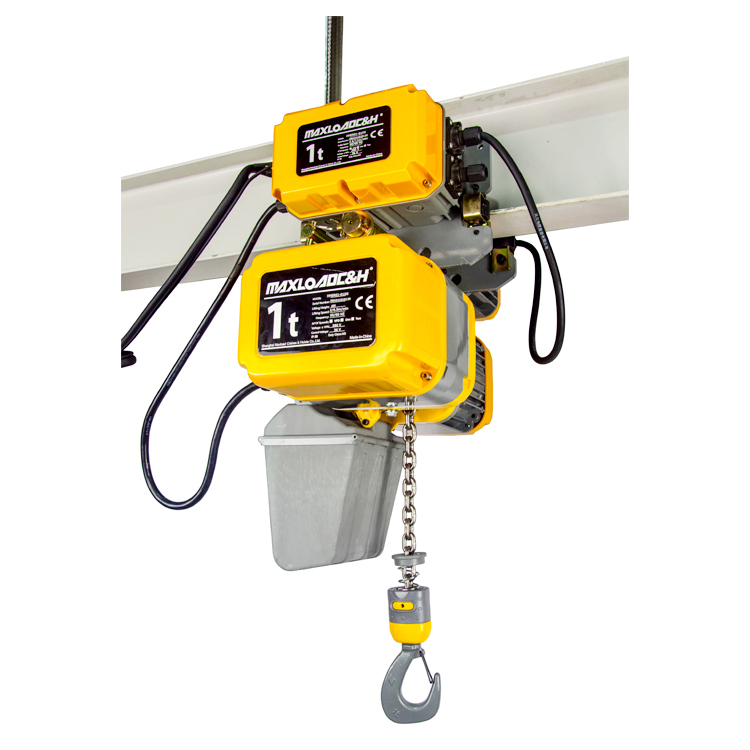
Matching the electric hoist: more than just "fitting a hoist"
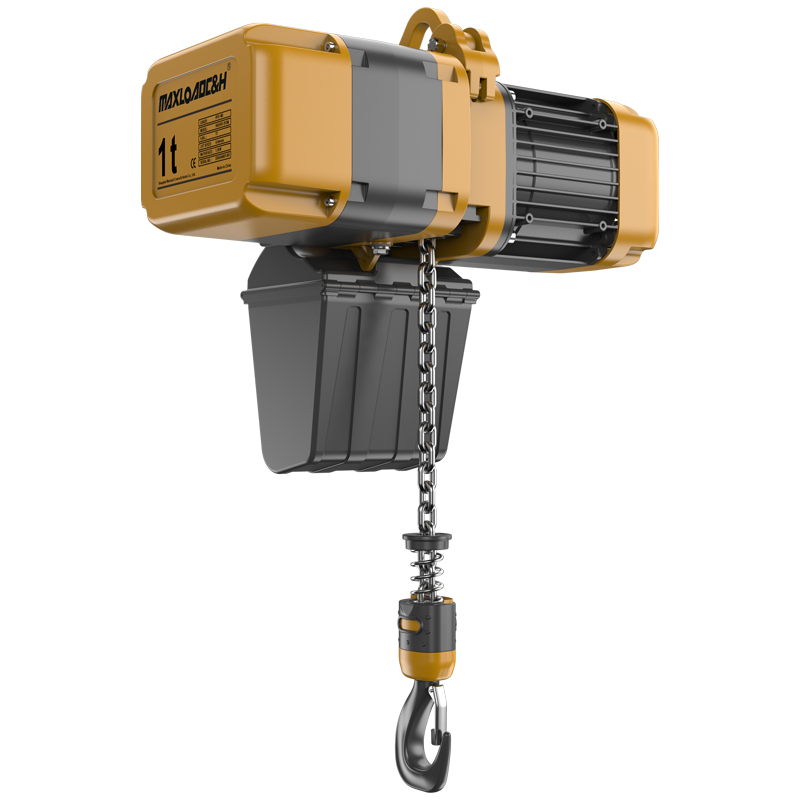
The most common electric hoist paired with a KBK system is the chain electric hoist. Its economy, efficiency, and low noise make it stand out in light industry, electronics, food processing, and other sectors. Maintenance is also relatively simple.
However, several details are often overlooked in the actual matching process:
Speed control. A single‑speed hoist has only one lifting speed, typically around 8 m/min. This speed is fine for general lifting, but for precise positioning it is less controllable—press the button and it jumps a bit; release it and it may still slide slightly. A dual‑speed hoist can reduce the slow speed to 1 m/min to 2 m/min, and with variable frequency control, it can achieve millimeter‑level fine movement. If your workstation requires precise positioning, dual speed is necessary.
Duty rating. Different usage frequencies require completely different duty ratings for the hoist. For a maintenance workstation that is used only occasionally, selection cannot be based solely on lifting capacity; you must also consider "how many times per day it is used."
Environmental adaptation. If the working environment has a lot of dust, a sealed‑shell model can be chosen to reduce the ingress of debris that could affect operation. In chemical and oil‑gas parts processing, explosion‑proof configurations are required; in pharmaceutical and electronics workshops, clean‑room configurations are needed. These special operating conditions must be considered at the selection stage.
There is no "one‑size‑fits‑all formula" for selecting a KBK system. The same 500 kg load may lead to completely different configurations in a machining workshop versus a warehouse—the former may require rigid rails and a dual‑speed hoist to ensure positioning accuracy, while the latter may be adequately served by flexible rails and a single‑speed hoist.
The correct path for selection should be: first, look at the workshop structure to decide between freestanding and suspended; then, look at the workstation layout and load to decide between rigid and flexible rails; finally, match the electric hoist's parameters and functions according to usage frequency and environmental conditions. Starting from the workstation environment, not from a specification sheet—that is the key to choosing the right KBK system.
 0086 156 1824 5535
 0086 156 1824 5535
 kimliu@chnhoist.com