From Mounting Structure to Track Type: The Complete Selection Logic
When installing a KBK crane system in a workshop, many people's first instinct is to check the lifting capacity and measure the track length. But anyone who has actually worked on such projects knows that the very first decision isn't about these parameters—it's about what will support the system. Will it be suspended from the factory roof, or will it stand on its own columns on the floor? Get this decision right, and the rest of the selection process falls into place; get it wrong, and you risk either underutilized equipment or, worse, safety hazards.
I. Look at the Roof First, Then the Floor: The Suspended vs. Floor-Supported Choice
The suspended type is currently the most widely used mounting method. The track is fixed beneath the factory roof's steel structure via suspension clamps, and the self-weight of the equipment and material loads is all transferred to the factory's steel beams and purlins. Its advantages are straightforward: it occupies no floor space, leaving the entire workshop floor clear for forklifts and personnel movement; installation is quick, requiring no foundation digging or concrete pouring—typically two to four weeks from arrival to handover; and overall costs are lower. New standard industrial workshops usually have reserved load-bearing capacity for crane suspension in their design, making it more than sufficient for a KBK system.
However, the suspended type has a hard prerequisite: the factory's steel structure must be able to handle these loads. The first thing to measure on-site isn't the floor—it's looking up at the roof: the purlin cross-section, material grade, spacing, and corrosion condition of steel beams. Without these data, the plan can't proceed. The number of suspension points isn't arbitrary; it must be calculated based on track cross-section, hoist self-weight, and full-load conditions, with a safety factor of no less than 4 for each suspension point. A common scenario: the factory was built over ten years ago as a light-steel structure, and the design never considered suspending lifting equipment, so the purlin sections are undersized. In such cases, a suspended system isn't entirely impossible, but structural reinforcement is needed at the suspension points, and this cost must be separately quoted. There's an even trickier situation: rented workshops where the lease explicitly prohibits drilling, welding, or adding suspended loads to the structure—in that case, forget about the suspended type.
The floor-supported (self-standing) KBK uses floor columns to hold up the track system, with loads transferred through columns to the ground foundation—the factory structure bears none of the forces. When must the floor-supported type be chosen? Three typical scenarios: older factory renovations—where steel structures are corroded, purlin sections are undersized, original drawings are missing, and no one dares to hang anything overhead; rented workshops—where landlords don't allow any modifications to the structure; floor-supported only requires chemical anchors in the floor, which can be removed and the floor restored when vacating; and workshops where production layouts may change—a floor-supported system can be fully dismantled and reassembled in a new workshop, whereas a suspended system leaves suspension points on the roof after removal. There's no fundamental difference in load capacity between the two methods; the core distinction lies in the installation approach and the dependency on the building structure.
II. Rigid Track vs. Flexible Track: Choose Based on Working Conditions
After deciding on the mounting method, the next core decision is the track's rigidity type. Rigid KBK uses cold-rolled C-section steel rails, with the main beam rigidly connected to the track via high-strength bolts—a fixed design with no sway risk. Flexible KBK uses Ω-shaped or aluminum alloy rails, with modular splicing via ball-and-socket connections, allowing free adjustment of track routing, even curved or intersecting tracks.
Differences between the two are evident in multiple dimensions. Support center distance: rigid floor-supported type can reach 6–9 meters, suspended type 1.6–9 meters; flexible KBK depends on load capacity, generally 0.3–3 meters. Load capacity: rigid KBK rated capacity up to 3 tons, track span extendable to 10 meters; flexible KBK rated capacity max 0.5 tons, main beam span no more than 8 meters. Positioning accuracy: rigid KBK achieves ±2 mm with low vibration, meeting millimeter-level precision assembly requirements; flexible KBK accuracy is around ±5 mm. Pushing/pulling force also differs notably—under a 500 kg load, rigid KBK requires 5–8 kg of thrust, while flexible KBK needs only 2–4 kg.
The selection logic is actually straightforward: if the lifting capacity is over 1 ton or the span exceeds 6 meters, prioritize rigid main beams; if the capacity is below 500 kg and light manual operation is desired, aluminum terminal or flexible systems are more suitable. Rigid KBK suits long-term fixed workstations, heavy material handling, and high-precision assembly; flexible KBK suits frequently adjusted production lines, multi-station movement, and light material handling.
III. Supporting Selection of Electric Hoists
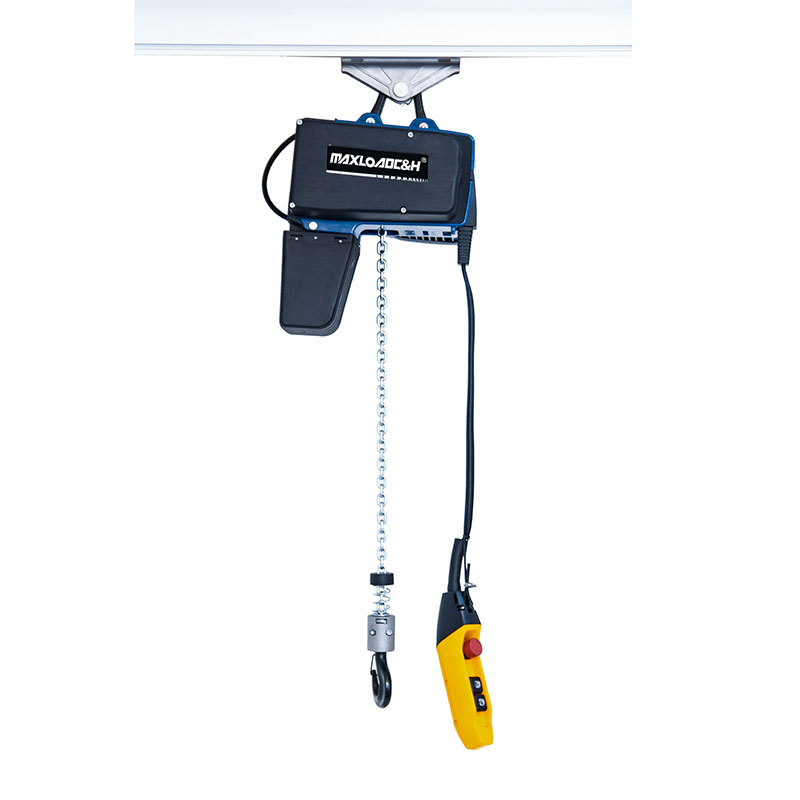
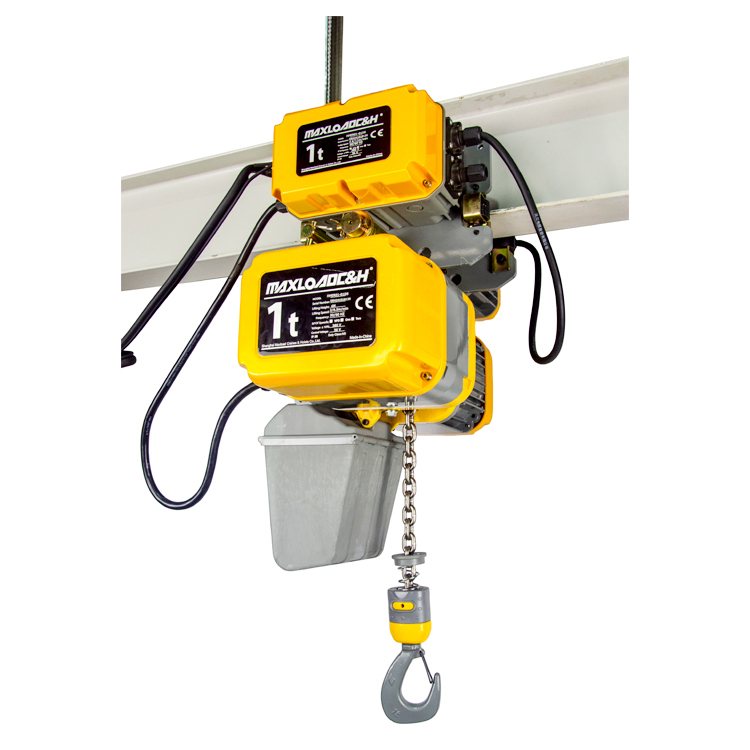
KBK cranes are almost always paired with chain electric hoists. Their economy, efficiency, and low noise make them particularly outstanding in light industry, electronics, food processing, and similar sectors, with relatively simple maintenance. If the workspace is limited, high positioning accuracy is required, and the lifting capacity is below 5 tons, chain electric hoists are the first choice.
Key points in hoist selection: strictly select the tonnage according to the actual lifting weight—never overload; for working environments—standard workshops, explosion-proof chemical settings, damp/corrosive conditions—choose standard, explosion-proof, or corrosion-resistant types, respectively; safety features: limit switches and overload protection are standard, with frequency conversion and wireless remote control optional for special conditions. For workshops with low ceiling heights, low-headroom electric hoists are recommended to ensure adequate lifting height.
IV. Selection Recommendations Based on Specific Workstations
Automotive assembly lines are typical for high-frequency, high-precision handling. Material weights usually range from 0.5 to 3 tons, requiring fixed workstations with frequent transfers—rigid KBK is the inevitable choice. In automotive final assembly, the lifting capacity should be calculated as the maximum workpiece weight multiplied by a safety factor of 1.2–1.3; the duty class should start at A5, and if the load factor exceeds 60% with double shifts, upgrade to A6; lifting speed should prefer two-speed frequency-configured hoists.
For electronic component assembly, food and pharmaceutical sorting, etc., material weights are typically under 500 kg, and production lines require frequent adjustments and multi-station movement. Flexible KBK's modular splicing and lightweight design allow quick track reconfiguration as the line changes. For cleanrooms and dust-free environments, special attention must be paid to materials: high-strength anodized aluminum alloy tracks are preferred—they are rust-proof, lightweight, have a dense, smooth surface that doesn't generate dust, and are corrosion-resistant. Aluminum tracks have low running resistance, some can be manually operated without motors, and produce low noise levels, making them suitable for clean industry needs like food processing.
Machine shops often have more complex conditions—both medium-sized (around 1 ton) fixed handling and small-component flexible transfer. In such cases, a combined rigid + flexible KBK system can be considered: rigid main beams cover heavy-duty stations, while flexible tracks cover light-load areas.
V. Several Easily Overlooked Selection Details
Ambient temperature must not be below -20°C or above 70°C; the site altitude should not exceed 2,000 meters; use is generally indoors. If the air is highly corrosive, protective measures are required. After track installation, the horizontal deviation must be controlled within 1/1000; leave a 2–3 mm expansion gap at track joints to accommodate thermal expansion/contraction. Regarding clear workshop height: the KBK track itself requires installation height—including suspension components, track profile thickness, hoist headroom, plus the spreader and workpiece height—and only then do you get the usable lifting stroke. These details must be calculated clearly at the planning stage; otherwise, you may find insufficient lifting height after installation, with extremely high rework costs.
Selecting a KBK system is never about picking a single product—it's about choosing a system that matches the workstation environment. First, check whether the factory structure can support it; second, determine rigidity vs. flexibility based on material weight and precision requirements; finally, select the electric hoist according to space and working conditions. Follow this sequence, and your selection won't go astray.
 0086 156 1824 5535
 0086 156 1824 5535