JIB Crane and Electric Hoist Combination: Three Pathways
In daily workshop material handling, the combination of a JIB crane and an electric hoist is almost standard – the crane provides horizontal slewing coverage, and the hoist handles vertical lifting. Together, they enable loading, unloading, turning, assembly, and a range of other operations within a sector or circular area. This setup appears simple, yet problems frequently arise in real projects: the hoist does not travel to the correct position, hook height is insufficient, cables twist and break, or even wheel flanges cause rail wear. Most of these failures are not due to poor single-unit quality, but rather because the JIB crane and electric hoist were not considered as an integrated system during the design phase.
The starting point for selection is not the parameter table, but the workstation itself. The workshop’s spatial conditions, the frequency and cycle time of operations, and the characteristics of the loads to be handled – these three factors together determine which type of JIB crane structure should be chosen and which electric hoist should be paired with it.
Pillar-Mounted JIB Crane: The First Choice for Fixed Workstations
The pillar-mounted JIB crane is the most widely used among the three types. It relies on an independent pillar and a concrete foundation to bear the load, without relying on the building structure, and it withstands the full overturning moment by itself. The slewing range typically reaches up to 270°, and with a slip ring assembly, continuous 360° rotation is possible.
When should a pillar-mounted type be selected? The most typical scenario is where the workstation is relatively fixed and the working area is concentrated. For example, loading and unloading CNC machine tools, changing molds on machining centers, and supplying parts on assembly lines – these operations are highly repetitive and have clear positions. One pillar-mounted JIB crane with a radius of 2 to 4 meters can serve 2 to 3 pieces of equipment. Since the pillar does not depend on walls, it is suitable for placement in the middle of the workshop or in areas far from walls.
When selecting an electric hoist for a pillar-mounted type, there is one easily overlooked issue – power supply. As the boom slews, the hoist’s power cable twists accordingly. The conventional solution is to install a collector slip ring at the top of the pillar to transmit power and control signals to the rotating boom, and then route the cable along the boom via cable trolleys or flat cables to the hoist. Sufficient circuits must be reserved on the slip ring – in addition to the main power supply, if the hoist has dual-speed control or a wireless remote receiver, control circuits and an emergency stop signal circuit must also be included. If one tries to cut corners by skipping the slip ring and simply using a spiral cable, under frequent slewing conditions, the insulation layer will wear out quickly, leading to grounding or short-circuit faults.
Additionally, the concrete foundation for the pillar is not something to be poured casually. The base plate and embedded anchor bolts must be able to resist the maximum overturning moment, and both the self-weight of the concrete foundation and the bearing capacity of the subgrade must have sufficient margins; otherwise, under repeated alternating loads, the foundation will loosen. The longer the boom and the greater the tip load, the more significant the bending moment on the foundation, and the requirements for base plate thickness and reinforcement increase accordingly.
Wall-Mounted JIB Crane: The Price of Space Saving
The wall-mounted JIB crane transfers horizontal reactions and bending moments to the load-bearing wall or building column. Its greatest advantage is zero footprint – forklifts, hand trucks, and personnel can pass freely underneath. In narrow aisles or tight workshop corners where floor space is limited, the wall-mounted type has an edge over the pillar-mounted type.
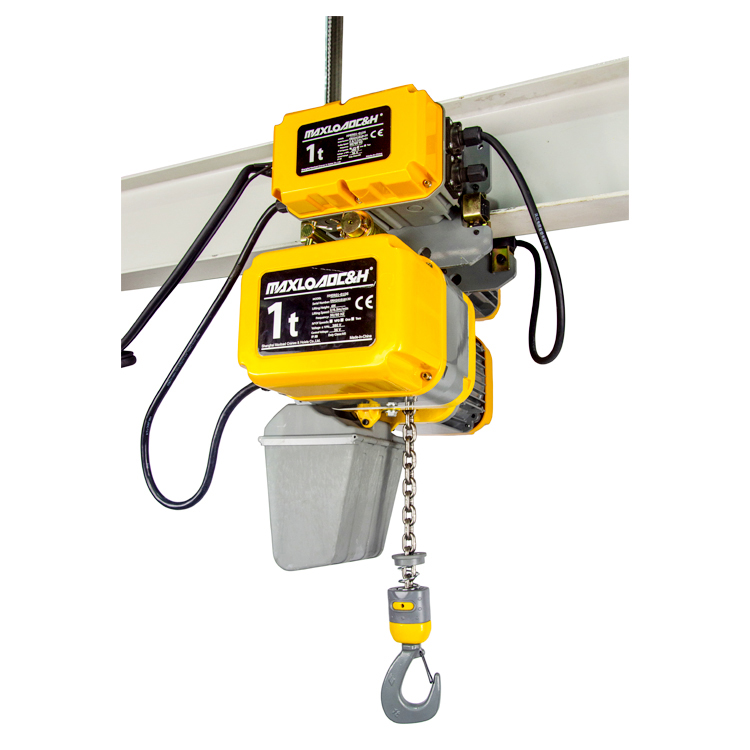
However, the trade-offs of the wall-mounted type are also specific. Since the mounting point is flush against the wall or column, the lateral available space for the hoist is limited. The overall width of the hoist and the extreme lateral position of the hook must be carefully calculated. If a wire rope hoist is used, the drum and motor protrude to one side, and at the far end of the hook, there may not even be enough safety clearance. Therefore, the wall-mounted type is usually paired with a compact chain hoist, and a low-headroom design is essential; otherwise, a significant amount of effective lifting height will be lost.
The slewing angle of the wall-mounted type is generally between 180° and 270°, and the boom length is relatively short. Before installation, the wall or column must undergo a strength check – when using chemical anchors or post-installed through-bolts, dynamic loads, fatigue, and concrete edge distances must be considered. In many retrofit projects where a wall-mounted JIB is installed directly on a steel structural column, it is necessary to verify whether the column flange and stiffeners can withstand the additional torsion and local bending. The capacity generally ranges from 0.125 tons to 2 tons.
Portable (Mobile) JIB Crane: The Boundary of Flexibility
The portable JIB crane has a counterweight base box at the bottom of the pillar, with traveling wheels underneath, allowing it to be moved between different workstations. It requires no foundation and can be relocated at any time. It is suitable for light loads and locations where workstations are not fixed – for example, where storage locations in large warehouses change frequently, where temporary lifting is needed at maintenance points, or where multiple workstations share one unit. The capacity generally ranges from 0.125 tons to 1 ton.
When selecting a portable type, two issues deserve special attention. First, the self-weight of the electric hoist affects the overall stability of the crane – the counterweight design of the portable JIB base must account for both the hoist self-weight and the rated load to prevent the entire unit from tipping when the load is at the end of the boom. Second, floor conditions – a certain level of floor flatness is required; otherwise, slewing becomes heavy, and the unit may even tip over during movement. Some workshops lay local steel track plates for the portable JIB to reduce damage to the floor.
Three Hard Constraints for Electric Hoist Matching
Regardless of which JIB structure is chosen, there are several hard constraints for matching the electric hoist that cannot be bypassed.
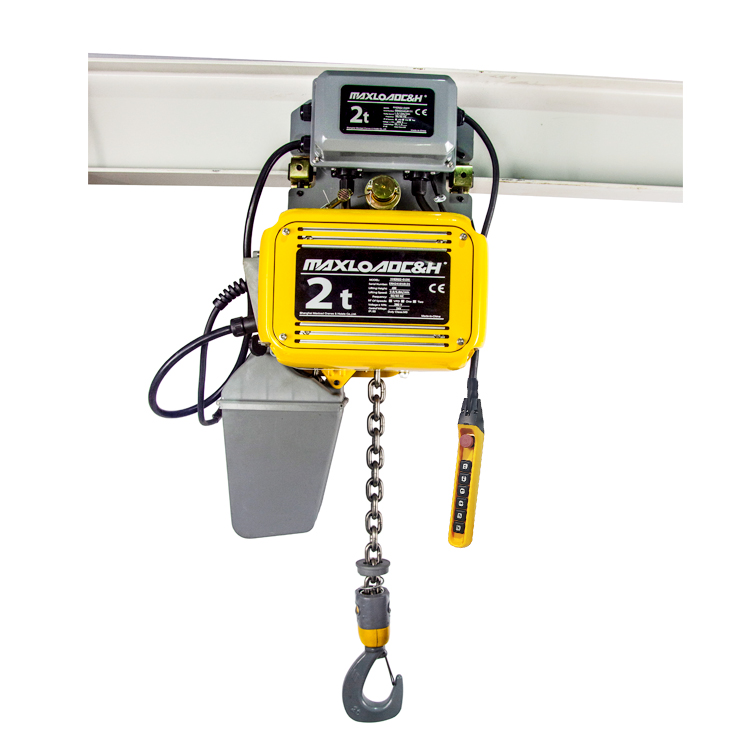
The first is headroom. The effective lifting height in a workshop is usually limited. The JIB boom itself occupies a certain height, leaving little space for the hoist. The advantage of a low-headroom chain hoist is evident here – the hook can be drawn up very close to the underside of the beam, releasing more effective lifting height. Although wire rope hoists are more reliable for heavy loads and high-frequency operations, they are clearly at a disadvantage in terms of headroom; the drum diameter and hook block height must be carefully calculated to ensure the hoist does not interfere with the boom.
The second is self-weight. Many people focus only on the rated lifting capacity when calculating loads, overlooking the effect of hoist self-weight on the boom. Suppose a pillar-mounted JIB has a span of 5 meters and is paired with a chain hoist weighing about 80 kg, plus the hook and rigging – these concentrated moving loads at the boom tip produce bending moments that can sometimes exceed those from the rated load itself. This data must be used as a design input to verify the bending stress and deflection of the boom cross-section. The longer the boom and the heavier the hoist, the more significant the derating of the effective lifting load.
The third is the duty class. Electric hoists are typically rated for duty classes M3 to M4, which correspond to intermittent operation with a rated load duty cycle of about 25%. This means the hoist is not designed for long-term continuous running. When selecting, the duty class must be matched to the actual frequency of use to avoid a shortened service life due to overload. For high-frequency operations on assembly lines, class M5 or higher is appropriate. Chain hoists are compact and have good tolerance to frequent inching and impact, making them more common in assembly lines and clean workshops; wire rope hoists have advantages in capacity and lifting height and can more easily achieve class M5 or above, making them suitable for heavy-load, high-frequency applications.
How to Choose:
Ultimately, selection is not about comparing parameter numbers, but about matching. No matter how impressive the equipment parameters look, if they do not match the workstation environment, the equipment will be awkward to use. First, clarify your own workspace, operation frequency, and load characteristics, and then work backward to choose the JIB structure and hoist configuration – do not reverse this order. If conditions permit, it is advisable to engage a professional manufacturer for an on-site survey. Many details – such as the geological conditions of the pillar foundation, the actual load-bearing capacity of the wall, and headroom interferences with workshop piping and equipment – simply cannot be identified without being on site.
 0086 156 1824 5535
 0086 156 1824 5535