Review the Workstation First, Then the Equipment
In workshop material handling, the combination of a JIB crane and an electric hoist is almost a standard configuration. JIB cranes have a small footprint and flexible slewing, and when paired with an electric hoist for vertical lifting and horizontal travel along the jib, they can perform loading/unloading, turning, assembly, and other operations within a sector‑shaped or circular area. However, this combination often causes problems in real projects – the hoist fails to move, hook height is insufficient, cables twist and break, and wheel flanges abrade the rail. In most cases, the issues do not stem from the quality of individual units, but from failing to treat the JIB crane and the electric hoist as an integrated system during the design phase.
I. Understand the Workstation Thoroughly Before Selection
Take a tape measure and mark three key positions at the workstation: material storage point, processing station, and finished‑goods temporary stacking area. From the column centre to the farthest point, add another 200‑300 mm – that is basically the effective jib length you need. But one detail is easily overlooked: when the jib slews, the hook’s end travels in an arc. If the workstation is tight against a wall or adjacent to another production line, at certain slewing angles, the jib tip may simply not reach the spot where you want to place the material. In that case, either shorten the jib or consider an offset base – move the column away from the workstation centre to gain effective coverage.
Vertical space is often tighter than horizontal. Measure from the floor to the underside of the roof, subtract the electric hoist’s own height, and then subtract the safety clearance between the hook at its highest position and the jib’s underside – the remainder is the actual usable lifting height. Many workshops have fire sprinkler pipes, cable trays, and lighting fixtures under the roof, leaving only a little over three metres of clear height, yet a standard hoist is selected. When the hook reaches its upper limit, there is nearly half a metre of dead space, so workpieces that could have been lifted cannot enter the equipment because the height is insufficient. In such cases, either switch to a low‑headroom electric hoist – where the hoist body and trolley are arranged side‑by‑side rather than stacked vertically, reducing height by more than 30% – or reconsider the type of JIB crane.
Lifting frequency and single‑lift weight are equally critical. Ten lifts per day versus ten lifts per hour produce completely different wear levels on the equipment. Some workstations need only 200 kg per lift, but repeat it 200‑300 times a day – the fatigue damage to the slewing mechanism and electric hoist is more severe than lifting one tonne a few times a day. Working radius is not always better when longer – doubling the jib length increases the bending moment at the root far more than twofold, and the strength requirements for the column and foundation rise geometrically. In addition, dust in foundries, corrosive gases in electroplating shops, low temperatures in cold storage, and outdoor sun and rain – these environmental factors directly determine material selection and protection ratings. A standard‑coating JIB will rust and seize within months in an acid‑mist environment, and standard electric hoists suffer from brittle plastic parts and solidified grease at sub‑zero temperatures.
II. Three Structures, Three Logics
Mainstream JIB cranes are divided into column‑mounted, wall‑mounted, and mobile types according to installation method. Each structure imposes completely different constraints on the electric hoist.
Column‑mounted JIB cranes are the most common type. The column is fixed to the floor, independent of building structures, and bears the entire overturning moment by itself. Its advantage is a small footprint – only a base plate is needed – making it ideal for “one‑to‑one” auxiliary handling beside machine tools or in spatially constrained workstations. The slewing range of a column‑mounted JIB is typically 270° to 360°, giving a large working coverage. Lifting capacities range from 125 kg to 5,000 kg.
The problem it brings to the electric hoist is power supply – when the jib slews, the hoist’s supply cable twists accordingly. The conventional solution is to install a collector ring at the top of the column to transfer power and control signals to the rotating jib, and then lead them along the jib via a cable‑trolley system to the electric hoist. The number of circuits in the slip ring must be sufficient – besides the main power, if the hoist has two‑speed control or a wireless remote receiver, the control circuits and emergency‑stop signal circuits must also be connected. If the slip ring is neglected and a spiral cable is used instead in frequent‑slewing applications, cable insulation wear soon occurs, causing earth faults or short circuits.
The installation of a column‑mounted JIB has foundation requirements. The column must remain perpendicular to the floor, anchor bolts must be tightened firmly, and the base plate must be well seated against the foundation. If equipped with an electric hoist, the foundation should have embedded cables and earthing facilities, with an earth resistance not exceeding 4 ohms. The column‑mounted type suits independent workstations located in the middle of a workshop that need to cover a large circular area.
Wall‑mounted JIB cranes are mounted on walls or structural columns, requiring no independent column or foundation. The jib is fixed to a load‑bearing wall or steel column via brackets, occupying zero floor space. The slewing angle is usually limited to 180°‑270°. The lifting capacity generally does not exceed 2 tonnes, restricted by the wall’s load‑bearing capacity.
The constraints on the electric hoist from a wall‑mounted type mainly come from lateral space. Since the mounting point is tight against the building column or wall, the side space available for the hoist is very limited. The overall width of the hoist and the extreme lateral position of the hook must be carefully calculated. Therefore, wall‑mounted JIBs are usually paired with compact chain electric hoists, and they must adopt a low‑headroom design; otherwise, the effective lifting height will be significantly reduced.
Wall‑mounted types are suitable for workshop corner workstations, narrow aisle areas, and locations where existing load‑bearing steel or concrete columns are available. They can save more than 15% of workshop floor space. However, the load‑bearing capacity of the wall or column must be verified by structural calculation.
Mobile JIB cranes have a counterweight box under the column, with travelling wheels at the bottom, so they can be pushed and moved between different workstations. This structure offers high mobility and wide adaptability, making it suitable for multi‑station sharing, temporary jobs, and maintenance workstations.
The core impact on hoist selection for a mobile type lies in stability. The whole unit can be pushed, but the hoist’s own weight must be accounted for in overall stability – the counterweight design of the mobile JIB must include both the hoist’s weight and the rated load to prevent overturning when the load is at the jib tip. Mobile JIBs typically operate within a 300° slewing range, with the hoist at one end of the jib and a counterweight at the other for balance.
III. Key Matching Points for the Electric Hoist
Regardless of which JIB type is selected, several matching points are unavoidable.
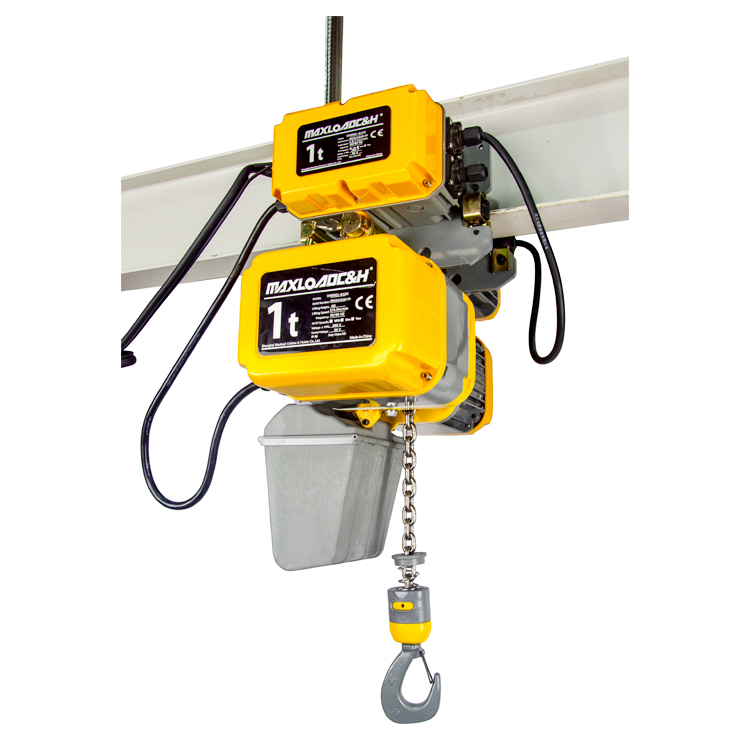
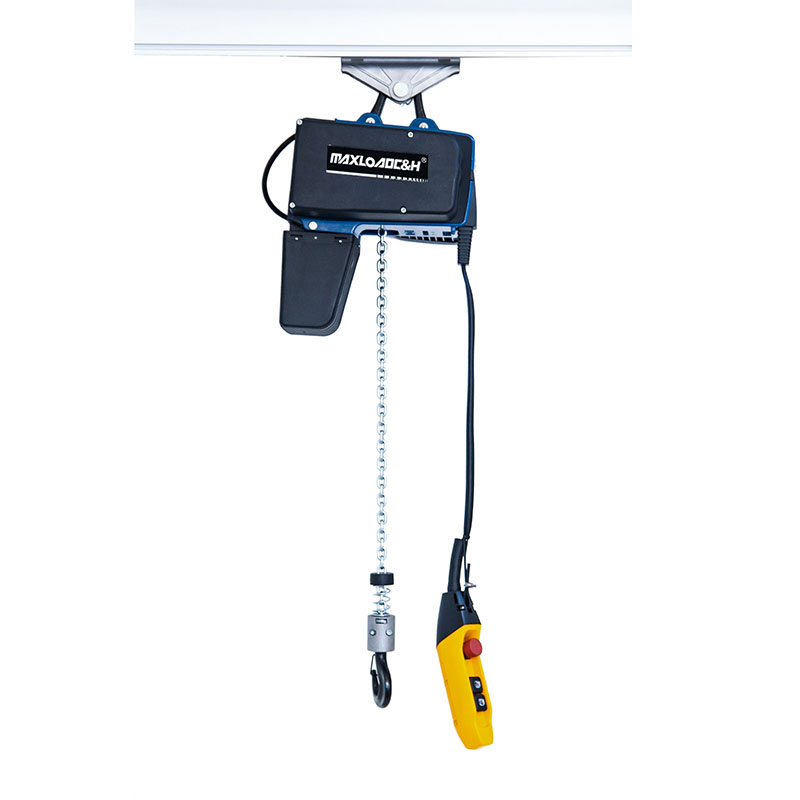
Headroom is often the first conflict to resolve. The effective lifting height in a workshop is usually limited, and the JIB itself occupies some height, leaving tight space for the hoist. The advantage of low‑headroom chain electric hoists is clear here – the hook can be brought very close to the underside of the jib, freeing up more effective lifting height. Wire‑rope electric hoists, though strong in load capacity and suitable for heavy‑duty high‑frequency use, are not advantageous in headroom; careful calculation of the drum diameter and hook block height is required to ensure the hoist does not interfere with the jib.
Duty classification is a parameter often overlooked. It comprehensively reflects the frequency and load state of the equipment. High‑frequency production line work is suitable for Class M5 and above; standby hoists may use Class M1. When selecting the rated lifting capacity, reserve a safety margin – typically multiply the maximum workpiece weight by 1.1. At the same time, the electric hoist’s rated capacity should not exceed the JIB crane’s own load‑bearing capability.
Operation mode also affects selection. For capacities below 500 kg, a manual hoist may be chosen; above 1 tonne, an electric hoist is recommended. Slewing operation is similarly divided into manual and electric – manual slewing is low‑cost and simple, suitable for under‑1‑tonne applications; electric slewing saves labour and is convenient, but costs more and is generally used for medium‑to‑heavy capacities of 1 tonne and above.
IV. How to Choose
Return to the most fundamental question: what does your workstation look like?
Workstation in the middle of the workshop, requiring 360° coverage, and a foundation can be made – choose column‑mounted. It is the most versatile, independently load‑bearing, and not constrained by building structures. When paired with an electric hoist, remember to equip it with a good collector ring.
Workstation against a wall, floor space is tight, and the wall or column has sufficient load‑bearing capacity – choose wall‑mounted. It takes zero floor space and has relatively lower cost, but the slewing range is limited. When pairing with an electric hoist, prioritise a compact chain hoist and low‑headroom design.
Workstation is not fixed, needs to move between multiple locations, and capacity is modest – choose mobile. It is flexible and mobile, but when selecting the electric hoist, you must account for the impact of its weight on stability and leave ample margin in the counterweight design.
First, clearly understand the workstation’s spatial dimensions, lifting frequency, environmental conditions, and load requirements, then compare the characteristics of the three structures before deciding. The equipment serves the workstation – not the other way around, where the workstation must adapt to the equipment.
 0086 156 1824 5535
 0086 156 1824 5535
 kimliu@chnhoist.com