Understand Your Worksite Environment to Choose the Right Electric Hoist
When selecting an electric hoist for a workstation, many people focus only on lifting capacity and height. In reality, what determines whether a hoist will perform reliably over the long term is the actual worksite environment beneath your feet. If you don’t fully understand the environmental parameters and make rough guesses, you’ll be inviting breakdowns, downtime, and even safety risks.
The following dimensions are critical points repeatedly validated in numerous hoist selections and retrofits. Clarifying them will allow you to specify accurate technical requirements and avoid the trap of “fits on installation, but fails soon after.”
Look Beyond the Rated Tonnage
The rated lifting capacity of an electric hoist is the maximum value under a specific duty classification. For the same tonnage, different workstations consume the hoist’s mechanical life at vastly different rates. The key concept is the mechanism duty classification, which combines the load spectrum and total operating time.
A rough estimation: list the lifting conditions over one shift—record how much time is spent at full load, medium load, light load, and even empty hook—and calculate the average number of starts per hour to derive the load duration factor. For example, an assembly station rarely lifts more than half the rated load and operates only 30–40 times per shift—an M3 or M4 classification is perfectly adequate. But a die‑change station, though it operates only a few times a day, lifts full loads with occasional impact—this requires at least M5 or even M6, with heavier motors and gearboxes and improved heat dissipation.
Ignoring the load duration factor leads to frequent motor burnout and rapid brake wear. For light‑load, high‑frequency duty, special attention must be paid to the equivalent number of starts per hour. Many on‑site failures, upon investigation, turn out to be mismatches between the duty classification and the actual load spectrum.
Overhead Clearance – More Troublesome Than Lifting Height
“I need to lift 3 metres, so I’ll choose a hoist with a 3‑metre lifting height.” The reality is often that the hoist’s own physical height is too large, and the hook hits the ceiling before reaching 3 metres. The clear space under the factory beams is limited, and additional fixtures, ducts, and piping further reduce the usable headroom.
This calls for a low‑headroom electric hoist. Such hoists typically compact the trolley and lifting mechanism, with the motor and gearbox offset to the side of the drum or using a small‑diameter drum with an extended barrel to increase rope capacity, thereby flattening the overall height. During selection, obtain the hoist’s “upper hook limit” dimension, and sketch a simple cross‑section incorporating the rail height and the distance from the lifting point to the tooling—don’t wait until installation to discover that the hook cannot reach the required position. If the workspace has overhead pipes that cross the travel path, the clearance distance for the hoist’s passage must also be considered.
Rail and Suspension Type – Decide Whether Travel Runs Smoothly
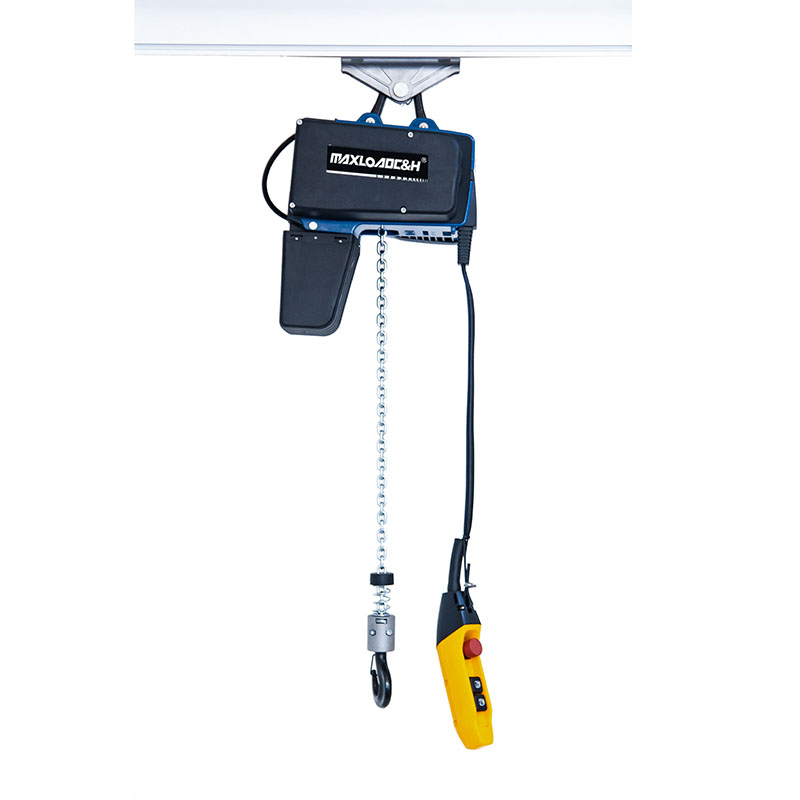
Workstations are not always standard straight I‑beam monorails. Jib crane columns, KBK flexible rail systems, and aluminium light‑rail systems are common. Different rails correspond to different wheel profiles, flange widths, and joint configurations. Particularly where the rail includes horizontal curves, the hoist’s travel mechanism must match the minimum curve radius. One assembly island used an 800‑mm radius rail with a standard trolley – it jammed at every turn, and eventually the trolley had to be replaced with a curve‑capable design.
Also, pay attention to the rail slope and surface condition. If the rail has a natural gradient along the workstation, the hoist may creep under full load – requiring additional anti‑creep brakes or a travel motor with fail‑safe braking. For outdoor or semi‑outdoor stations, consider the effect of rain, snow, and ice on slipping – the drive wheels may need increased wheel loading or higher friction coefficients.
Environment – The Biggest Variable
Many selection errors are not due to mechanical parameters, but to invisible killers such as dust, moisture, corrosion, and extreme temperatures.
Heavy dust – e.g., welding, grinding, woodworking shops – metal dust or fibrous debris can be drawn into the motor fan, embed into chain or wire rope gaps, accelerate wear, and cause brake linings to slip or stick. In such cases, the motor should have at least IP54 protection, and the brake ideally IP55, with additional dust‑proof bellows covers, chain bags, and other shielding. If the dust is also conductive, pay special attention to control cabinet sealing and regular purging.
High humidity or direct water contact – e.g., food washing lines, seafood processing rooms – the fundamental issues are rust and insulation degradation. Hooks, chains, and slings should be stainless steel or have reliable anti‑corrosion coatings. Gearbox breathers need splash‑proofing, and motor insulation should be at least Class F, ideally with built‑in anti‑condensation heaters that energise during downtime to prevent winding condensation. Junction boxes and remote‑control receivers must have waterproof connectors.
Acid/alkali mist or salt spray – e.g., electroplating lines, chemical tank areas – special anti‑corrosion measures are required. Ordinary wire ropes can suffer stress‑corrosion cracking in a short time under such atmospheres – replace them with stainless‑steel wire ropes or high‑strength synthetic fibre slings, and apply epoxy or powder coating to the hoist housing and rope guide. Lifting chains require specialised surface anti‑corrosion treatment – not just a simple coat of rust‑preventive oil.
Explosion‑proof environments form another strict system. In paint‑spray booths, solvent handling areas, etc., even painting an ordinary hoist with “explosion‑proof paint” is fatally self‑deceptive. You must select a hoist that has full explosion‑proof certification according to the hazardous area classification, with its explosion‑proof rating and temperature class strictly matching the on‑site media characteristics. Chains, hooks, housing materials, and surface finishes must all meet specific non‑sparking requirements.
Power Supply and Control Scheme – Match the Workstation’s Cycle
For mobile power supply, whether to use conductor bars or trailing cables depends on overhead interference, cleanliness requirements, and travel length. If the workstation is frequently washed down or subject to dust accumulation, enclosed conductor bars are much safer than bare copper bars.
At the control level, for stations requiring frequent and precise positioning, conventional single‑speed lifting and jogging operation will strain the operator, causing large load swings that reduce efficiency and risk collisions. In such cases, two‑speed or even variable‑frequency lifting should be used – the creep speed allows very smooth micro‑positioning. Variable‑frequency control also reduces starting current, which is kind to motor thermal protection and ideal for high‑start/stop duty. Also verify whether the actual supply voltage is 380V, 220V, or other – don’t let a nameplate voltage mismatch burn out the motor.
Safety Configurations – Add According to Workstation Risk
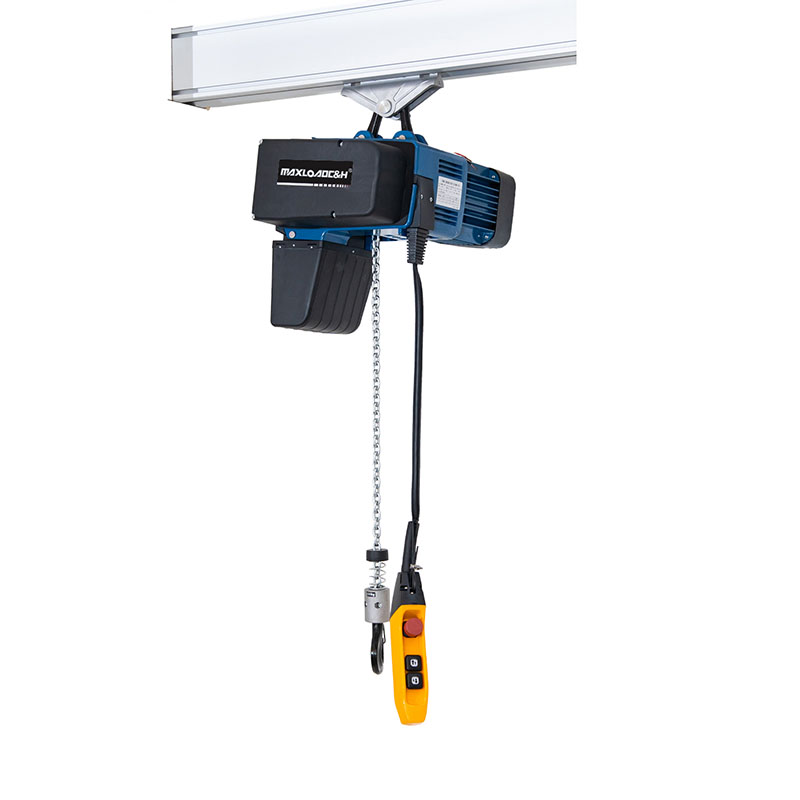
Upper/lower limit switches and overload limiters are essentially mandatory, but special stations need more. If the lifted load passes over areas where personnel frequently work, consider adding redundant brakes or a safety braking system to prevent accidental load dropping. Phase‑sequence protection should also be included to avoid the dangerous situation where, after on‑site maintenance with reversed phase sequence, pressing “down” causes the load to go up. For long‑lifting‑height stations, the chain or wire rope droops excessively and can snag on people or materials – a chain bag or rope anti‑sway tray must be provided to keep the suspended part under control.
Leave Room for Maintenance
Even the best hoist needs servicing. During selection, consider: Is chain lubrication manual or automatic? Is the brake wear inspection port easily accessible? If the hoist is installed in a particularly cramped overhead space, it is advisable to specify a split construction or a trolley with quick‑release features, so that mid‑life overhauls can be done without dismantling large sections of tooling.
In the end, selecting an electric hoist for a workstation is a careful “translation of the environment.” Go to the site first and measure thoroughly: the real load, the overhead clearance, the rail routing, the level of dust and temperature, the presence of corrosion or explosion risks. Then use those data to cross‑check the specification sheets, and fix each parameter—duty classification, protection rating, insulation class, explosion‑proof rating, speeds, and control method—one by one. Only then will the hoist you select work steadily for the next three to five years, rather than becoming a recurring source of trouble on the production line. There is no standard answer for a workstation – the right configuration is the most reliable.
 0086 156 1824 5535
 0086 156 1824 5535
 kimliu@chnhoist.com