The Core Logic of Electric Hoist Selection
When purchasing an electric hoist, many people instinctively start with two questions: "What tonnage?" and "How much does it cost?" These questions are certainly important, but if you focus only on these two points, chances are high you will make the wrong choice. An electric hoist is not a one-size-fits-all tool that works right out of the box. Its selection logic must start from the workspace environment – what to lift, where to lift, how to lift, and how often to lift. Once these four questions are answered clearly, the selection process will stay on track.
I. First, Calculate Weight and Height Accurately
The first step in selection is always calculating the weight. This is not simply placing the workpiece on a scale; you need to calculate the "total lifting weight" – the weight of the workpiece itself plus packaging, slings, and fixtures. Many people tend to make two mistakes here: first, they calculate only the net weight of the workpiece, ignoring the weight of slings and accessories; second, they choose a hoist whose rated capacity exactly equals the maximum workpiece weight, leaving no margin. The correct approach is to add a margin on top of the total weight – it is usually recommended to choose a specification one grade higher than the maximum lifting weight. This is not waste; it is safety redundancy. A hoist that continuously operates at full capacity will experience much faster wear on its motor and brake than one with a built-in margin.
Height is equally critical. The effective lifting height is not the building height, but the distance from the lowest hook position to the highest working position. In the calculation, you must deduct the rail elevation, the hoist's own structural height, the hook block height, the workpiece height, and the required safety clearance below. Many older workshops have limited ceiling heights, and after installing a standard model, they find that the hook cannot reach the floor, or the workpiece hits the hoist's bottom casing halfway up. This is especially common in low-ceiling workshops, where a low-headroom design is needed to gain effective lifting travel.
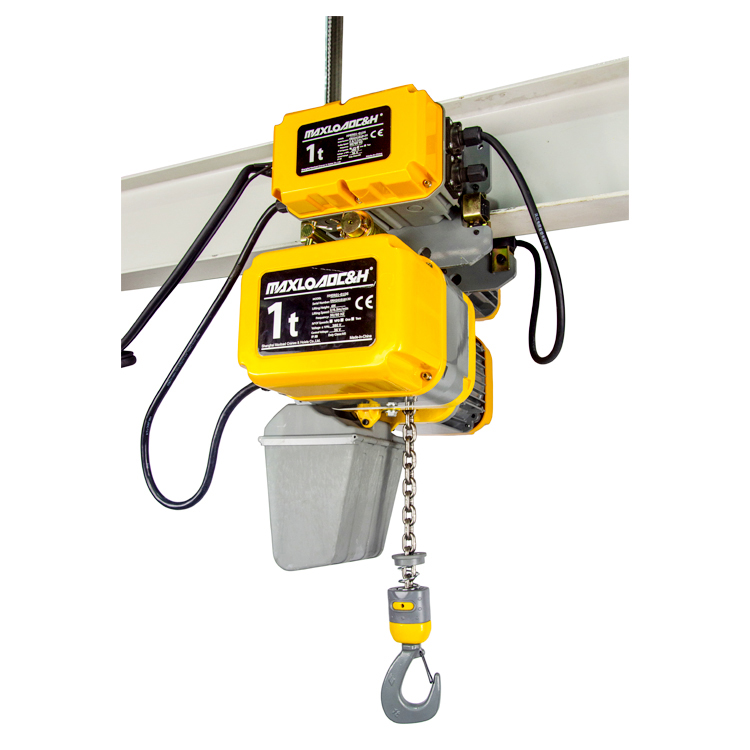
II. Chain or Wire Rope? Depends on How the Workspace Is Used
This is the most common binary choice in selection. A rough rule of thumb: for loads under 5 tons, compact workspaces, and frequent start/stop with precise positioning, a chain electric hoist is more suitable; for loads above 5 tons, higher lifting heights, and smooth operation requirements, a wire rope electric hoist is the mainstream choice.
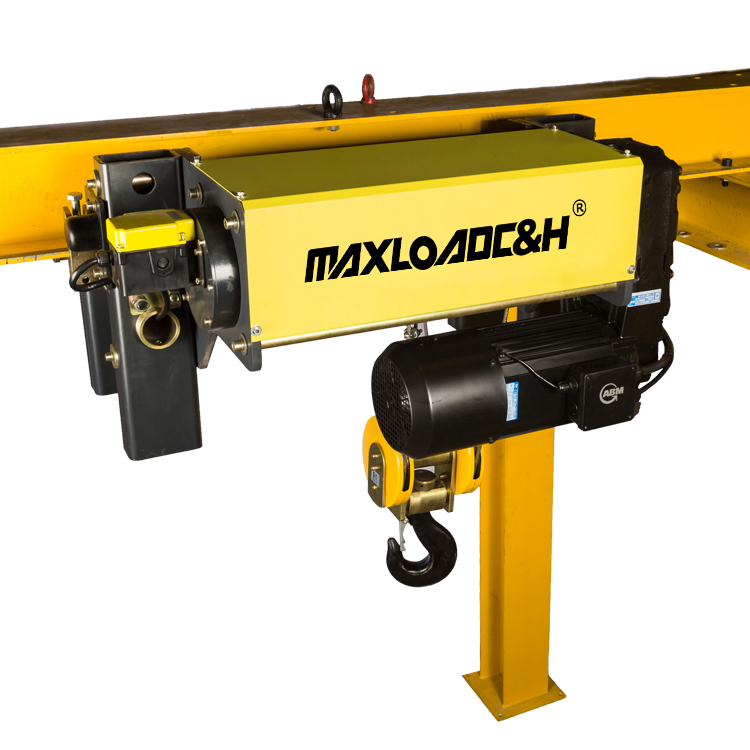
But this dividing line is not absolute. The advantages of a chain hoist lie in its compact structure, light dead weight, good chain toughness, and low maintenance/replacement costs, making it suitable for operations in confined spaces. Its lifting speed is relatively slow, allowing more controlled positioning, which suits assembly stations requiring repeated alignment. A wire rope hoist offers faster lifting speeds and smoother operation, suitable for long-distance, high-frequency continuous work. If the workspace involves fixed-point lifting within a limited range, a chain hoist is often more flexible; if it is part of a bridge crane system or requires cross-zone transfer, a wire rope solution is more common.
Also consider an often-overlooked detail – angled pulling. Chain hoists tolerate slight angled pulls somewhat better than wire rope hoists, but this does not mean prolonged angled operation is acceptable. If the workspace design cannot guarantee vertical lifting, you must factor in chain or wire rope wear during selection, or even reassess the workspace layout.
III. Duty Classification: A More Critical Hidden Parameter Than Tonnage
Tonnage determines "how heavy" you can lift; duty classification determines "how long" you can lift it. This is the aspect most easily misled by sales pitches during selection.
Duty classification is a comprehensive indicator of the hoist's usage frequency and load intensity, with domestic standards ranging from M3 to M8. M3 is suitable for occasional use, such as equipment maintenance or light warehouse handling, with no more than 10 operations per day. M4 suits moderate-frequency work in general factory workshops, with 10 to 30 operations per day. M5 to M6 correspond to frequent lifting, such as assembly line work, with 30 to 80 operations per day. M7 to M8 are for continuous heavy industrial applications.
Many people only look at tonnage and ignore duty class, using light-duty equipment in heavy-load, high-frequency workstations – resulting in motor overheating, accelerated gear wear, and equipment that should last five to six years failing within one or two years. Moreover, each step difference in duty class roughly doubles the service life of mechanical components. A 1-ton hoist used for 50 lifts per day in a workshop must be M5-rated, not the cheaper M3 often recommended by sales. Therefore, be sure to calculate the daily number of lifts and the duration of each operation before selecting – do not take it for granted.
IV. Environmental Factors Determine Protection Ratings
The physical environment of the workspace directly affects hoist selection. Temperature, humidity, dust, corrosive media, and flammable/explosive risks – each of these can change your choice.
The standard operating ambient temperature for electric hoists is generally between -20°C and +40°C. If the workspace exceeds this range – for example, near a heat-treatment furnace or in outdoor winter operations in northern regions – you need to select heat-resistant or cold-resistant models; the motor may require forced cooling, and the lubricant must be changed to a grade suitable for that temperature range.
For humidity, under normal conditions with relative humidity not exceeding 85%, an IP44 protection rating is generally adequate. However, if the workspace has higher humidity, or even reaches 100%, the protection rating must be upgraded to IP55 or higher, and electrical components need special moisture-proof and waterproof treatment. Dusty environments similarly require sealed housings to prevent debris from entering and affecting operation.
For workspaces with flammable or explosive gases – such as chemical, painting, or petroleum applications – explosion-proof electric hoists are mandatory, with no room for compromise. The explosion-proof level must match the specific type of explosive medium and temperature class on site; you cannot just pick any model to cut corners. Corrosive media require corrosion-resistant hoists, with housing and components made of specially treated materials.
V. Installation Space Determines Model Selection
Building height and rail conditions also constrain selection. Low-ceiling workshops require low-headroom designs, which optimize the structural layout to reduce the hoist's own height, thereby maximizing effective lifting travel within limited clearance. If this is overlooked, a standard model may leave the hook with insufficient travel to even reach the floor.
Rail matching is another common pitfall. Electric hoists run on I-beam rails, and different models have different rail profile requirements. Buying a hoist only to find it does not fit – rework costs are far higher than confirming specifications upfront.
VI. Control Methods and Ancillary System Boundaries
Finally, consider the operating mode and supporting systems. Single-speed hoists are suitable for rough lifting with no positioning accuracy requirements. Two-speed hoists offer both normal and slow speeds, with the slow speed used for fine positioning – ideal for assembly, mold maintenance, and similar scenarios. If the workspace requires frequent precise placement, two-speed or even variable-frequency speed control is a necessary investment.
For control methods, a pendant push-button station is standard and suits conventional indoor workshops; wireless remote control is suitable for large-span workshops or high-altitude operations, with an operating range of tens of meters, allowing operators to stay away from the lifting area for greater safety.
An electric hoist is not a standalone device – it also involves rails, trolleys, electrical controls, power supply, and a series of ancillary systems. Focusing solely on the host unit price and comparing that alone will often result in higher-than-expected operating and maintenance costs down the road. Considering the entire ancillary system boundary during selection helps avoid repeated headaches later.
In the final analysis, there is no "one-size-fits-all formula" for electric hoist selection. Every parameter must be judged against the actual conditions of the workspace. Calculate the weight accurately, measure the height thoroughly, determine the frequency precisely, and verify the environment comprehensively – follow these four steps, and the equipment you select will truly match your production needs.
 0086 156 1824 5535
 0086 156 1824 5535
 kimliu@chnhoist.com