A Professional Guide to Electric Hoist Selection
When many people choose an electric hoist, their first reaction is to look at "how heavy" and "how high." That's not wrong, but if you only focus on these two numbers, you often fall into traps – the tonnage and height match, yet the equipment frequently breaks down, feels awkward to operate, or even poses safety risks. The root of the problem is that the workspace environment is the key variable that determines the selection logic.
I. First, Calculate the "Work Intensity," Then Look at "Tonnage"
The rated lifting capacity is indeed the most intuitive parameter, but what truly determines equipment lifespan is the duty classification (ISO standard M3-M8, FEM standard 1Bm-4m). This indicator integrates two dimensions: the average number of working hours per day, and the load distribution – whether it operates near full capacity year-round or mostly lifts light items.
For example: Two workstations both lift 1-ton workpieces. Station A only lifts 10 times a day, with gentle handling each time. Station B has a fast production line pace, lifting 30 times an hour with frequent starts and stops. If you choose the same tonnage specification, the equipment at Station B might fail within six months – motor overheating, brake wear, gearbox noise. The reason is simple: the duty classification doesn't match. The theoretical lifespan of mechanical components is calculated based on full-load operating hours. An M4 class corresponds to 800 hours, while an M6 class corresponds to 3,200 hours – a difference of an order of magnitude.
The correct approach during selection is to count the "cycles per hour" and "starts per cycle," combine these with the average lift height to calculate the actual daily operating hours, and then cross-reference with load distribution charts to determine the required duty class. This step doesn't need to be highly precise, but it must be done.
II. Spatial Dimensions Determine the "Effective Lifting Height"
The building height is fixed, but the effective lifting height is calculated. Many users only report "the building is 8 meters high," assuming they can lift a 6-meter workpiece. But once the hoist body and hook block are installed, the actual clearance is only just over 4 meters, and the workpiece can't even be lifted.
The key is the headroom – the vertical distance from the underside of the runway beam to the upper limit position of the hook. Standard hoists have larger headroom. If the building has a low ceiling, you need to consider a low-headroom solution, which optimizes the structural layout of the trolley and mechanism to reduce the space occupied by the equipment itself, freeing up valuable vertical space for lifting travel. For old factory renovations, mezzanine levels, basements, and similar scenarios, low headroom is almost the only choice.
Also, don't overlook another easily missed point: the lower limit position of the hook. Some workstations have equipment, pits, or operating platforms below, so the hook cannot descend indefinitely. You need to clearly define the travel range during selection and, if necessary, install limit devices.
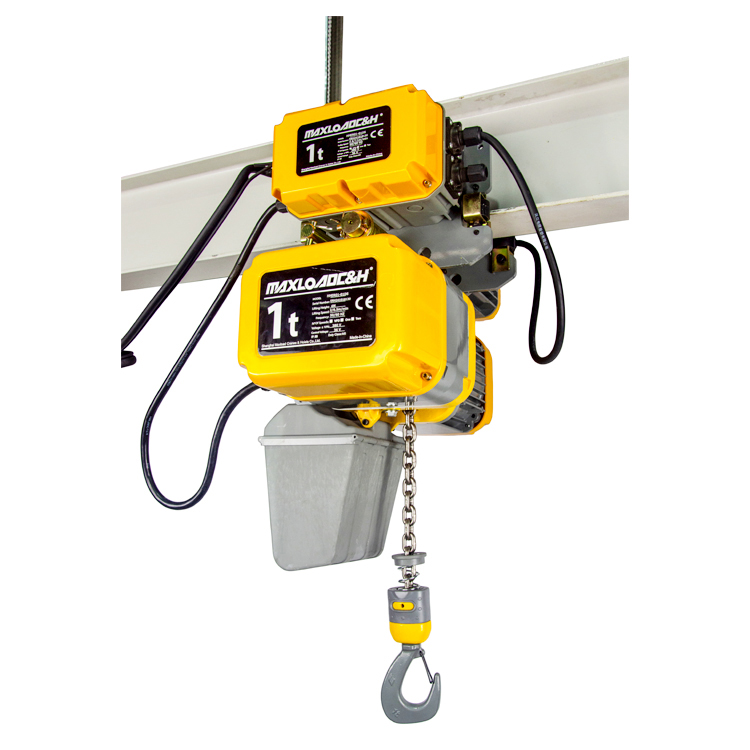
III. Handling Method Determines "Fixed or Mobile"
The work range of the workstation also determines the equipment configuration:
Single workstation, point-to-point lifting: A fixed installation is sufficient – directly mounted on a roof anchor point or support bracket – compact and cost-effective.
Requires horizontal movement along a track: You'll need a manual or motorized trolley to allow the hoist to travel along an I-beam track. Here, you must also consider the track profile, span, load capacity, and whether the trolley's turning radius matches the site layout.
Multiple workstations, large coverage area: May require a KBK modular crane system or a single-girder overhead bridge crane, where the hoist is just one module of the entire system.
IV. Environmental Factors: Many Failures Originate Here
The environment is the most overlooked dimension in selection, but it is precisely a common trigger for equipment failures.
Corrosive environments: In electroplating shops, acid pickling lines, marine chemical plants, and similar places, airborne acid/alkaline mists can corrode standard housings within months. You need corrosion-resistant hoists, with critical components isolated, special surface coatings, and a protection rating of at least IP56.
Explosion-proof requirements: In spray painting shops, oil/gas warehouses, flour mills, or other areas with flammable gases or dust, you must use explosion-proof electric hoists, with fully flameproof motors and electrical components, and with the appropriate explosion-proof certification.
High-temperature environments: In foundries or near furnaces, thermal radiation accelerates electrical component aging and lubricant degradation. Key areas require heat shields, and the motor insulation class must be at least Class F.
Low-temperature environments: In outdoor operations in northern winters or in cold storage, ordinary steel may become brittle and lubricant may congeal. You need low-temperature-resistant materials and specialized lubricants.
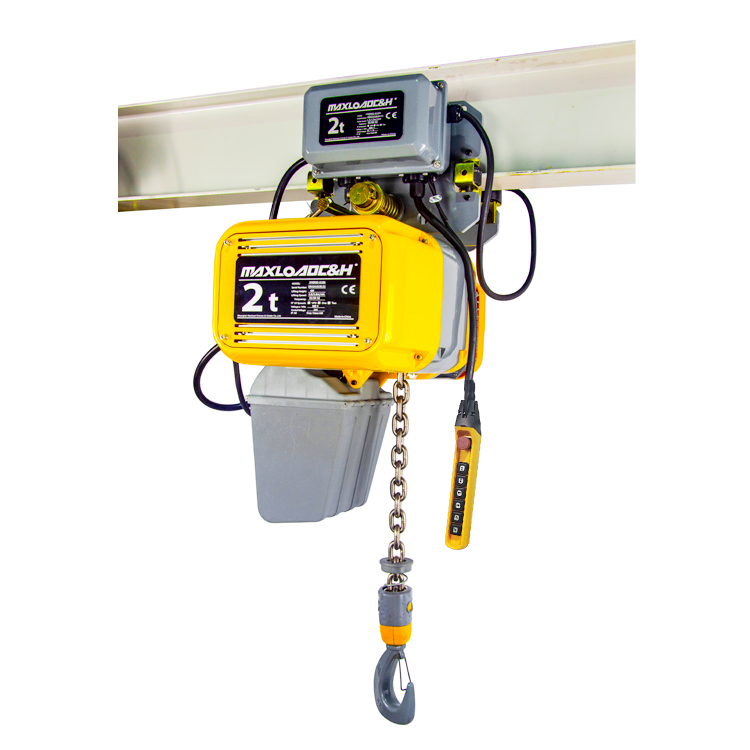
V. Control Method: Human-Machine Matching Matters More Than You Think
The control method directly affects operational efficiency and safety. There are currently three main options:
Low-voltage pendant control: Economical and practical, suitable for fixed workstations, with direct operation, but the operator must follow the equipment.
Wireless remote control: The operator can stand in the best position to observe the workpiece, staying away from the path beneath the load, greatly improving safety. Ideal for large-range movement or applications with limited visibility.
Two-speed / variable frequency control: For precision assembly, mold alignment, or other scenarios requiring slow positioning, a single-speed motor doesn't provide fine control. You need a two-speed or variable frequency drive to achieve "fast lift, slow lower" or stepless speed adjustment.
Conclusion
Choosing an electric hoist is essentially about balancing tonnage, height, work intensity, spatial dimensions, environmental conditions, and control requirements. No single piece of equipment can fit all operating conditions. Only by thoroughly understanding the details of the workspace environment can you make a choice that is both economical and durable. It's recommended that you fill out the checklist below before requesting a quote – you'll find that the gap between professional selection and "buying by gut feeling" is much larger than you think.
 0086 156 1824 5535
 0086 156 1824 5535