Practical Guide to Electric Hoist Selection
Walking into any modern workshop, the electric hoists suspended above the workstations are often critical nodes on the production line. Yet in actual procurement processes, we frequently encounter this scenario: the purchase order simply states "XX-ton electric hoist, one unit," while completely overlooking the complex variables of the workstation environment. The consequence of this oversimplified thinking is often that after installation, numerous incompatibilities emerge—either inconvenient operation, difficult maintenance, or even potential safety hazards.
The selection of an electric hoist is by no means a simple tonnage match; it is a comprehensive interpretation of the workstation environment. Below, we break down the selection logic from five dimensions.
Precise Calculation of Lifting Height
Many factories, when measuring lifting height, only calculate the vertical distance from the ground to the lifting point. This figure is usually insufficient. The true lifting height should equal "vertical distance + rigging device's own height + safety margin + future possible floor buildup margin." For example, if a workpiece needs to be lifted first and then moved horizontally, the space between the hook's lower edge and the workpiece's lifting lug must also accommodate rigging installation.
A more subtle issue: when the electric hoist is installed on an existing runway, there are often beams, pipelines, and other obstructions beneath the runway that compress the actual usable height. It is recommended to use a laser rangefinder from the ground up to the lifting point, while also recording the lowest elevation of obstructions beneath the runway, and take the smaller of the two values as the design benchmark.
Scientific Definition of Duty Classification
This is the most easily overlooked parameter. Two seemingly identical 5-ton hoists—one used at a maintenance station with only two or three lifts per day, the other on an assembly line with lifts every five minutes—should have completely different structural designs and electrical configurations.
Duty classification is determined by two factors: load state (light, medium, or heavy) and frequency of operation (number of operations per hour). Light duty corresponds to fewer than two operations per day, with lifted loads typically not exceeding one-third of the rated capacity; medium duty corresponds to 6–8 operations per hour, with loads between 50% and 80% of the rated value; heavy duty corresponds to more than 10 operations per hour, with loads frequently approaching the rated value.
During selection, the actual operational intensity must be assessed honestly; otherwise, issues such as motor overheating and accelerated brake wear may occur. Special attention should be paid to workstations that appear to have low lifting frequency but require inching for alignment on each lift—frequent inching operations impose much higher wear on contactors and braking systems than smooth lifting. In such cases, the duty classification should be appropriately upgraded.
Site-Adapted Power Supply Methods
The power supply conditions at the workstation directly determine the direction of hoist selection. There are three common power supply methods, each with its applicable scenarios:
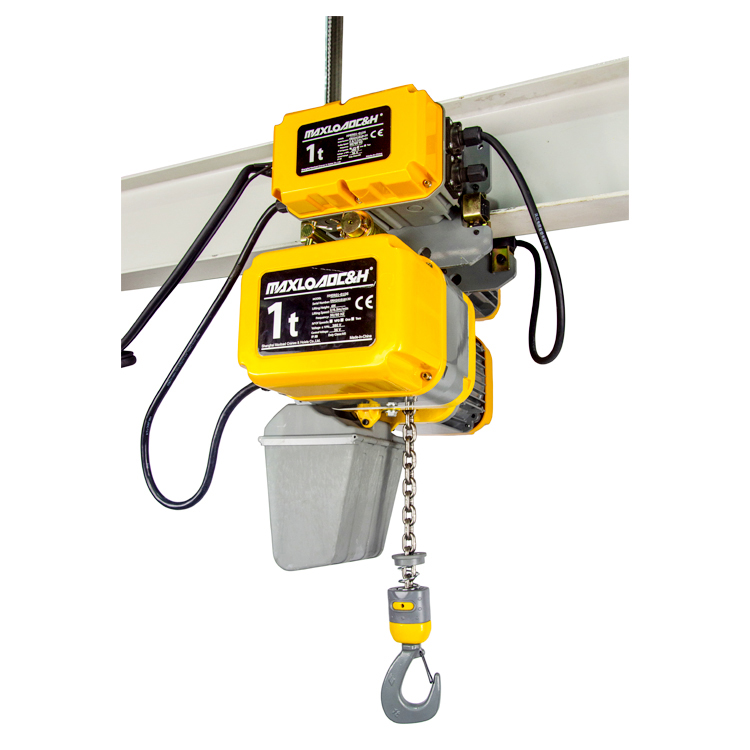
Cable trolley power supply is the most traditional method, suitable for travel distances not exceeding 30 meters and slower travel speeds. Its advantages are simple structure and low maintenance costs; its disadvantage is that cables tend to age from repeated bending.
Suspended cable track power supply is suitable for medium-to-long distance workstations with travel distances of 30–80 meters. The cable slides within a C-shaped track via trolleys, with controlled bending radius, resulting in significantly longer service life than ordinary trolley cables.
Enclosed conductor bar (safety sliding contact) power supply is suitable for workstations with long travel distances (over 80 meters) and high operational frequency. Current collectors contact the conductor bars, eliminating cable drag issues and offering the highest reliability, though initial investment is greater.
When choosing the power supply method, environmental factors such as corrosive gases and dust must also be considered. For example, conductor bars in pickling plants should be corrosion-resistant types, while those in foundries should be enclosed types to prevent dust ingress.
Scenario-Appropriate Control Methods
Floor control or cab control? This decision depends on the actual layout of the workstation.
For the vast majority of workstations, pendant push-button or remote control operation is sufficient. The advantage of remote control is that the operator can choose the best viewing position to avoid obstruction by the workpiece, which is especially suitable for large-piece lifting. However, remote controls may experience signal delays or misoperations in strong electromagnetic interference environments—in such cases, a wired pendant control is actually more reliable.
Cab control is typically used only in two scenarios: first, when the lifting height exceeds 12 meters, making it difficult for ground operators to observe the hook position; second, for heavy-duty continuous operation, where the operator can reduce fatigue inside the cab. The mounting position of the cab is also critical—for hoists that primarily travel along the runway direction, the cab should face the runway direction; for those requiring frequent cross-travel, a rotating cab function should be considered.
Targeted Responses to Environmental Conditions
Environmental factors are often the most easily overlooked variable in selection, yet they carry the most serious consequences.
Temperature environment: The standard operating ambient temperature for ordinary electric hoists is generally -20°C to +40°C. If the workstation is in a cold storage, a low-temperature configuration is required: the wire rope must be galvanized with anti-freeze grease applied to its core; gearbox lubricating oil must be replaced with a low-temperature grade; and the operating temperature range of electrical components must be re-evaluated. Conversely, in high-temperature workstations such as foundries, additional heat shielding is required, motors should use Class H insulation, and auxiliary cooling fans should be considered.
Dust environments: Workstations in wood processing, feed production, and similar industries with combustible dust impose explosion-proof requirements on electric hoists. Dust explosion protection and gas explosion protection are governed by different standard systems; it is essential to clarify whether the hazardous substance in the workstation is dust or gas—the two cannot be interchanged. Dust-explosion-proof hoists feature sealing structures at all housing joints to block dust ingress, and motor surface temperatures are also restricted; ordinary hoists fitted with explosion-proof enclosures are not an acceptable substitute.
Hot and humid environments: Workstations in southern China's rainy season or coastal areas must address condensation issues. Anti-condensation heaters should be installed inside the hoist's terminal box to prevent control circuits from short-circuiting due to moisture ingress.
Electric hoist selection is fundamentally a matching process—matching load, matching space, matching frequency, and matching environment. Common faults encountered in practice—such as frequent brake failures, motor overheating trips, and abnormal wire rope wear—can often be traced back not to product quality issues, but to deviations in judging the workstation environment at the very beginning of the selection process.
It is recommended that before making a selection, you spend half an hour walking through the workstation on-site: stand at the operator's position to assess whether the field of view is unobstructed, measure the clearance height beneath all obstructions under the runway, estimate the actual number of lifts in a typical day, and record temperature, humidity, and the presence of corrosive media. These firsthand data are far more valuable than any product brochure. Only by thoroughly understanding the workstation environment can you select an electric hoist that not only meets current production needs but also retains a reasonable performance margin for the future.
 0086 156 1824 5535
 0086 156 1824 5535