Workstation "Micro-Environment" Determines Equipment Success or Failure
In factory workshops, the combination of a jib crane and an electric hoist is often seen as the "last half meter" solution for workstation logistics. However, in practice, many companies invest significant sums in such equipment but end up feeling it falls short: either the rotation is not smooth, the lifting height is insufficient, or worse, the column begins to tilt within a year due to improper foundation calculations. Where does the problem lie? Mostly in the fact that during selection, only basic parameters like "how heavy to lift" and "how high to lift" were considered, while the "micro-climate" and "spatial constraints" of the workstation environment were overlooked.
Determine the Type: First, Check the Workstation's "Household Registration" and "Real Estate"
The first step in selecting a jib crane is not calculating the load, but examining the spatial ownership and load-bearing conditions of the workstation. This is the fundamental prerequisite for determining which structural type of jib crane to choose.
The pillar-mounted type is the most common form, suitable for workstations with fixed concrete foundation conditions. Its advantages are good rigidity, strong load-bearing capacity, a slewing angle of up to 360°, and a full circular coverage area. However, its "Achilles' heel" lies in the foundation: the column needs to be fixed to a dedicated concrete foundation using anchor bolts. If the workstation floor is only a standard hardened ground with insufficient load-bearing capacity, forced installation may lead to foundation cracking or even overturning. Standards typically require foundation concrete grade not lower than C20, and specialized calculations must be performed based on load and geological conditions.
The wall-mounted type is suitable for workstations with tight floor space that operate along walls. It is installed directly on the plant's load-bearing columns or solid load-bearing walls, occupying zero floor area, making it ideal for narrow aisles or old plant renovation scenarios. However, the load-bearing capacity of the installation wall is a hard threshold: concrete wall thickness should be ≥300mm, or H-beam steel column flange width ≥150mm. Installation on hollow brick walls or ordinary brick walls is absolutely prohibited, as there is a risk of wall cracking.
The portable/movable type is designed for scenarios where multiple workstations share the equipment and the operating point is not fixed. The base is equipped with casters and a counterweight box, allowing it to be moved by hand without the need for embedded foundations. However, it has strict limitations: the operating floor must be level and firm, with a slope ≤1°, and moving under load is strictly prohibited. The portable type is suitable for maintenance workshops, temporary loading/unloading, and other non-fixed operations, but it is not suitable for fixed workstations with long-term, high-frequency use, as the operation process—locking casters and extending support legs before each use—is relatively cumbersome.
The articulated jib/knuckle boom type is the "special forces" choice for scenarios with dense equipment where precise lifting is needed to bypass obstacles. Its boom has multiple articulated joints that can navigate around equipment, piping, and other obstacles to deliver the lifting point to a designated location. In regular open workstations, the pillar-mounted type is more cost-effective and offers higher load capacity, so there is no need to choose the articulated type; however, in tight spaces or areas with many obstacles, its value is irreplaceable.
Judgment Mnemonic: Fixed workstation with a foundation? Choose pillar-mounted. Against the wall to save space? Check the wall and opt for wall-mounted. Multiple workstations with no fixed point? Consider portable. Need to bypass obstacles for precise positioning? Only then use the articulated type.
Determine Load and Boom Reach: A Load Curve Chart Is More Important Than a Parameter Table
After determining the structural type, the key technical selection lies in matching the rated lifting capacity and boom length. There is a common misconception here: boom length and lifting capacity are not fixed values but are inversely related.
Many procurement staff only remember "this jib crane is rated for 1 ton" while ignoring the effective working radius. In reality, given the fixed strength of the column and slewing system, the further the lifting point is from the column, the smaller the safe lifting capacity. The manufacturer must provide a load curve chart clearly specifying the corresponding lifting capacity at different boom lengths. For example, a device might lift 1000kg at a 3-meter boom length, but when extended to 5 meters, the safe lifting capacity may drop to 500kg. Overloading at the maximum boom range is strictly prohibited, as it poses a risk of boom bending or even fracture.
Additionally, when calculating the lifting capacity, one cannot look only at the net weight of the workpiece; the weight of the slings/rigging must be included as per regulations, and a safety margin should be reserved. According to national standards, the selected lifting capacity should be calculated using (workpiece weight + rigging weight) × 1.25 as a safety factor. If the workpiece weighs 800kg and the rigging weighs 50kg, the theoretical selection should not be less than 1063kg. Directly choosing a 1-ton class device would be at a critical state; it is recommended to consider a 1.5-ton or 2-ton class for greater safety.
Two additional spatial parameters are often overlooked:
Top clearance: At least 0.5 meters of safe distance should be reserved between the top of the boom and the plant ceiling or any overhead obstacles, to leave room for the hoist's lifting height and maintenance access.
Swept area clearance: Within the slewing radius of the boom, there must be no fixed equipment, columns, walls, or other obstacles; otherwise, "slewing blind spots" will be created, posing collision hazards.
Selecting the Hoist: Chain, Wire Rope, or Intelligent Balance Hoist?
The "hook" part of the jib crane—the selection of the electric hoist—should be determined based on lifting precision, frequency of use, and environmental conditions. This is a key factor affecting operational experience and efficiency.
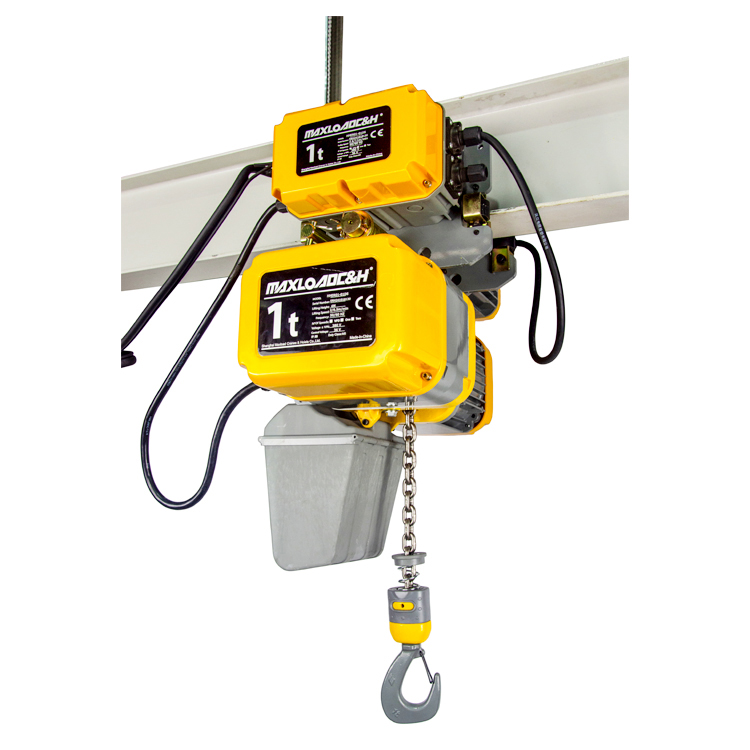
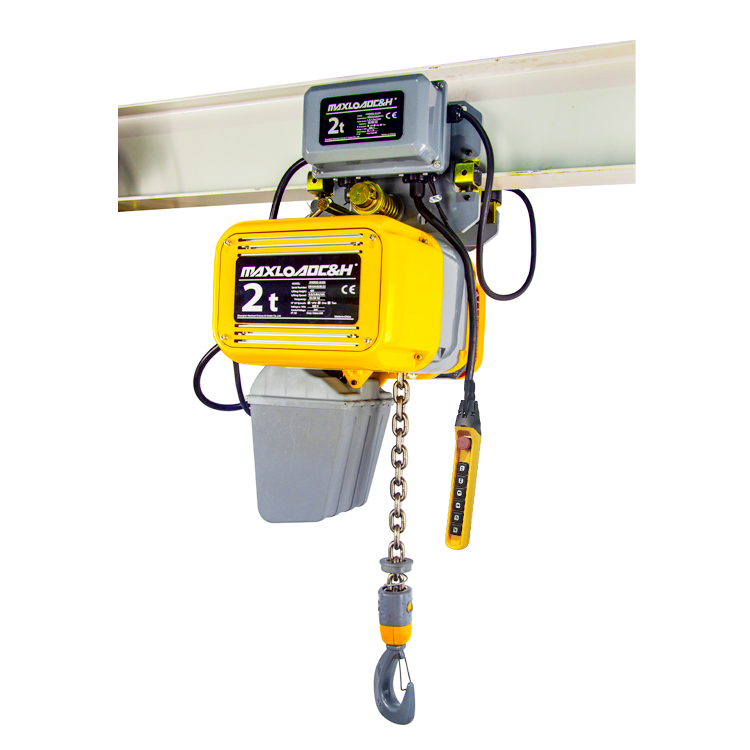
The chain electric hoist is the most common choice for jib cranes. It is compact, lightweight, moderately priced, and suitable for most workstation lifting scenarios, especially those with moderate lifting frequencies. For scenarios requiring precise positioning, it is recommended to choose a two-speed or inverter-controlled chain hoist, whose slow speed allows for millimeter-level fine adjustments to avoid hard impacts.
The wire rope electric hoist offers advantages in greater lifting height and suitability for heavier rigging, but it is more expensive and heavier, which imposes higher demands on the crane's load-bearing capacity. Mini wire rope electric hoists are often used with light-duty pillar-mounted or wall-mounted jib cranes.
The intelligent balance hoist is a high-end option that has seen increasing application in precision assembly in recent years. It can operate in a "floating mode," allowing the operator to easily control the load for fine three-dimensional positioning, much like using a hand tool, greatly improving assembly efficiency and accuracy. If the workstation requires precise docking and assembly, it is worth considering, though the cost is considerably higher.
Environmental "Micro-Climate": Red Lines for Selection under Extreme Conditions
Ordinary workshop environments have little impact on the equipment, but environmental factors under special conditions can directly determine equipment selection and material choices.
Flammable and explosive environments are a red line for selection. Explosion-proof motors, explosion-proof electrical components, and electric hoists and jib cranes with appropriate explosion-proof ratings must be used, strictly following standards such as GB 6067 Safety Code for Lifting Appliances.
In cold storage or low-temperature environments, the toughness of metal materials decreases, and ordinary lubricants may solidify. Low-temperature-resistant materials and low-temperature greases must be selected, and attention should be paid to condensation on rails.
Clean rooms have strict requirements regarding particle emissions and surface treatment. Customizable aluminum alloy rail jib cranes are available to reduce friction-generated dust and minimize contamination risks.
Summary
Selecting a jib crane paired with an electric hoist is essentially a process of "workstation adaptation." It requires a comprehensive judgment based on four dimensions: spatial constraints, load characteristics, frequency of use, and environmental conditions. The most economical approach is: before selection, first invite a specialized manufacturer to conduct an on-site survey, focusing on verifying ground bearing capacity, wall strength, headroom height, and obstacle distribution. Then, based on the load curve chart, select the appropriate type of electric hoist. Only then can you arrive at an equipment configuration plan that is safe, efficient, and capable of long-term stable operation.
 0086 156 1824 5535
 0086 156 1824 5535