Workstation "Tailoring": The Logic Behind Cantilever Crane Selection
In the daily operation of a factory, many seemingly minor pain points at workstations often stem not from insufficient equipment capacity, but from a breakdown in the dialogue between humans and tools. For instance, an overhead crane may be available right next to a machine tool, yet workers prefer manual handling of dozens of kilograms of workpieces just to save a few steps. At some stations, cantilever cranes are installed, but due to sluggish rotation, erratic hoist lifting speeds, or awkward operation, workers find them frustrating and simply abandon them.
This brings us to a core question: How do you match an electric hoist to a cantilever crane based on the actual workstation environment? This is far more than just checking a box next to the lifting capacity—it requires a meticulous matching process involving space, mechanics, and operational habits.
Assessing the "Ground" and the "Wall": Spatial Form Determines the Cantilever Crane's Framework
Before deciding on the hoist, you must first select the structural type of the cantilever crane. This depends entirely on whether your workstation is an "island," "inline," or "mobile" setup.
Column-Mounted Cantilever Crane: The First Choice for Independent Workstations
If your workstation is independent and fixed—for example, at a machining center or an assembly table—and there are no existing load-bearing structures nearby, the column-mounted type is the most practical option. Its greatest advantage is its self-contained nature: it only requires a concrete floor with a thickness of no less than 150 mm and a strength grade of C20 or above to anchor itself. This solution is particularly friendly for retrofitting older factory buildings where reliance on overhead cranes is not feasible. The slewing range typically reaches 270° or 360°, sufficient to cover a fan-shaped working area.
Wall-Mounted Cantilever Crane: Maximizing Corner Spaces
If the workstation is situated against a wall or a factory column, the wall-mounted type excels at "stealing space." It occupies no floor area and is fixed directly to the wall or structural steel column, making it ideal for narrow aisles and space-constrained areas. However, there is a strict prerequisite: the mounting structure must have adequate load-bearing capacity. Solid concrete walls must be at least 300 mm thick, and H-beam flanges should be at least 150 mm wide. Hollow brick walls are absolutely unsuitable. Its slewing range is generally limited to within 180°, which is sufficient for covering areas adjacent to the wall.
Mobile Cantilever Crane: A Flexible Solution for Multi-Station Sharing
If the lifting point is not fixed—for example, in equipment maintenance, temporary loading/unloading, or shared use across multiple workstations—the mobile cantilever crane is the only logical choice. Its base is equipped with casters, requires no foundation, and can be pushed around. However, it is critical to note that this is a flexible piece of equipment and demands a highly level floor. Additionally, moving it with a load is strictly prohibited. The base dimensions and counterweight directly determine its resistance to overturning, so do not prioritize boom length alone during selection.
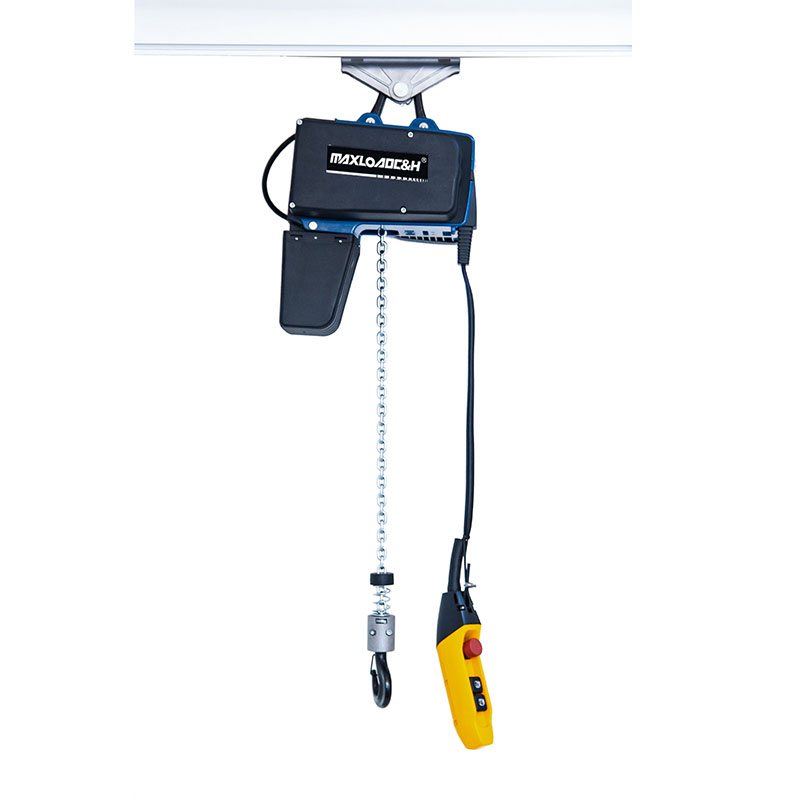
Selecting the "Hoist": The Lifting Mechanism is the Heart – Don't Compromise
The cantilever boom is merely the "skeleton"; the electric hoist is what actually does the work and interacts directly with the operator. Selecting the hoist involves three dimensions: load capacity, environment, and controllability.
Load Capacity and Safety Factor: Don't Just Calculate the Net Weight of the Workpiece
This is the most fundamental and most often overlooked step. Many users only consider the weight of the workpiece, neglecting the weight of the lifting accessories. The correct calculation is:
Net Weight of Workpiece + Weight of Rigging × 1.25 Safety Factor. This is a mandatory requirement per national standard GB/T 3811-2008.
For example, for a 200 kg workpiece with 50 kg of rigging, the rated load should be at least (250 × 1.25) ≈ 315 kg, which rounds up to a 0.5t model. This margin is not for handling occasional overloads but to account for the load reduction at the maximum boom radius—the longer the boom, the less weight it can actually lift.
Environmental Adaptation: Standard, Explosion-Proof, and Clean Room Types
Environmental compatibility is a common pitfall. During selection, you must clearly answer three questions:
Standard Workshop: A standard electric chain hoist is the most versatile choice. It has a compact structure, lower maintenance costs than wire rope hoists, and the chain is less prone to wear.
Flammable/Explosive Environments: An explosion-proof type is mandatory. The electrical components must be specially flameproof-enclosed—this is a safety red line with no room for compromise.
Clean Workshops (Electronics, Food, Pharmaceutical): Standard hoists' paint and lubricants may become sources of contamination. A hoist made of stainless steel or with an anodized surface, featuring a smooth, dead-corner-free finish to prevent dust accumulation, is required.
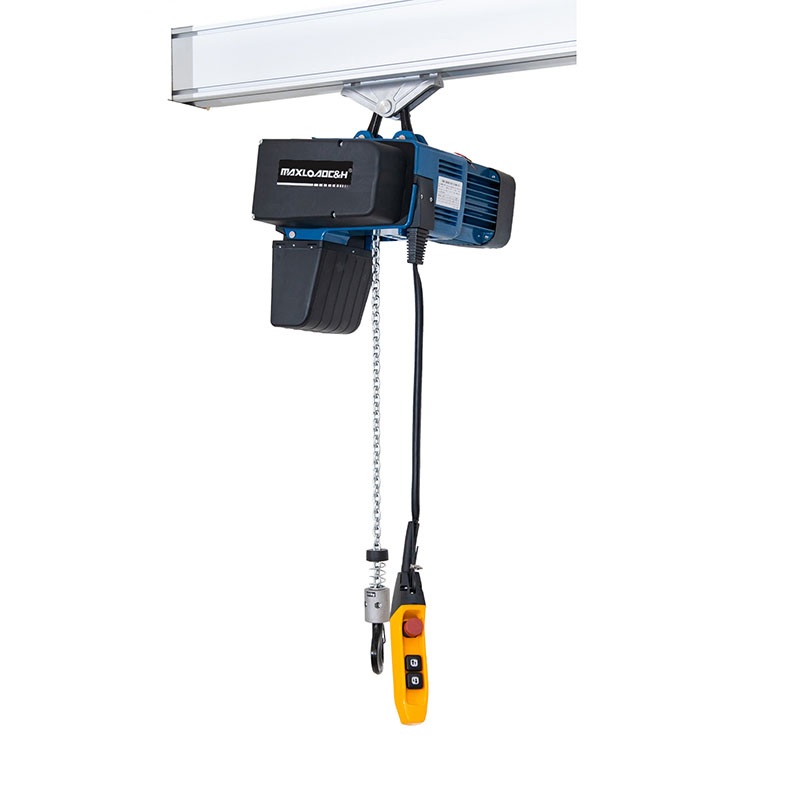
Controllability: "Usable" vs. "User-Friendly"
This directly impacts the worker's willingness to use the equipment.
Lifting Speed: Standard single-speed hoists offer only one speed, causing significant impact during initial lifting, which is unfriendly to precision workpieces. If precise positioning is required, it is highly recommended to opt for a dual-speed or variable-frequency-drive hoist, where the slow speed allows for millimeter-level fine adjustments.
Slewing Method: For small tonnages and low slewing frequency, manual push-rotation is sufficient. If the tonnage is larger or slewing frequency is high, an electric slewing mechanism should be selected; otherwise, the operator's arms will experience extreme fatigue by the end of the day.
System Integration: Don't Let Weak Points Surface at the Interfaces
Once both the cantilever crane and the electric hoist are selected, the final step is to verify they can work together harmoniously.
Slewing Flexibility Check: If manual slewing of the boom becomes stiff after hoist installation, it is highly likely due to improper column verticality adjustment or insufficient lubrication of the slewing bearing. This significantly increases operational resistance, forcing the worker to waste energy pushing the boom.
Headroom Clearance Calculation: The lowest point of the boom must be at least 2.2 m above the floor. Simultaneously, verify the hoist's lifting height: (Column height + Boom height above floor – Rigging length). Ensure it can comfortably lift the workpiece clear of the equipment or worktable.
- Interference Check: Within the boom's slewing radius, there must be no pipes, cable trays, or adjacent equipment. For 360° slewing column-mounted types, it is crucial to ensure the rotation path does not collide with walls or structures.
Conclusion
Equipping a workstation with a cantilever crane and hoist is not fundamentally about purchasing steel and motors; it is about providing the operator with a capable assistant. This assistant must be strong, responsive, and smooth. Instead of getting lost in complex parameter sheets, return to the workstation itself. Examine the floor hardness, measure the aisle width, and ask the operator where they feel the process is awkward—the answers often become clear.
When properly matched, it becomes a tool whose presence you barely notice, yet without it, the production line would come to a halt. When poorly matched, it becomes a stubborn piece of "scrap iron" that fights you every day. Selection is a process worth taking slowly and meticulously.
 0086 156 1824 5535
 0086 156 1824 5535