A Practical Buyer's Guide Based on Real-World Usage Scenarios
In factory workshops, electric hoists are a common sight. But being common doesn't mean they are easy to select. Many procurement personnel focus solely on the rated load capacity when choosing a hoist, only to discover a host of problems after installation—the lifting height is just short of reaching the target, the movement is jerky and obstructed, operators complain that the pendant cable is too short, or the motor noise is too loud. These seemingly minor issues actually erode production efficiency every day and can even create safety hazards.
An electric hoist is not a standard off-the-shelf product; its selection must be based on a thorough understanding of the workstation environment. A hoist that performs well in a large assembly shop could be a disaster in a cramped equipment maintenance area. Below, we break down the key points that truly matter during the selection process, based on actual usage scenarios.
Spatial Geometry Parameters Are the Foundation
When you get the drawings for a workstation, the first things to confirm are not the tonnage of the hoist, but three geometric parameters: lifting height, travel distance, and operating space.
Lifting height is not simply the building height minus the distance from the floor to the suspension point. You must consider the height occupied by the hook block itself when the hook is at its upper limit, as well as the minimum number of safety wraps of wire rope that must remain on the drum. Many users overlook this, resulting in a hoist that, once installed, leaves the hook hanging in mid-air at its highest point, forcing operators to stand on tiptoe to attach loads. The correct approach is: take the suspension point height, subtract the maximum height required for the load to be positioned, and then subtract the height of the slings and the hook block. The resulting value is the effective lifting height. If this value does not meet requirements, you will need to request a non-standard lifting height from the manufacturer.
Regarding travel distance, in addition to the track length, pay attention to the installation position of the bumpers. The electric hoist needs sufficient deceleration distance at both ends of the track. If there is equipment or walls at either end of the workstation, the length and installation method of the bumper stops must be communicated and clarified in advance. Otherwise, the hoist will hit the ends hard every time, significantly reducing the lifespan of the track and end trucks.
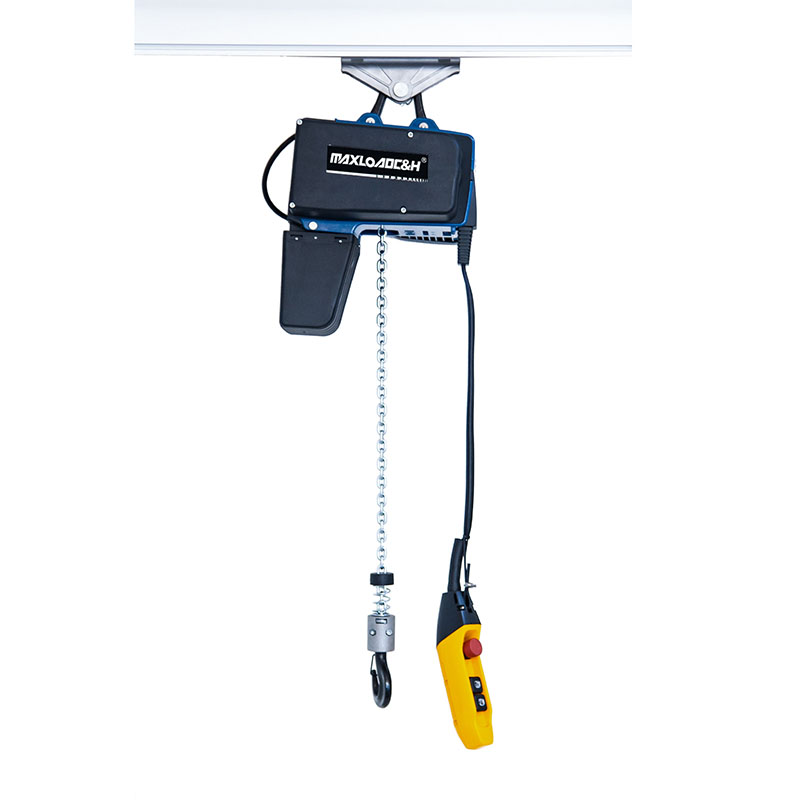
The dimensions of the operating space are the most easily overlooked. Are there pipes, pillars, or protective netting around the hoist body and the load during lifting? Is the operator's standing position directly under the hook or to the side? If the workstation is narrow, a standard electric hoist might not fit due to the size of the motor housing. In this case, you need to consider a more compact model or request detailed dimensional drawings from the manufacturer for verification during selection.
Travel Speed Is Not Always Better
A common misconception among users is that faster lifting and travel speeds mean higher efficiency. However, in actual workstations, speed matching is often more important than sheer speed.
For precision assembly workstations, loads need to be positioned smoothly and accurately. This requires the hoist to have slow-speed modes or inching functionality for both lifting and traversing. If the workstation demands even higher positioning accuracy—for example, mold installation or machine tool loading/unloading—a variable frequency drive (VFD) controlled hoist could be considered. However, this significantly increases cost, and the VFD has certain environmental requirements; in dusty workshops, the enclosure protection rating needs consideration.
Conversely, if the workstation is purely for material handling with high lifting and traversing frequency, choosing a higher speed is sensible. However, higher speeds mean increased motor power and brake load, leading to faster energy consumption and brake wear. This is the trade-off for improved efficiency and must be considered comprehensively.
Power Supply and Control Method Choices
The power supply method for an electric hoist directly impacts the stability and safety of the equipment. On common I-beam tracks, cable trolleys are the most mainstream power supply solution, offering moderate cost and easy maintenance. However, the number of trolleys must be calculated based on track length and cable sag. If the spacing between trolleys is too large, the cable will sag and snag; if too small, it increases resistance and wear.
For long-travel tracks, a safe conductor bar system is a better choice. Conductor bars provide a stable power supply with less wear but have a higher initial investment and require precise track straightness and installation accuracy. If the workstation is outdoors or in an environment with corrosive gases, a conductor bar with the appropriate protection rating is necessary.
The control method seems simple, but its choice directly affects the operator's experience and work efficiency. The pendant push-button station is the most traditional and reliable method. However, several details must be considered: Does the pendant cable length cover all positions where the operator needs to stand? Are the direction arrows clearly marked on the buttons? Is the emergency stop button within easy reach?
Wireless remote controls are increasingly common in workstations. Their biggest advantage is allowing the operator to stand away from under the load, choosing a safer position. However, remote control has limitations—battery life, signal interference, response delay, and potential frequency conflicts in areas with multiple devices operating simultaneously. These are not technical hurdles, but the configuration needs to be specified during selection, such as backup batteries and frequency setting methods.
Motor Protection Rating and Environmental Matching
The motor is the heart of the electric hoist, and its protection rating directly determines the hoist's service life in a specific environment. IP44 is the standard configuration for most general-purpose hoists and is suitable for typical workshop environments. However, the protection rating must be increased if the workstation falls into the following categories:
Dusty environments: Foundries, woodworking shops, cement plants, etc. Dust can enter the motor, causing short circuits or bearing wear. At least an IP54 rating is required, and the ease of cleaning cooling fins on the motor surface should be considered.
Wet or corrosive environments: Electroplating shops, wash bays, outdoor installations, etc. Moisture and corrosive gases can attack the motor housing and internal windings. Besides an IP55 or higher rating, additional anti-corrosion coating on the motor surface should be specified, and wire ropes should be galvanized or stainless steel.
High-temperature environments: Near furnaces, heat treatment stations, etc., where the ambient temperature exceeds 40°C, the motor's cooling capacity decreases. Continuous operation may cause frequent thermal overload tripping. In such cases, the manufacturer must be informed of the ambient temperature during selection; a larger motor or one with forced air cooling might be necessary.
Duty Cycle Rating Reflects Usage Intensity
This is the most common pitfall in selection. Many users only look at the load capacity and ignore the duty cycle rating. As a result, an M3-rated hoist is used as if it were M6, leading to severe gear wear and brake slippage within six months.
The duty cycle rating of an electric hoist is determined by both the load state and the frequency of use. Simply put, if the workstation lifts loads no more than 10 times per day, mostly under the rated load, then M3 or M4 is sufficient. If the workstation is part of an assembly line with over 20 lifts per hour, often at over 80% of rated load, then at least M5 is required. For continuous heavy-duty operations like metallurgy or casting, M6 or even M7 is the appropriate choice.
Selecting a rating that is too low may lead to premature equipment failure—and safety issues are the bigger concern. Selecting a rating too high increases initial procurement costs unnecessarily. Therefore, this parameter must be calculated based on the actual production cycle of the workstation and cannot be guessed.
Essential Safety Features
Beyond the standard upper and lower limit switches, several safety features deserve special attention during selection:
Overload limiter: For workstations with significant load fluctuations or where operators might misjudge load weight, mechanical or electronic overload limiters effectively prevent accidents caused by improper operation. Electronic versions can have set alarm and trip values, offering more flexibility but at a higher cost.
Phase sequence protector: Incorrect power supply phase sequence causes the motor to reverse. Without phase sequence protection, the hook might descend when the operator presses the 'up' button, posing a major accident risk. Although most hoists have this function integrated, it is wise to confirm its presence during selection.
Rope guide limit switch / Emergency limit switch: This is the final safety barrier. If the upper and lower limit switches fail, this switch cuts the motor power directly. The reliability of this component is critical for safety. When selecting, choose certified products and make it a key point of focus during regular maintenance inspections.
Pre-Planning for Installation and Maintenance
An electric hoist doesn't work automatically just by being placed on-site. Installation conditions and long-term maintenance costs must also be considered during selection.
Installation: Does the I-beam track model match the hoist's trolley? If the track flange width and thickness are outside the standard range, the trolley may not fit or may run roughly. If there is an existing track, the track specifications must be sent to the manufacturer for confirmation during selection.
Maintenance: Is the brake adjustment position easily accessible? Does replacing the wire rope require dismantling many surrounding parts? Are the electrical components in the control box readily available for purchase? These seemingly trivial issues will recur over the years of use. A well-designed hoist can significantly reduce maintenance costs and downtime.
There is no single "correct" answer in electric hoist selection, only the most suitable solution. Only after thoroughly understanding the workstation's spatial conditions, usage frequency, environmental characteristics, and operational habits, and then cross-referencing them with the manufacturer's technical specifications, can you make a decision you won't regret. The initial purchase cost is just the beginning; usage costs and maintenance costs are the expenditures that span the equipment's entire lifecycle.
Next time you face a selection sheet, take a moment to visit the workstation. Watch how the operators work, measure the spatial dimensions, and ask the maintenance staff about their common frustrations. These on-site details will often tell you more about which hoist to choose than the parameters in the product brochures.
 0086 156 1824 5535
 0086 156 1824 5535