Selection Logic and Practical Considerations for Electric Hoist Sizing Based on Workspace Constraints
In factory planning or production line renovation, lifting equipment selection is often treated as a "standard parts purchase"—check the load capacity, match the lifting height, look at the speed, and place the order once the parameters seem about right. However, in actual use, what truly makes operators feel at ease or awkward, and what increases or decreases maintenance frequency, is often not the numbers on the specification sheet, but rather how well the equipment fits the workspace environment.
This article attempts to step away from mere parameter listings and organize a more field-oriented selection approach from three dimensions: physical constraints of the workspace, usage rhythm, and human factors.
Look at the Space First, Then the Load Capacity
When selecting an electric hoist, most people's first instinct is to ask, "What's the load capacity?" That is not wrong, but in a workstation setting, spatial dimensions are often a harder constraint that should be prioritized over load capacity.
Clear Height Above and Lifting Point Structure
Is the overhead structure a crane runway beam, a steel structural corbel, or a pre-embedded lifting ring in a concrete slab? This directly determines the mounting configuration of the hoist. Two common types exist:
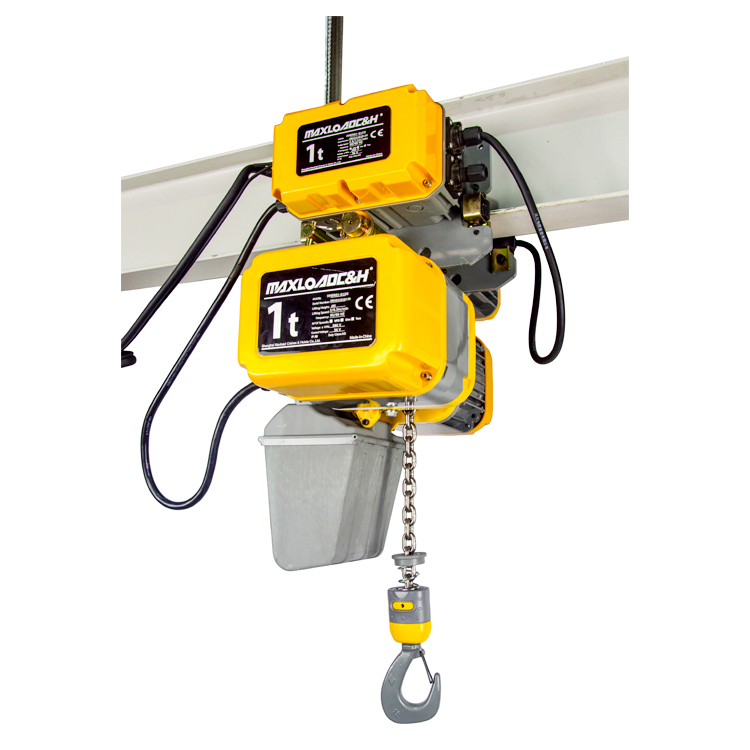
Suspended (underhung) type: The hoist body hangs below an I-beam track, suitable for workstations requiring continuous tracks and linear or curved movement.
Fixed type: The hoist is secured to a single lifting point and performs only vertical lifting, suitable for spot lifting operations.
If the overhead clearance is tight—for example, in old factory buildings with low ceiling heights or existing pipes and ducts above—the fixed type is often more practical than the suspended type. For the suspended type, track height must be further considered: the combined height of the hoist body plus the upper limit position of the hook must be less than the clear distance from the lifting point to the floor; otherwise, the hoist will reach its upper limit before the hook attains the required height.
Lateral Operating Radius
A workstation is not an open square. Incoming materials sit on a pallet to the left, the assembly table is in the middle, and finished goods go to the right—the distances among these three points determine the fan-shaped or rectangular area the hoist needs to cover.
For the suspended type, track length and turning radius are key specifications; for the fixed type, the farthest point the hook can reach depends on boom length or wire rope fleet angle. A common site issue is: the hoist is selected, but when the hook is at its lowest position, it cannot reach the farthest corner bin of the workstation, forcing operators to "swing" the workpiece over—which is both dangerous and fails to truly reduce manual labor.
Suggested approach: Before selection, use a tape measure to map out three critical points within the workstation—loading point, processing/assembly center point, and unloading point—and measure their distances relative to the vertical projection of the lifting point. This field data will help determine boom extension length or track layout far more effectively than any formula.
Lifting Height Is Not Always Better When Higher
Lifting height is another parameter easily oversimplified. Many assume, "A bit more stroke gives some margin," but over-pursuing high lifting height in a workstation comes with real trade-offs.
Two Heights Must Be Distinguished
Lifting height: The travel distance of the hook from its highest to lowest position.
Highest hook position: The distance from the hook bottom to the floor when fully raised.
If the workstation requires lifting a workpiece to a certain height for standing operators to work, the highest hook position should be slightly above the worktable height plus the clearance needed for workpiece turnover. If the highest hook position is too high, operators must tilt their heads up and reach up to guide the hook or workpiece, which becomes a significant source of fatigue over time.
Floor and Pit Factors
Some workstations incorporate pits or sunken work platforms to maintain floor-level surfaces. In such cases, does the hook's lowest position need to enter the pit? If so, the number of wire rope wraps on the drum changes, affecting limit switch settings—this is not covered by the hoist's default factory configuration and must be specifically addressed during selection.
Speed Is Not Always Better When Faster
Choosing lifting speed and traveling speed is where the "spec-sheet mindset" most easily leads to errors.
The Pace Lies Between Fast and Slow
Many users prefer dual-speed or variable-frequency drives, which is fine in itself. But the upper and lower speed limits should derive from the workstation's cycle time, not from the intuition that "faster means higher efficiency."
Precision assembly workstations: Workpieces require alignment with dowel pins or threads; excessive lifting speed makes positioning difficult, forcing operators to rely on jogging, which actually prolongs single-lift cycle time. Here, low-speed stability matters more than the high-speed number.
Rough handling workstations: Workpieces are large castings that only need moving from one rack to another; speed sensitivity is low, but start/stop impact sensitivity is high—excessive speed changes accelerate wear on wire ropes and brakes.
Micro-motion Performance Is Often Overlooked
More impactful than speed values in daily use is the hoist's response characteristics at its lowest speed. When the operator presses the button, does the hook move smoothly in millimeter increments, or does it either "not move at all or jerk suddenly"? This characteristic is usually absent from selection literature, yet it largely determines whether operators are willing to use the hoist and whether they dare to work close to the workpiece.
Suggested approach: When conditions allow, have an experienced rigger test-operate a sample or similar equipment, focusing on the smoothness of low-speed start/stop. This is not a quantifiable parameter, but it is one of the most impactful experiential factors in actual use.
Control Method and Operating Field of View
Pendant or Remote Control?
This question essentially asks: where does the operator stand, and where do they look while working?
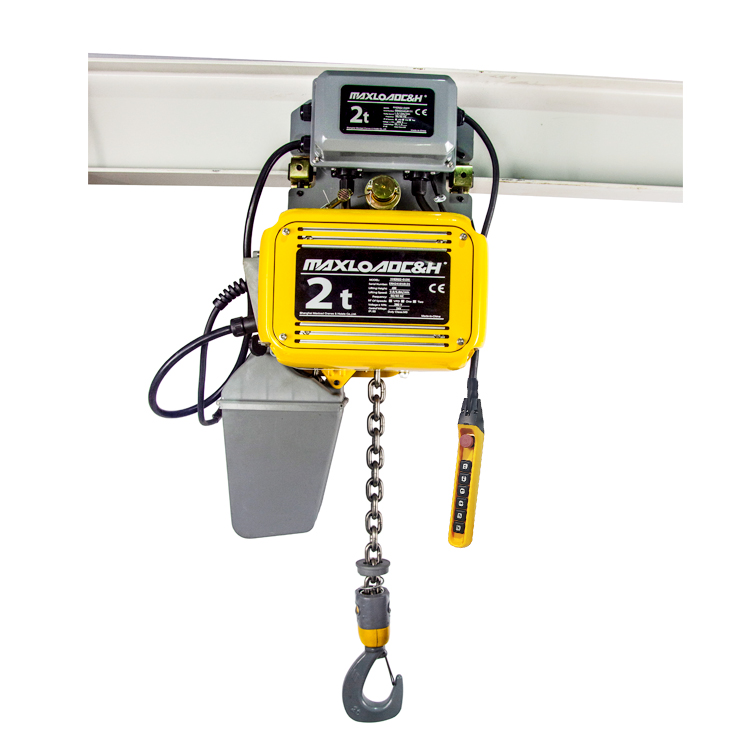
A pendant is connected via cable, requiring the operator to stand directly below or near the hoist. If the workstation has rotary tables, transfer conveyors, or high-temperature zones, the cable may snag or become heat-damaged.
A remote control allows operators to stand in a safe location with the best visibility to observe lifting and movement. However, remote controls come with trade-offs: battery management, signal interference, and preventing inadvertent control of multiple devices—these daily hassles become additional maintenance burdens.
For small workstations with simple, fixed-point lifting, a wired pendant is often more reliable and straightforward; for workstations with large-range movement, the flexibility of wireless remote control is worth the extra effort.
Control Interface Layout
An easily overlooked detail is button arrangement and actuation force. Is the emergency stop button within natural thumb reach? Is the spacing between up and down buttons sufficient for gloved operators to accurately identify and avoid misoperation? These design details directly affect reaction speed in emergencies.
Wire Rope vs. Load Chain—Selection Logic
Electric hoists primarily use either wire rope or load chain as the load-bearing element, each suited to different workstation environments.
Wire Rope Electric Hoists
Suitable for workstations with higher lifting heights and higher duty classifications. Wire rope advantages include smaller drum diameters and shorter drum lengths for the same lifting height, helping reduce hoist body dimensions. However, wire rope life under bending fatigue and corrosive environments requires attention—if the workstation contains acid mist, moisture, or high-temperature radiation, the wire rope's surface treatment requirements and periodic replacement intervals must be clearly specified.
Chain Electric Hoists
Feature a more compact structure, with the sprocket directly driving the chain and no drum occupying lateral space. The disadvantage is that for the same lifting height, the total chain length accumulates, requiring sufficient space for the chain container; however, chain hoists better accommodate angled lifts due to the sprocket's tolerance for fleet angles compared to wire rope drums.
Key Selection Point
If the lifting point is not directly above the workpiece, and the wire rope or chain operates at an angle to the vertical, special attention must be paid to whether that angle exceeds the equipment's allowable range. Exceeding it causes the wire rope to rub against drum flanges or the chain to wear abnormally on the sprocket—these are among the most common early failure causes in the field.
Safety Features: Which Are Mandatory and Which Are Add-Ons Based on Environment
Basic safety features for electric hoists include upper/lower limit switches, emergency stop buttons, and overload limiters—standard in most industrial settings. However, special risks in the workstation environment may require additional consideration:
High-temperature environments: Near foundries, forges, or heat-treatment stations, choose heat-resistant wire rope and thermal insulation guards; electrical component temperature ratings must also be upgraded accordingly.
Dusty environments: Woodworking, carbon, and powder metallurgy stations may allow dust ingress into motor commutators and brake clearances—consider enclosed structures or additional dust suppression measures.
Wet or corrosive environments: Electroplating, washing, or outdoor stations require attention to enclosure protection ratings and options such as stainless steel or galvanized wire rope.
A common mistake is adding all possible safety options, thinking "more is better." In practice, excessive sensors and electrical interlocks increase failure points and add to daily inspection workloads. The correct approach is to identify the actual risks specific to the workstation and select corresponding countermeasures based on that risk assessment.
Allow for Installation and Maintenance Access
One of the most easily forgotten aspects during selection is that equipment will eventually need servicing and component replacement.
Is sufficient maintenance clearance left around the hoist body? Does opening the motor cover require access from the side or the end? Does replacing wire rope or chain require removing the entire hoist? The answers to these questions affect workstation layout—if the hoist is installed tightly against a wall or beneath overhead pipes, future maintenance may require scaffolding or pipe removal, and the indirect cost of a single service event could exceed the hoist's price difference.
A better approach: during the selection phase, clearly define the mounting method and access routes, and confirm that routine inspection items are operationally feasible on-site. If a piece of equipment requires a lift truck or removal of adjacent equipment for daily checks, its total lifecycle cost will far exceed its purchase price.
In Conclusion
Electric hoist selection is not a mathematical exercise on a spec sheet, but a holistic judgment of the workstation's physical environment, operational habits, and maintenance conditions. The same hoist model may be well-liked, durable, and operator-friendly at Workstation A, yet become a source of frustration—awkward, laborious, and trouble-prone—at Workstation B. The difference often lies not in the equipment itself, but in whether the selection process accounted for those real, nuanced, and hard-to-quantify factors in the workstation environment.
Return to a fundamental principle: the goal of selecting a hoist is not to fill out a parameter table, but to make the person at that workstation able to use it comfortably, safely, and without hassle. From this perspective, many seemingly complex selection problems actually become clearer.
 0086 156 1824 5535
 0086 156 1824 5535