How to Precisely Select the Right Electric Hoist for Your Workshop Workstation
In modern factory workshops, the workstation is the smallest unit of production activity and the most direct arena where efficiency and safety intersect. When selecting an electric hoist, many people habitually focus solely on the rated load capacity, thinking, "As long as the tonnage is right, that's enough." However, in actual workstation operations, a mismatched electric hoist can cause far more trouble than simply "not being powerful enough": it may overheat and trigger thermal protection due to frequent starts and stops, its chain may sway ineffectively and knock into workpieces, or even cause safety incidents due to blind spots.
Selecting an electric hoist is, in essence, a process of "decoding" the workstation environment. Rather than saying we are choosing equipment, it is more accurate to say we are matching it to a solution that adapts to the space, operations, power supply, and working conditions. The following analysis breaks down five core dimensions to help you match the most suitable electric hoist to your workstation.
Spatial Geometry and Lifting Path: The First Threshold for Equipment Selection
The physical space of the workstation directly limits the available types of electric hoists.
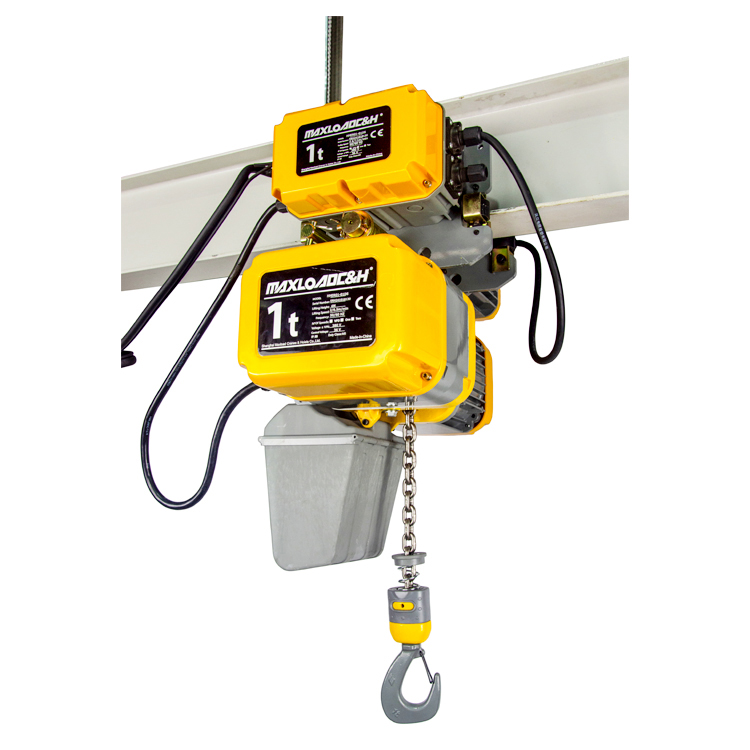
The Predicament of Low Headroom: In many older factories or workshops with low ceilings, the vertical distance between the overhead support beams and the floor is very limited. In such cases, if a standard hook-type electric hoist is chosen, its own structural height may consume the already scarce space, causing the lower hook limit position to be too high, forcing operators to bend over or use ladders to attach and detach workpieces.
Solution: In low-headroom environments, priority should be given to low-headroom electric hoists. These products optimize the connection between the hoisting mechanism and the traveling trolley, "side-mounting" or "top-mounting" the hoist body, significantly reducing the equipment's own structural height. This effectively increases the hook's lifting height without altering the plant's structure.
The Real Need for Lifting Height: A greater lifting height is not always better. Excessively long wire ropes or chains are prone to tangling during lifting and increase the time for an empty hook to descend. Be sure to measure the exact distance from the hook's upper limit position to the floor, and then add the heights of the slings and the workpiece itself to calculate the actual lifting height required. If the workstation has a pit or requires lifting workpieces into equipment, you must also consider the safety turns of the wire rope on the drum and leave sufficient margin.
Frequency of Use and Duty Cycle: The Dividing Line Between "Usable" and "Durable"
This is the most easily overlooked "hidden cost" in the selection process. An electric hoist that works 8 hours a day under full load is fundamentally different in internal construction from a backup hoist used only half an hour a day.
Duty Classification – Not Just a Power Issue: The lifespan of an electric hoist depends not on how many years it has been used, but on how many stress cycles it has endured. This is the significance of the mechanism's duty classification. If the workstation involves heavy-duty machining or continuous assembly lines with a very high load factor, a hoist with a higher duty classification must be selected. Such hoists are equipped with larger-capacity motors, more heat-resistant brakes, and thicker wire ropes or chains, with enhanced heat dissipation and insulation grades. Conversely, if used occasionally in a maintenance workshop, a hoist with a standard duty classification will suffice, avoiding unnecessary cost overruns.
The Challenge of Inching/Jogging Operation: Workstation lifting often involves frequent micro-movements and inching – for example, placing a large workpiece into a machine chuck requires millimeter-precise positioning. This type of operation places significant stress on contactors and motors. If a standard general-purpose hoist is chosen, frequent inching can lead to contact tip burnout and excessive motor temperature rise. In such cases, attention must be paid to whether the hoist is equipped with soft-start or variable frequency drive (VFD) functionality. A VFD-controlled hoist enables smooth acceleration and deceleration, reducing mechanical shock to the gearbox while achieving precise load suspension and positioning – which is precisely the critical requirement for precision assembly workstations.
Control Interface and Visibility: The Safety Logic of Human-Machine Interaction
The core of workstation operation is the human operator. A hoist that is awkward to control or has obstructed visibility is a major safety hazard.
Evolution of Control Methods:
Push-Button Pendant: This is the most traditional control method, with low cost and stable signals. However, in workstations with large travel distances, operators are often constrained by long cables and can be tripped by workpieces. If choosing wired control, ensure the cable length is sufficient to cover the farthest operating point and that a suitable suspension wire rope is equipped to prevent cable abrasion.
Wireless Remote Control: This is currently the mainstream trend for workstation operation. The operator can stand at the best vantage point, away from directly beneath the lifting path, to observe the lifting and movement of the workpiece. However, in environments with strong electromagnetic interference, the remote control's anti-interference capability is crucial.
Blind Spots and Dual-Speed Operation: When the workstation has obstructions, or the operator cannot directly see the hook position, a single-speed travel mechanism can easily lead to collisions. For turning over or positioning long, oversized workpieces, it is recommended to choose a hoist with dual-speed control, using the slow speed for precise positioning and the fast speed for general handling.
Power Supply and Adaptability: A Critical Foundation Not to Be Overlooked
Many factories discover that their power supply capacity is insufficient only when adding new equipment.
Voltage and Number of Phases: Standard industrial power in China is mostly 380V, three-phase. If the workstation is in a pilot workshop or temporary area with only 220V single-phase power available, a dedicated single-phase electric hoist must be selected, or a variable frequency power conversion system may be required – though the latter is costly. Be sure to confirm the circuit breaker capacity and cable gauge at the workstation's distribution panel before selection to prevent motor burnout caused by excessive voltage drop during startup.
Hoisting Speed and Motor Pole Number: Where power supply conditions permit, the number of motor poles determines the hoisting speed. For precision welding or assembly workstations, slow hoisting helps reduce alignment errors caused by workpiece sway; for bulk unloading workstations, fast hoisting effectively shortens the operational cycle time.
Environmental Corrosive Factors: The Invisible "Killers"
The workstation environment dictates the anti-corrosion grade and ingress protection (IP) rating of the hoist's materials.
Dust and Moisture: Foundries and woodworking shops generate significant dust, and fine particles can infiltrate the motor commutator or brake gaps, leading to short circuits or brake failure. Such environments require motors with at least IP55 protection and enclosed dust-proof brakes. In electroplating or cleaning stations, where corrosive acid/alkali fumes are aggressive, galvanized chains or stainless steel wire ropes must be used, and electrical enclosures need special anti-corrosion coating treatment.
High Temperature and Thermal Radiation: Near smelting and forging workstations, thermal radiation can easily deform the plastic housings of limit switches and cause lubricating oil to volatilize. In such cases, heat-insulated electric hoists should be considered, or fixed heat shields should be installed between the hoist body and the heat source. Additionally, in high-temperature environments, the heat-resistant friction material of the brake is a key factor determining safety.
Mandatory Requirements for Explosive Atmospheres: If the workstation involves paint spraying, solvent cleaning, or the presence of flammable gases/dust, standard electric hoists are absolutely inadequate. An explosion-proof electric hoist of the appropriate classification must be selected in accordance with national explosion-proof standards. Such hoists have stringent mandatory requirements for motors, electrical components, limit switches, and even non-sparking materials on hook surfaces – this is an unbreachable red line.
Maintenance Convenience and Lifecycle Cost
Finally, a point often overlooked by decision-makers – how easy is this hoist to repair?
Workstation production time is valuable, and any downtime due to failure means lost capacity.
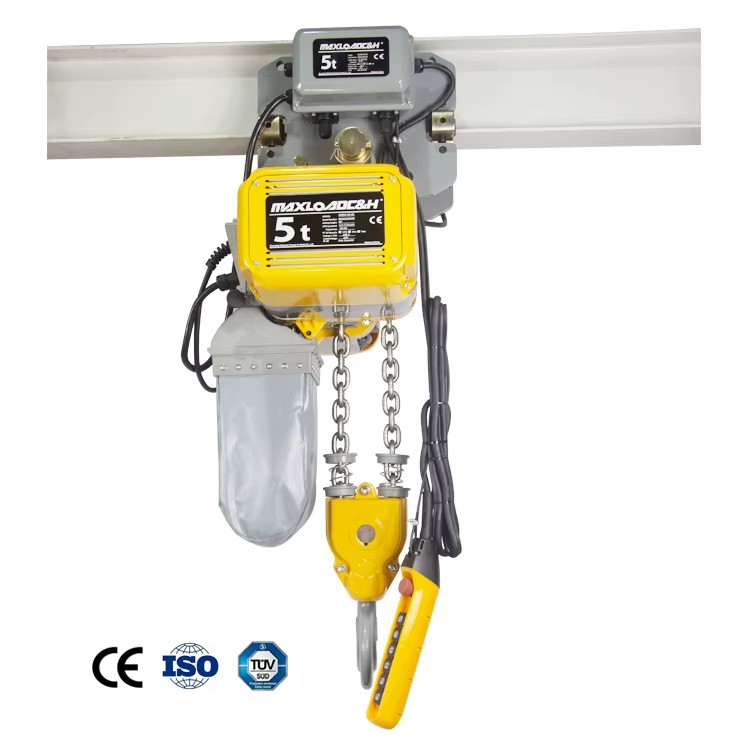
Structural Accessibility: Choose models with externally mounted and easily adjustable limit switches. If adjusting the lifting limit requires removing entire cover panels, the cumulative time lost from half-hour maintenance sessions can be significant.
Commonality of Wear Parts: Are the push-button switches, contactors, rope guides, or chain containers standard off-the-shelf components? The procurement lead time for non-standard custom parts can stretch to several weeks, while standard parts can be replaced and production resumed the same day.
Chain vs. Wire Rope: For short-distance, high-frequency workstations, chain electric hoists are preferred because the chain is less prone to wear and does not tangle easily; for greater lifting heights, wire rope electric hoists are lighter and more cost-effective.
Conclusion
There Is No "Best" Hoist, Only the Most Appropriate Configuration
Selecting an electric hoist for a workstation is a systematic engineering task. It demands precise measurement of spatial height, a rational assessment of operational frequency, matching the control method to the human operator, a meticulous review of the power supply environment, and respect for corrosive, high-temperature, dust, and other harsh factors.
Before purchasing, be sure to:
Measure every inch of the workstation space with a tape measure.
Record the actual number of lifts the hoist performs in a typical day.
Communicate with frontline operators to understand their pain points in frequent operations – whether it's insufficient speed, inadequate positioning accuracy, or troublesome cables.
Input this specific, quantifiable information to the supplier and request a written selection calculation sheet. Only when you clearly depict the "full picture of the workstation" to the supplier can they tailor the right hoist – one that works safely and efficiently while balancing long-term maintenance costs.
After all, in the confined space of a workstation, precision is the ultimate responsibility for efficiency.
 0086 156 1824 5535
 0086 156 1824 5535