Workshop Environment Determines Equipment Efficiency
During the selection process for industrial lifting equipment, we have observed a common phenomenon: many users focus almost all their attention on the rated lifting capacity of the electric hoist while overlooking the more critical determining factor—the workshop environment. This "capacity-first" approach often leads to various incompatibilities after the equipment is put into service—whether it be restricted operating space, inconvenient control methods, or equipment service life falling far short of expectations. In fact, the degree of match between the workshop environment and equipment characteristics directly determines the efficiency, safety, and total cost of ownership of lifting operations.
Beyond Lifting Capacity: The Full Picture of Load Parameters
Lifting capacity is indeed the starting point for electric hoist selection, but it is by no means the entirety. The choice of rated lifting capacity must be based on accurate load calculations, which should include not only the net weight of the workpiece or material but also the weight of auxiliary devices such as slings and fixtures. Experience shows that reserving a 15%–20% load margin is necessary—this not only provides a safety buffer for unexpected overload situations but also leaves room for future workstation adjustments or process changes.
However, lifting capacity data alone is far from sufficient. The determination of lifting height directly affects the vertical layout of the workstation. When measuring the distance from the upper limit position of the hook to the lower limit position, it is necessary to consider workpiece height, sling length, and operational clearance requirements. In many workstation designs, inconveniences caused by insufficient lifting height are far more prominent than those caused by excessive lifting height.
The selection of duty classification is another parameter that is often overlooked. Different workstations impose vastly different demands on the frequency and load rate of electric hoists. For the same 1-ton lifting capacity, a workstation with dozens of lifts per day and one with hundreds of lifts per day have completely different requirements for the equipment's fatigue strength. Selecting an appropriate duty classification based on actual operating conditions is far more economically rational than purchasing a "sturdier" piece of equipment.
Workspace Constraints and Breakthroughs
The geometric characteristics of the workshop space are the aspect of electric hoist selection that most requires a "tailor-made" approach. Workshop height directly determines the installation method and hoist body configuration. In workstations with ample height, standard layout solutions can be adopted; in height-restricted workstations, low-headroom designs must be considered—by altering the relative position of the hoist and the runway rail to reduce the overall height occupied. While such adjustments may increase equipment costs, they are often the only viable solution for achieving lifting functionality within limited spaces.
The planning of runway layout also requires adaptation to local conditions. Straight runways are suitable for point-to-point transfer or linear process flows, while curved runways or switch systems can serve more complex spatial layouts. It is worth noting that the determination of curve radii must comprehensively consider the trolley turning performance of the electric hoist and the swing space of the suspended load—overly conservative radii result in wasted space, while overly compact radii may cause travel jamming or excessive load sway.
Clearance and width requirements for the passage area of suspended loads are often overlooked constraints in workstation design. In workshops with densely arranged equipment, the clearance of obstacles below and on both sides of the load travel path, as well as the assurance of safety distances, must be fully considered during the selection phase.
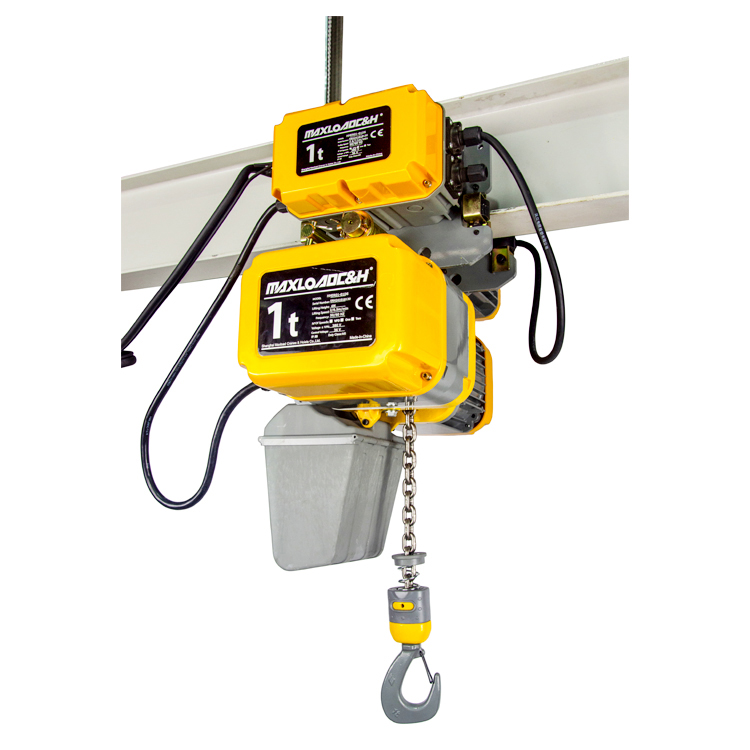
True Matching of Usage Frequency and Duty Intensity
The selection of the electric hoist's duty intensity class must be based on an accurate assessment of the workstation's actual duty cycle. The duty classification reflects the proportion of time the equipment operates under various load conditions. A common misconception is to simply describe duty intensity as "heavy duty" or "light duty" without considering quantitative indicators such as the duty cycle (intermittent periodic duty) or the number of starts per hour.
To give a specific example: two workstations both lift a 1-ton load. Workstation A performs 20 lifts per day, with each travel distance of 5 meters; Workstation B performs 200 lifts per day, with each travel distance of 2 meters. Although the total travel distances are similar, the vast difference in the number of start/stop cycles results in completely different thermal loads on the motor, contactors, and brakes, requiring equipment with different duty classifications.
Understanding the duty cycle (intermittent periodic duty) is also crucial. It reflects the percentage of time during a 10-minute cycle that the electric hoist is actually powered and operating. For continuous-operation assembly line workstations, a duty cycle of 40% or even 60% may be required; for intermittent maintenance workstations, 25% is typically sufficient. Selecting a duty cycle higher than actual needs means excessive equipment margin and cost waste, while selecting too low a duty cycle will cause frequent thermal overload protection trips, disrupting normal production.
Control Methods: Balancing Operational Convenience and Safety
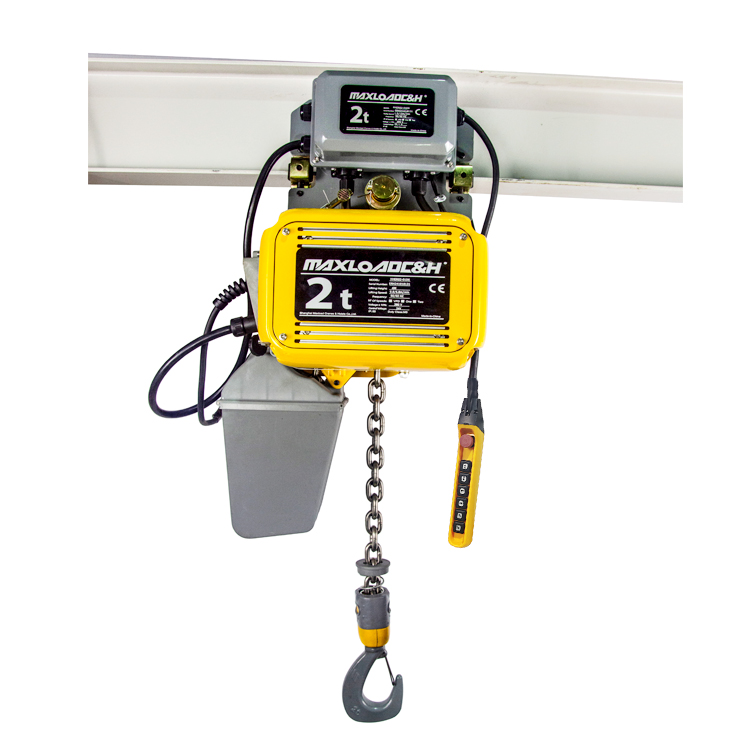
The choice of control method for an electric hoist directly affects the operator's work efficiency and physical workload. The pendant cord control is the most traditional and direct method, where the operator controls lifting and travel by pressing buttons. The advantages of this method include direct control signal transmission, rapid response, and few failure points, making it suitable for workstations with good visibility and fixed operating positions. However, the cable restricts the operator's range of movement, making it less effective in situations where the load needs to be guided over long distances.
Wireless remote control has gained increasingly widespread application in recent years. The operator can stand at the best observation position for control, unencumbered by cables, offering clear advantages in workstations involving large workpieces or requiring close observation during positioning. However, the reliability of wireless remote control is affected by factors such as signal interference and battery life, requiring careful evaluation in workstations with complex electromagnetic environments. Additionally, while the response delay of wireless remote controls is already at the millisecond level, for operations requiring fine positioning, this delay may still affect precision.
Fixed operator cab control is suitable for workstations with very high operating frequencies or harsh environments. The operator works in a relatively comfortable and safe environment and can perform lifting operations over extended periods. However, this method offers the least flexibility, and the cab layout must comprehensively consider the field of view and operational convenience, placing higher demands on workshop space.
The choice of control method should also consider the operator's habits and training costs. From an ergonomic perspective, selecting a control method consistent with or similar to existing workstations can reduce training time and the risk of misoperation.
Environmental Constraints and Countermeasures
The working environment of an electric hoist has a significant impact on its performance and service life. Ambient temperature is a fundamental indicator. Standard electric hoists are typically suitable for ambient temperatures ranging from -20°C to +40°C. In high-temperature environments, motor heat dissipation conditions deteriorate, requiring motors with higher insulation classes or forced cooling; in low-temperature environments, the viscosity changes of lubricating greases, the cold brittleness of structural steel materials, and the flexibility of cables all require special consideration.
Dust and humidity conditions are another important factor. The ingress protection rating for general industrial environments is sufficient for ordinary workshops, but in workstations with high dust levels such as cement, chemical, or grain processing plants, higher protection ratings are required to prevent dust ingress into motors and electrical components. In humid environments or where corrosive gases or liquids are present, anti-corrosion treatment of metal structural parts and moisture-proof measures for electrical components are mandatory considerations.
Special operating conditions require special countermeasures. In workstations where flammable or explosive gases or dusts may be present, explosion-proof electric hoists must be selected, involving explosion-proof treatment of all electrical components including motors, electrical control boxes, and limit switches, as well as measures to prevent sparking from mechanical components such as hooks and wire ropes upon impact. In metallurgical workstations, facing high-temperature radiation and splashes of molten metal, thermal insulation protection and heat-resistant design solutions are required.
Reliability Design: A Comprehensive Consideration of Longevity and Economy
The service life of an electric hoist depends not only on the quality of the equipment itself but also on the convenience of maintenance and the maintainability of the design. During selection, consideration should be given to whether wearing parts are easy to replace, whether lubrication points are readily accessible, and whether routine inspection tasks can be completed quickly.
The selection and management of wire rope directly relate to lifting safety. In corrosive environments, galvanized or stainless steel wire ropes offer significantly better corrosion resistance than ordinary bright wire ropes; in high-temperature environments, varieties with better heat-resistant fiber cores should be selected. The discard criteria for wire ropes must be strictly enforced—the number of broken wires, reduction in diameter, and distortion are all criteria for determining whether to continue using the rope.
Chains and wire ropes each have their applicable ranges. Chain electric hoists offer better economy at greater lifting heights, as the increase in self-weight of the chain is less pronounced than that of wire rope, and chain wear can be assessed by measuring link pitch, without requiring the complex internal flaw detection needed for wire rope. However, in high-speed lifting applications, the flexibility and impact resistance of wire rope are generally superior to those of chain.
Matching Power Supply Conditions and Installation Foundations
Power supply conditions can sometimes become a limiting factor in electric hoist selection. Three-phase 380V/50Hz is the standard industrial power supply, but in some older workshops or special areas, only single-phase power or other voltage levels may be available, requiring the selection of motors with corresponding voltage ratings or the installation of transformers.
Verification of installation foundations and load-bearing structures is equally important. Whether using I-beam runways or dedicated load-bearing beams, their load-bearing capacity must match the maximum static and dynamic wheel loads of the electric hoist. Many users are accustomed to calculating lifting capacity while neglecting the impact of wheel loads on runways and civil structures—this practice can lead to rail deformation or even structural safety hazards.
In summary, the selection of an electric hoist is a systematic project that requires comprehensive consideration of multiple factors, including lifting capacity, lifting height, duty classification, workshop space, control methods, and environmental conditions. Conducting a thorough measurement and assessment of the workshop environment before selection is far more reliable than "theoretical selection" based solely on a parameter sheet. The installation and commissioning phase after equipment delivery is equally critical—whether limiters are adjusted accurately, rail joints are treated smoothly, and control circuit connections are reliable—the quality of these detailed tasks directly affects whether the electric hoist can perform effectively in its specific workshop environment. It is recommended that users invite the equipment supplier's technical personnel to conduct on-site surveys of the workshop during the selection process, and based on a full understanding of the workshop environment and operational requirements, jointly develop the most suitable selection solution. Only in this way can a perfect match between equipment and workstation be truly achieved, delivering a safe, efficient, and economical lifting solution.
 0086 156 1824 5535
 0086 156 1824 5535