Starting from the Environment: Choosing the Most Suitable Material Handling Solution
In industrial manufacturing and warehousing logistics, the combination of a jib crane and an electric hoist is one of the core pieces of equipment for workstation-level material handling. However, during the actual selection process, many companies tend to fall into the trap of "focusing solely on load capacity" or "fixating only on price," while overlooking the actual constraints of the workstation environment. This often leads to inconveniences in use after installation, decreased efficiency instead of improvement, and even hidden safety hazards.
This article starts from six key dimensions of the workstation environment, combined with the matching logic for electric hoists, to provide a practical selection framework that helps users make more reasonable and cost-effective choices.
Look at the Space First: Jib Crane Rotation Radius and Clear Height
The core advantage of a jib crane lies in its ability to cover a sector-shaped working area. However, many workstations overlook two critical data points during planning: the effective rotation radius and the clear height below the hook.
The effective rotation radius is not the length of the jib arm, but the actual distance from the center of the column to the farthest point of the hook. Within this range, it is necessary to consider whether other equipment, columns, walls, or material storage areas interfere with the slewing path. Conventional jib cranes offer two slewing ranges: 0°–180° and 0°–360°. If the workstation is arranged against a wall, 180° is usually sufficient; if it is located in the center of the workshop and needs to serve multiple directions, 360° slewing should be selected. More importantly, if personnel frequently move within the slewing radius, it is advisable to shorten the actual operating radius or install slewing limit devices to prevent the jib tip from injuring people or causing collisions.
Clear height is often the "invisible killer" that gets overlooked. Many workstations have cable trays, air ducts, lighting fixtures, or fire protection pipes overhead. The upper support structure of the jib crane occupies a certain amount of vertical space. Insufficient clear height may prevent installation of the jib, or the hook height may be inadequate when the hoist reaches its upper limit, failing to meet the lifting requirements. Before selection, be sure to measure the distance from the lower edge of the highest overhead obstacle to the floor, and compare it with the installation height dimensions specified in the jib crane product catalog.
Look at the Floor: Foundation Conditions Determine the Column Type
The column fixing method for jib cranes mainly falls into two categories: foundation with embedded anchor bolts, and floor-mounted base plate with anchor bolts. Which one to choose does not depend solely on load capacity, but more on the floor conditions of the workstation.
If the workstation is in a new workshop where the floor has not yet been hardened, the embedded bolt solution is the most stable, offering strong load-bearing capacity and long-term resistance to settlement. However, if the workstation is in an existing workshop with a hardened floor that cannot be extensively demolished, the base plate anchor bolt solution should be chosen—securing the base to the existing concrete floor using chemical anchors or expansion bolts. In this case, it is particularly important to verify the concrete thickness and strength grade. Typically, the floor thickness should be no less than 150 mm, and the strength grade no lower than C25; otherwise, the anchor pull-out force may be insufficient, and under heavy loads the base plate could be pulled out together with the concrete block.
There is also a special case: if there are load-bearing steel beams overhead with sufficient capacity, and the floor does not permit installation, a wall-mounted jib crane may be considered, with the support structure fixed to a load-bearing wall or column. However, this approach imposes extremely high requirements on the wall structure and is not recommended for general working conditions.
Duty Cycle: Determines the Hoist's Work Class
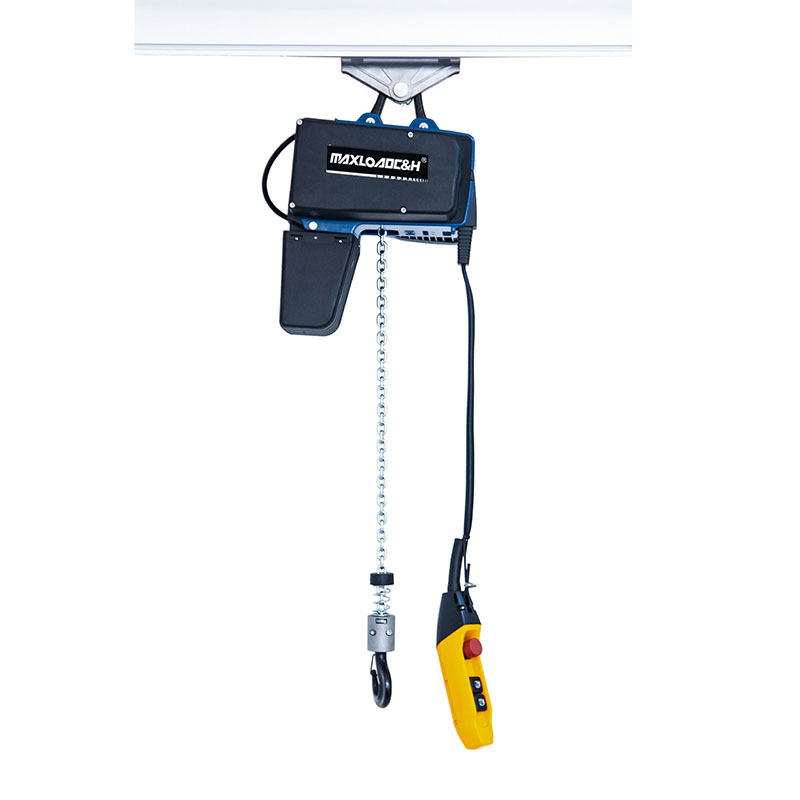
This is the most technically demanding aspect of selection and the one most easily overlooked. Many users only look at lifting capacity while ignoring usage frequency and load factor, resulting in choosing a hoist with a work class that is too low, leading to motor overheating, accelerated brake wear, and service life far shorter than expected.
The work class of an electric hoist is usually defined according to ISO or FEM standards, determined by two factors: the load spectrum coefficient and the daily operating time. In simple terms, if the workstation performs lifting operations for no more than 2 hours per day, and most loads are below 60% of the rated capacity, a 1 Am or 1Bm class is sufficient. However, if the workstation operates at a production-line rhythm—lifting, moving, and lowering every 5 minutes, with daily usage exceeding 4 hours, and loads frequently approaching the rated value—then 2m or 3m class should be selected.
A common misconception is to choose an oversized hoist for light tasks, assuming that "a big horse pulling a small cart" will be more durable. On the contrary, the motor, gearbox, and brake of an oversized hoist are designed for heavy-duty conditions. Prolonged light-load operation with frequent jogging may actually prevent the brake from properly bedding in, or degrade low-speed control accuracy. The correct approach is to select a hoist with a matching capacity for the actual load, and then choose the appropriate work class based on usage frequency—rather than simply increasing the tonnage.
Environmental Factors: Temperature, Dust, and Corrosiveness
The workstation environment directly determines the electrical protection rating and material requirements for the electric hoist.
High-temperature environments: In foundries, heat-treatment workstations, or other areas where ambient temperatures regularly exceed 40°C, standard electric hoists may have insufficient motor temperature rise margins. Hoists with H-class insulation motors and high-temperature grease should be selected, and the control box should be installed as far away from heat sources as possible.
Dusty environments: In wood processing, carbon production, cement, and building materials workstations, dust concentrations are high, and particles are fine. Standard hoists typically use exposed disc brakes; dust ingress can reduce braking friction and even cause brake failure. For such workstations, hoists with enclosed brake protection should be selected. In addition, the motor cooling air ducts should feature anti-clogging designs, and the control pendant should preferably be explosion-proof or at least IP65-rated with a sealed design.
Corrosive environments: In electroplating workshops, pickling stations, and offshore equipment manufacturing sites, acid and alkali vapors in the air can corrode wire ropes, housing paint, and electrical components. In such cases, the entire unit should have corrosion-resistant paint, wire ropes should be galvanized or made of stainless steel, and the electrical control box should be made of engineering plastic or stainless steel with sealing treatment.
Control Method: Pendant, Remote, or Follow-Me Control?
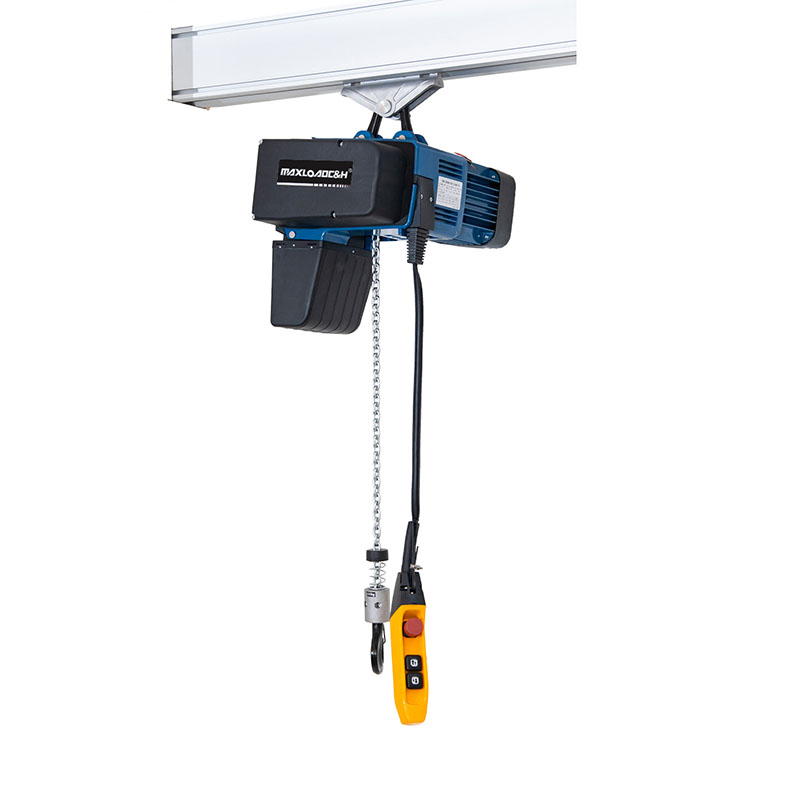
The control method for the jib crane + electric hoist combination is not simply a matter of "with or without remote control." It must match the actual operating habits and line-of-sight conditions of the workstation operators.
Floor-mounted pendant control is the most traditional method. Its advantages are low cost, reliable signal transmission, and direct feedback. The disadvantage is that the operator's position is restricted—they must stand where they can simultaneously see the hook's up/down movement and the jib's slewing motion, and the pendant cable length must cover the entire working area. If the workstation area is large, the cable dragging on the floor may trip personnel or be run over by wheels; in such cases, wireless remote control should be prioritized.
Wireless remote control offers high flexibility, allowing the operator to stand anywhere within the workstation and choose the best viewing angle for positioning the load. However, two points require attention: first, the remote control battery life must cover the entire shift—it is recommended to choose a model with replaceable battery packs and keep a spare battery; second, the remote control must be equipped with an emergency stop and anti-accidental-actuation features to prevent unintended movements. In workstations with significant signal interference, industrial-grade remote controls with frequency-hopping technology should be selected instead of consumer-grade products.
Follow-me control is a newer trend, where the hoist's control system is integrated into the jib's slewing mechanism or trolley travel mechanism. The operator uses a handle or remote to simultaneously control the jib slewing, trolley traversing, and hoist lifting/lowering in a single "one-click positioning" action. This solution offers the highest efficiency, but also demands the highest operator skill and comes with significantly higher costs. It is suitable for highly repetitive workstations with strict cycle time requirements.
Maintenance and Service Access: The Overlooked "Last Meter"
After installation, whether daily inspections, lubrication, and repairs are convenient is key to determining long-term operating costs.
During selection, a clearance of no less than 500 mm around the jib crane column should be reserved for personnel to access the slewing bearing for greasing, limit switch checks, and cable slip ring inspection. The hoist's lifting motor and gearbox should have removable inspection covers, and the wire rope drum observation window should face a direction that facilitates inspection. The end of the jib arm typically has a guide pulley for the wire rope or chain, which requires periodic replacement of wear parts. If the installation height is high and there is no nearby structure for setting up ladders or platforms, maintenance will become very difficult later on.
A practical suggestion: before signing the technical agreement, request that the supplier provide an installation drawing with detailed overall dimensions and maintenance space annotations, and overlay it with the actual workstation layout plan to confirm that all points requiring manual operation and maintenance can be easily accessed. Do not wait until the equipment arrives on site and is being installed to discover that "it fits, but you can't reach it."
 0086 156 1824 5535
 0086 156 1824 5535