The Adaptation Logic of Electric Hoists
When a factory workshop is going to install an electric hoist, most people's first reaction is "how much can it lift?" Tonnage certainly has to be calculated, but if you place an order based only on tonnage, you may find after installation that the hook cannot reach the machine tool farthest away, or that workers complain it is too slow and refuse to use it, or that after three months the motor frequently overheats. The root of these problems is not tonnage, but whether the "workstation environment" was seriously taken into account during selection.
The selection logic of an electric hoist is essentially to make the equipment adapt to the workstation, not to make the workstation accommodate the equipment. Below is a breakdown of five dimensions for how to choose a hoist that is suitable and smooth to use according to the site conditions you have on hand.
First, look at space: clear height and horizontal coverage determine the major machine type.
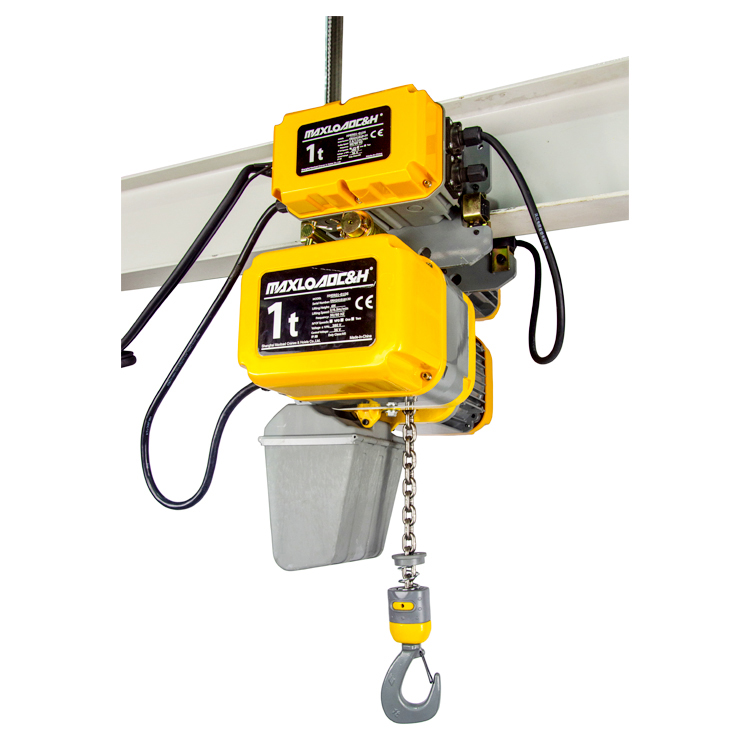
The physical space of the workstation is the first sieve. In many old workshop renovation projects, the biggest headache is insufficient floor height. Traditional wire rope electric hoists have a relatively large axial dimension because the drum must accommodate a sufficient length of wire rope, so in low-clearance environments there is often little lifting stroke left after installation. The axial dimension of the chain wheel of a chain hoist is only about 1.6 times the chain width, and the body is noticeably thinner. If there are pipes, cable trays, or building beams above the workstation that are already low, the chain type is almost the only comfortable choice.
Another spatial dimension is the horizontal travel distance. A stationary hoist can only work under one suspension point, suitable for loading a single machine tool or handling molds at a fixed position. If materials need to flow across workstations, a traveling trolley and track are required. Here is a detail that is easily overlooked: track turning radius. For wire rope hoists with the motor axis parallel to the drum, the track turning radius requirement is relatively large, and it may not be able to turn in a compact circular layout. In scenarios where the workstation layout is compact and the track needs to turn, the chain type with a curved-track trolley offers greater flexibility. Next, look at the work rhythm: the duty class is the underlying parameter for selection.
The duty class is often skipped, but it directly determines equipment life. The duty class of an electric hoist is classified according to FEM/ISO standards, ranging from M3 to M6. In plain terms: M3 corresponds to occasional use, and M6 corresponds to frequent continuous operation.
The method of judgment is simple: count how many actual lifts the workstation performs each day and how long each operation lasts. If it is only occasionally lifting a motor during equipment maintenance, M3 is sufficient. If it is an assembly line lifting a workpiece every two minutes, that is a typical high-frequency operation, and M5 or M6 must be selected. Using a low-duty-class hoist for high-duty-class work may not show problems in the short term, but after half a year the failure rate will rise significantly.
Directly linked to the duty class is the lifting speed. A single-speed hoist has only one lifting speed, suitable for conventional lifting and lowering that does not require high positioning accuracy, with high cost-effectiveness and a simple structure. A dual-speed hoist has fast and slow gears. The slow gear is used for precise positioning when approaching the workpiece, avoiding the hook damaging the workpiece or mold. For assembly line workstations, precision workpiece assembly, and sand box mold closing, which require "millimeter-level" control, the dual-speed model is a necessity.
Third, look at environmental corrosiveness and cleanliness requirements.
With the same tonnage and space, the hoist needed in a chemical workshop and an electronic assembly workshop are completely different things.
An ordinary workshop can choose the standard model. But if there are acid and alkali vapors, moisture, or salt, corrosion will begin to spread from the wire rope, chain, and outer coating. The equipment may still look fine, but the internal load-bearing components are already becoming brittle. In this case, a corrosion-resistant type is needed, or a higher surface treatment grade must be required on a conventional model.
More extreme is an environment with flammable and explosive gases. In petroleum, chemical, pharmaceutical, and coating workshops, the hoist's motor, control box, and push-button switch may all produce sparks or high-temperature surfaces during normal operation. An ordinary hoist placed there is an ignition source. The logic of an explosion-proof hoist is to enclose all electrical components that may produce sparks in explosion-proof housings. Even if an internal explosion occurs, the housing can prevent the flame from spreading to the external environment. When selecting, confirm that the explosion-proof marking matches the hazardous gas level at the site. For example, Class IIB is suitable for ethylene-type environments, while Class IIC covers hydrogen and acetylene. This is not a parameter where "close enough" is acceptable.
There is another easily overlooked environment: food, pharmaceutical, and electronic clean workshops. These workstations do not have explosion-proof requirements for the hoist itself, but they are afraid of lubricating grease dripping and contaminating products, and afraid of dust accumulating on the equipment surface and breeding bacteria. A belt hoist uses fiber belts instead of wire rope or chains, requires no lubrication, and has no risk of oil dripping. At the same time, it is equipped with an insulated hook and stainless steel components, making it a targeted solution for such environments.
Fourth, look at the match between the operator and the workstation.
Equipment is used by people. The height of the workstation, the operator's standing position, and the line of sight determine how the control method should be chosen.
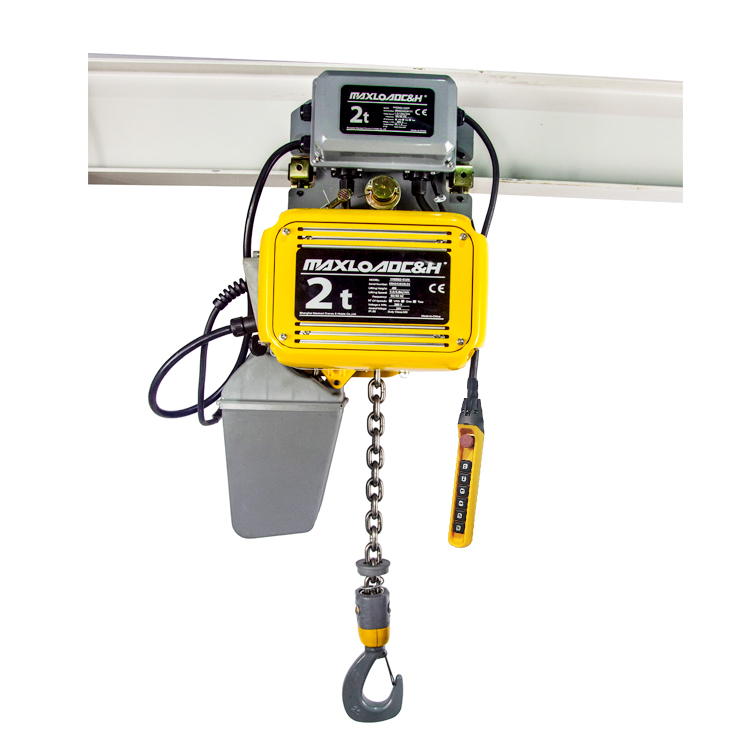
Pendant control is the most common solution. The operator follows the hook, and the control cable length must cover the workstation's activity range. If there are obstacles above the workstation or the operator needs to stand at a certain distance to observe, a remote control can be considered. For workstations where a traveling hoist frequently moves on a long track, dragging a long pendant cable becomes cumbersome.
There is another detail: the workstation's power supply conditions. Standard hoists usually use 380V three-phase power, and the control voltage of 24V or 36V is a safe voltage. If an old workshop has an unstable power supply or large voltage deviation, a variable-frequency-controlled hoist has higher tolerance for power supply fluctuations and starts and stops more smoothly, but the price is higher. Whether it is worth it depends on the workstation's actual requirements for smooth operation.
Fifth, look at a parameter that is easily overlooked: the relationship between lifting height and wire rope/chain length.
The lifting height of a wire rope hoist is determined by the drum's rope capacity and is basically non-expandable after leaving the factory. If the workstation may change layout in the future and needs increased lifting height, allowance must be left during selection. Under the premise that the specification remains unchanged, the chain of a chain hoist can be lengthened, and the adjustment space is relatively flexible.
Conversely, wire rope has somewhat better resistance than chain in dusty and mildly corrosive environments, while chain requires regular lubrication, and wear accelerates after picking up dust. If the workstation is very dusty and maintenance is neglected, the service life of the chain may be less than expected.
An electric hoist is not a standard part; it is a functional module embedded in a specific workstation. The site conditions determine whether it should be chain type or wire rope type, single-speed or dual-speed, standard or explosion-proof. Only after clarifying these premises should price be discussed, so that you do not end up buying a piece of equipment that is "usable but not easy to use."
 0086 156 1824 5535
 0086 156 1824 5535