A practical judgment framework for real-world operations
When selecting an electric hoist, most people focus on lifting capacity. That is certainly not wrong, but it is far from enough. The same hoist with a rated load of two tons, used on an assembly line and started hundreds of times a day, will face completely different requirements than one used at a maintenance station two or three times a week. The former may develop motor overheating or brake wear within a few months, while the latter may run steadily for ten years. The root of the problem is not the quality of the equipment, but whether the constraints of the workstation environment were truly understood during selection.
The following breaks down, from several practical dimensions, how the workstation environment determines the direction of electric hoist selection step by step.
Reverse-engineer the structural form from the available headroom
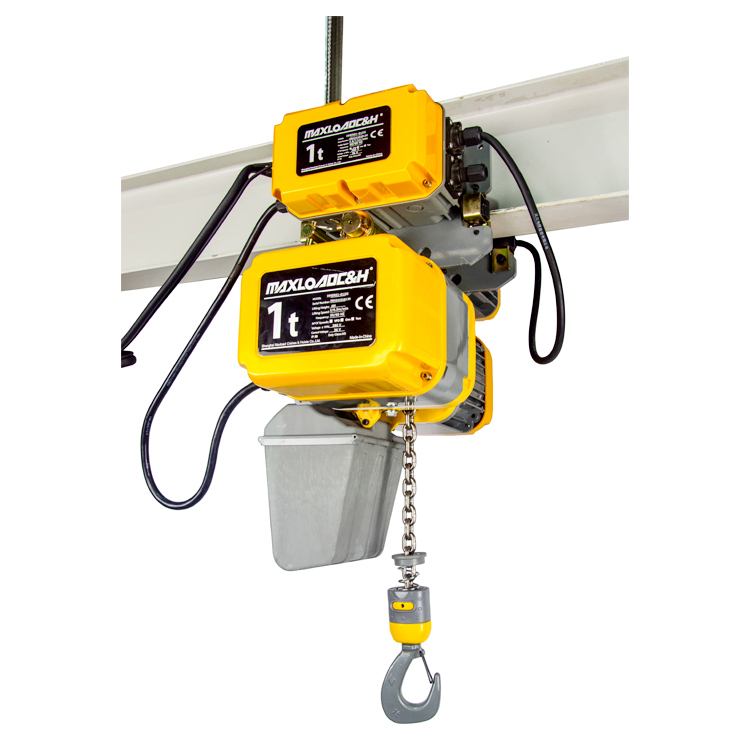
How much usable vertical space there is above the workstation is the first filter in selection. In many old factory buildings or renovated workshops, the area below the roof is already filled with ventilation ducts, firefighting pipelines, and cable trays, leaving very limited headroom for lifting equipment. In such cases, wire rope electric hoists often cannot fit because their drum structure means the body has considerable height. Chain electric hoists have a more compact body and are the only feasible choice in some low-headroom workstations.
Conversely, if there is ample space above the workstation and the required lifting height is relatively large, the advantages of wire rope hoists in lifting height and running stability become more obvious. The choice between the two does not depend on which is "better," but on how much space is still available at the workstation.
The duty class is not decoration on a parameter sheet
The duty class is the most easily overlooked indicator in selection, yet it is the one that most determines equipment life. It essentially describes "how much work this equipment actually has to do each day."
Taking commonly used electric hoists in workshops as an example, for workstations with ordinary intermittent operation, a duty class of around M3 is sufficient. But if it is a workstation running in coordination with the takt time on an assembly line, the hoist may need to complete dozens of lifting and lowering cycles per hour, with frequent starts, and the motor repeatedly bearing inrush current, so heat accumulation is far higher than in intermittent operation. In this case, the duty class must be at least M5 or even higher.
Differences in duty class are reflected in a series of invisible places such as motor insulation grade, brake durability, and gearbox design life. If selected too low, the equipment will not fail immediately, but it will begin to have frequent problems after half a year to a year, and by then it is often already out of warranty. The judgment method is actually not complicated: count roughly how many lifts this workstation performs per shift, how long each operation lasts, and whether it is mostly full load or light load. These data do not need to be very precise, but they must exist and cannot be guessed.
The choice of lifting speed depends on "how precise the positioning needs to be"
The price difference between a single-speed hoist and a dual-speed hoist is not large, but if used in the wrong scenario, the operating experience is worlds apart.
For ordinary material transfer and workstations with low requirements for landing point accuracy, a single-speed hoist is completely sufficient, with a simple structure, fewer failure points, and easier maintenance. But for precision assembly, mold closing, and workstations where workpieces need to approach the locating surface slowly, the "one speed" of a single-speed hoist makes operators very nervous - both lifting and lowering are equally fast, fine adjustment is almost impossible, and repeated inching is the only option, which damages both the equipment and the workpiece.
The slow speed stage of a dual-speed hoist provides controllable fine adjustment when approaching the target position. In precision positioning scenarios, this is not "the icing on the cake," but "timely help in the snow."
Environmental erosion determines whether it "lasts" or "does not last"
Differences in the workstation environment have a continuous and cumulative impact on the hoist.
Humidity and corrosive atmospheres are invisible killers of electric hoists. In electroplating workshops, pickling workstations, and seaside factories, corrosive media in the air will slowly erode motor housings, brake springs, chains, or wire ropes. In such environments, an ordinary hoist may look fine on the outside, but the internal electrical contacts and brake mechanisms are already aging at an accelerated rate. Anti-corrosion treatment is not simply applying a layer of paint; it involves a series of changes such as motor insulation, brake materials, and chain coatings.
Dusty environments are another easily underestimated factor. Dust in cement plants, foundries, and woodworking workstations not only clogs heat dissipation channels, but more seriously, after entering the brake clearance, it directly affects the stability of braking torque. Dust-proof hoists have higher sealing grades at the motor and brake locations. This is not an "optional configuration," but a basic requirement for ensuring safety.
High-temperature workstations require attention to motor insulation grade and the heat fade characteristics of brakes. For hoists near metallurgical workshops or heat treatment workstations, the ambient temperature may remain above 50 degrees Celsius for long periods. Under such temperatures, the braking torque of ordinary hoists will decrease, creating a risk of load slipping. It is necessary to confirm the derating conditions for equipment use at the actual workstation temperature.
The workstation layout determines the installation and operation method
Once the hoist is installed at the workstation, how people operate it and how the trolley moves must also be considered.
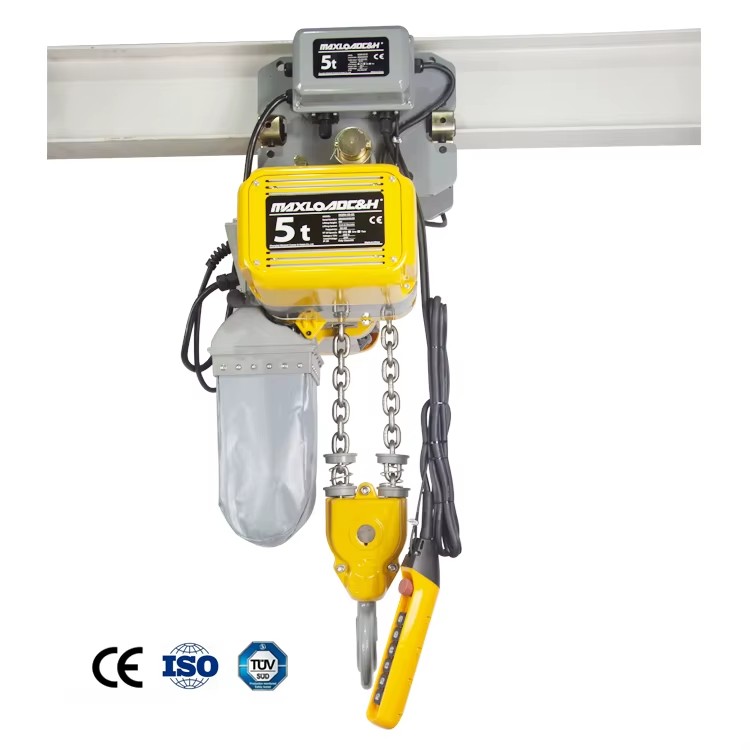
Fixed hoists are suitable for scenarios where the lifting point is fixed and materials only need to be lifted and lowered at one point. If materials need to move laterally within the workstation, a traveling trolley is needed. Trolleys can be manual or electric. Manual trolleys are simple in structure and low in cost, but the operator needs to pull the hoist itself to move materials. If the material is heavy or the movement distance is long, the operating intensity will be great. Electric traveling trolleys use pushbutton control for lateral movement, saving effort but increasing electrical complexity.
The operation method is also worth considering. Pendant control is the most common solution, and the length of the control cable determines how far away the operator can stand. If there are obstacles at the workstation that need to be bypassed, or if the operator needs to stand away from the lifting point to observe the material status, remote control will be more practical. This choice does not affect the intrinsic safety of the equipment, but it directly affects the convenience of daily use.
Safety margin is not "the bigger the better"
There is a common dilemma in tonnage selection: choose one that is just enough, or leave a margin?
The logic of leaving a margin is valid. The impact at the moment of lifting, the weight of the rigging, and wear after long-term use will all cause the actual load to exceed the net weight of the material. Under conventional working conditions, it is recommended to match the hoist tonnage at 1.25 times the maximum lifting weight; for frequent operations or workstations with large vibration, the margin should be increased further.
But the margin is not the bigger the better. Using a five-ton hoist to lift a one-ton workpiece is like using a truck to carry a suitcase - oversizing is not only wasteful, but under small loads the matching of the brake and motor may not be in the optimal working range, and the operating feel will also become rough. A reasonable choice is: the heaviest material at the workstation plus the weight of the rigging, multiplied by an appropriate safety factor, falling near a standard tonnage level.
String these clues together
The selection of an electric hoist is essentially translating the specific constraints of the workstation environment into the technical specifications of the equipment. Headroom determines whether to use a chain hoist or a wire rope hoist; operating frequency determines the duty class; positioning accuracy determines single speed or dual speed; what is in the air determines the protection and material grade; how the workstation is laid out determines the installation and operation method; what is being lifted determines the tonnage and margin.
These factors are often interrelated: a precision assembly workstation will most likely also require dual speed, a relatively high duty class, a compact body, and a good protection grade. A simple maintenance workstation, however, may be more than adequately served by an ordinary single-speed hoist. The key is not whether the equipment itself is "advanced," but whether it truly matches the actual needs of the workstation. Choose correctly, and the equipment is almost unnoticeable; choose incorrectly, and it will remind you of its existence with frequent failures.
 0086 156 1824 5535
 0086 156 1824 5535
 kimliu@chnhoist.com