Scenario-Based Selection Logic for Electric Hoists
Many people, when selecting an electric hoist, are accustomed to first looking at tonnage and price. That in itself is not wrong, but it is far from enough. The same 2-ton hoist can be used for ten years in a dry assembly workshop, but if moved next to an electroplating tank, it may rust through in half a year; installed in a standard factory building, everything is fine, but squeezed into a low, old renovated workstation, even the hook may not be able to rise into position.
An electric hoist is not a universal part. Its selection is essentially a function of the workstation environment: whatever characteristics the environment has, the hoist must have corresponding configurations. The following breaks down the impact of the workstation environment on selection from five dimensions, helping you build an operational judgment logic.
Start with the space "overhead" at the workstation
Electric hoists are divided into two major categories: wire rope type and chain type. Their differences in space occupation directly determine whether they can fit into your workstation.
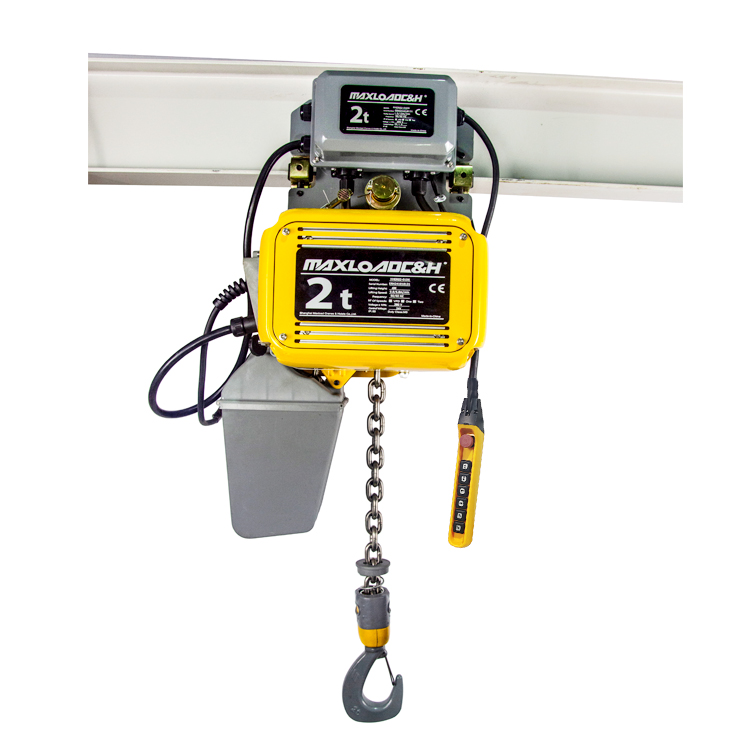
The drum of a wire rope electric hoist needs enough space to wind the wire rope, so the body is relatively longer and taller. Under a standard I-beam, it requires a considerable amount of clear height to ensure the hook rises to the ideal position. If your workstation is in a standard factory building with sufficient floor height and there are no dense pipelines or air-conditioning ducts overhead, a wire rope hoist is the first choice—large lifting height, stable operation, and a mature maintenance system.
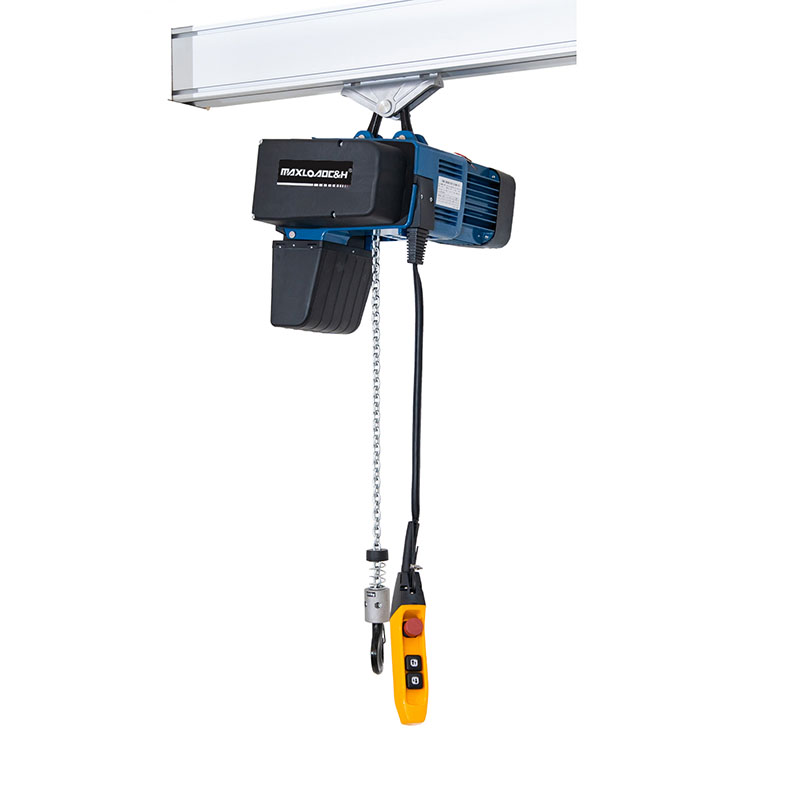
Conversely, if you are facing an old workshop renovation, dense overhead equipment, or the workstation itself is in a mezzanine or low space, the advantages of a chain hoist become apparent. A chain hoist has no drum, and the sprocket mechanism is much more compact, so the body height can be made very thin. Under the same building clear height, it can "steal" an extra few dozen centimeters to one meter of lifting height. In scenarios where the lifting path needs to pass above equipment or cross obstacles, this is often the difference between being installable and not being installable.
There is another easily overlooked point: the lifting point arrangement of a chain hoist is much more flexible. It can be used for normal lifting or inverted lifting, and can also be installed on cantilever workstations, curved tracks, or fixed lifting points. If the material flow path at the workstation is not a straight line, the adaptability of a chain hoist is clearly stronger.
Tonnage selection: leaving margin is discipline, not a suggestion
The maximum lifting weight at the workstation is not equal to the rated tonnage of the hoist. The impact at the moment of lifting, the dead weight of the rigging, and the wear caused by long-term high-frequency operation are all quietly eating away at the safety margin.
A practical judgment standard is: for workstations with intermittent, low-frequency operations, select according to 1.25 times the maximum lifting weight; for assembly line workstations, working conditions with large vibration, and outdoor operations, leave 1.5 times. Do not choose a 2-ton hoist for a 2-ton workpiece; choose 2.5 tons or 3 tons. The extra cost is far lower than the price of premature major overhaul or an accident caused by overload.
This rule is most easily discounted during execution. In the procurement stage, when people see a model that is "just enough," they always feel that saving a little is better than saving nothing. But the rated load of an electric hoist is calibrated according to ideal working conditions. Every emergency stop and every angled pull at the actual workstation deviates from the ideal state.
Working class: the overlooked "life account"
Working class is the item most easily skipped in selection, but it precisely determines the actual service life of the hoist at a specific workstation. The ISO standard classifies working classes from M3 to M6, corresponding to different design lives and applicable scenarios.
M3 corresponds to a design life of about 800 hours, suitable for warehouse maintenance workstations with occasional lifting. If your workstation only lifts a few times a day for a few minutes each time, M3 is completely sufficient and offers the best cost performance. M4 is suitable for workshop assembly and assembly line workstations, with a certain frequency each day but not continuous operation. M5 corresponds to heavy-duty working conditions, such as metallurgical auxiliary and casting workshops, with high load frequency and harsh environments. M6 is oriented toward high-intensity scenarios such as docks and continuous production lines.
Choosing too high wastes budget; choosing too low leads to premature scrapping of equipment. The judgment method is simple: estimate the actual number of lifting hours per day at the workstation, then look at the load distribution—whether it is lifting light objects year-round with occasional heavy objects, or frequently working near full load. A workstation running at full load for two hours a day and a workstation lifting an empty hook ten times a day require completely different classes.
Environmental grade: first judge "whether there is danger," then judge "how harsh it is"
Environment is the link with the most variables in selection. According to risk, from high to low, it can be divided into three levels.
Explosion-proof environment. Chemical workshops, flour mills, pharmaceutical factories, gas stations—as long as combustible gas or dust may exist in the air, ordinary electric hoists absolutely must not enter. Sparks from motor commutation and contacts of electrical components are all potential ignition sources. The core of an explosion-proof hoist is not "being sturdier," but that electrical components are enclosed in flameproof housings and the surface temperature is limited below the ignition point of the hazardous medium. During selection, the explosion-proof grade must be matched: Class IIB corresponds to ethylene-type gases, Class IIC corresponds to hydrogen and acetylene, and dust environments depend on the Zone 21 or Zone 22 classification. The price of explosion-proof models is usually 30% to 50% higher than ordinary models, but this is a compliance bottom line with no alternative.
Corrosive environment. Electroplating workshops, seaside workstations, and chemical storage areas—corrosive media will eat away at the hoist from the outside in. The gaps between the wires of a wire rope easily accumulate corrosive substances, and chains also face corrosion. For mild corrosion, models with anti-corrosion coating treatment can be selected. For strong acid and alkali or salt spray environments, stainless steel material or heavy anti-corrosion configurations need to be considered. Explosion-proof and anti-corrosion are two independent selection logics and cannot replace each other.
High dust and high humidity. High-concentration dust in cement plants, mines, and flour workshops will invade the motor and gearbox, accelerating wear. Humid environments test the protection rating—IP55 is the baseline, and water spray environments require IP65 or even IP66. If the workstation is outdoors or semi-outdoors, rain covers and low-temperature startup issues must also be considered. The standard electric hoist's operating temperature range is usually -20°C to +40°C. Beyond this range, customized high-temperature or low-temperature configurations are required.
Speed and precision: workstation takt determines control requirements
The choice of lifting speed depends on the workstation's operation takt and requirements for positioning precision.
Single-speed hoists are suitable for simple loading and unloading and warehouse lifting. The operator does not need to precisely control the landing point; just press the button and wait for it to arrive. Low price, few failure points, and simple maintenance.
But if your workstation requires frequent inching for positioning—for example, placing a workpiece precisely onto a fixture or completing precision docking on an assembly line—the "full-speed start-stop" of a single-speed hoist will make the workpiece sway. At best, it cannot be aligned; at worst, it collides and causes damage. At this time, dual-speed or variable-frequency models are needed. The slow speed of a dual-speed hoist is usually one-tenth of the normal speed. During inching, it produces almost no sway and can effectively avoid workpiece collision and offset.
There is a tradeoff here: dual-speed and variable-frequency models are more expensive, have more complex electrical systems, and have higher maintenance thresholds. If your workstation actually does not require precision positioning, then you do not need to pay for "functions you will not use."
Look at the five dimensions together
Returning to the workstation itself, the selection logic becomes clear: first look at space—wire rope or chain; then look at tonnage—leave 1.25 to 1.5 times margin; then determine the class—M3 to M6 correspond to different life requirements; next judge the environment—explosion, corrosion, and dust each follow their own configuration path; finally look at takt—single-speed or dual-speed.
The five dimensions are not parallel, but have a sequence. Space determines the major machine category, tonnage and class determine the basic specifications, environment determines special configurations, and speed determines the control experience. Skipping any step may leave hidden dangers in a certain link.
There is no "best" answer in electric hoist selection, only the answer that "best matches this workstation." Once the environmental parameters are clearly understood, more than half of the selection is complete.
 0086 156 1824 5535
 0086 156 1824 5535