Five on-site judgment dimensions for electric hoist selection
When purchasing electric hoists for many workstations, the habitual approach is to report only "how much weight" and "how high," and then let the supplier configure a piece of equipment at a suitable price. This selection method may work in simple loading and unloading scenarios, but once a workstation involves frequent starts and stops, limited space, dust and humidity, or precise positioning requirements, it will become apparent after installation that the equipment is either difficult to use or does not last long. The essence of electric hoist selection is the process of translating the workstation's physical conditions, operational rhythm, and environmental constraints into equipment parameters. The following discussion expands on the five dimensions that are most easily overlooked but directly affect usage results.
I. Clearance is not the same as ceiling height; effective lifting height must be back-calculated
The height of a workstation ceiling is not equal to the usable lifting height. A conventional wire rope electric hoist body itself occupies a certain amount of vertical space, and the hook block and rigging also consume a portion. If the workstation needs to lift workpieces over equipment or assembly line surfaces while the clearance above is relatively tight, directly selecting a standard model based on ceiling height often leads to the awkward situation of "after installation, it cannot reach the specified position."
In such cases, a low-headroom chain electric hoist is a more practical choice. Its structural design arranges the motor and transmission mechanism more compactly, leaving more effective travel below the same track. The judgment criterion is simple: measure the vertical distance from the lower edge of the track to the highest lifting point of the workpiece, deduct the occupied dimensions of the hook block and rigging, and if the remaining value approaches or is less than the height of a standard hoist, it is time to switch to a low-headroom model. Workstations in old workshop renovations and those with dense overhead piping especially need to perform this calculation first, rather than looking at the tonnage table first.
II. Work rhythm determines single-speed or dual-speed, not budget
Single-speed hoists are cheaper and have fewer failure points, and are entirely adequate for auxiliary material handling workstations that lift materials three to five times a day with low positioning accuracy requirements. However, once the workstation rhythm increases, the shortcomings of single-speed become apparent. Both lifting and traversing are at fixed speeds, and the operator must rely on jogging to fine-tune the position each time, causing large workpiece sway, prolonged positioning time, and considerable cumulative ineffective operation time over the course of a day.
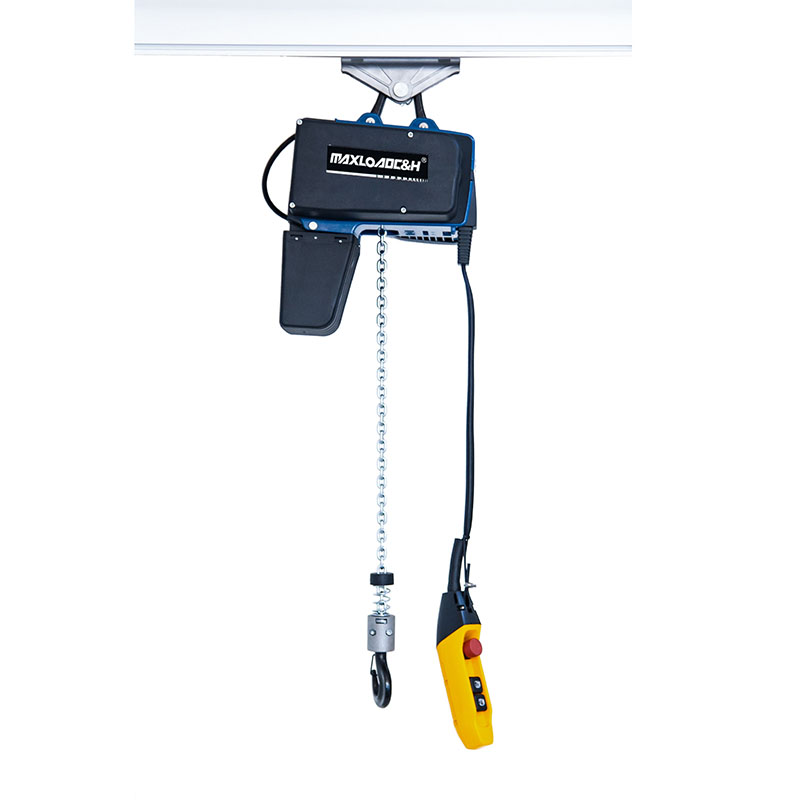
For upstream and downstream cutting on assembly lines, precise workpiece insertion into fixtures, and assembly workstations where collision avoidance is required, the value of dual-speed or variable-frequency models lies not in "speed" but in "stable slowness." Fine control of the hook in the slow-speed gear allows the workpiece to approach the target position smoothly, reducing repeated corrections. When selecting, do not look only at the numerical value of the lifting speed; ask clearly whether the slow-speed gear covers the fine-tuning range actually required by the workstation. If the workstation lifts more than dozens of times per day and requires alignment to a fixed position each time, the procurement price difference saved by a single-speed model will soon be offset by inefficient operation.
III. Environment is not just indoor or outdoor; dust and humidity have specific protection thresholds
The motor protection rating of electric hoists in ordinary industrial environments is typically based on IP44. This rating is fine for dry, clean workshops, but if there is grinding dust, coating particles, moisture, or cleaning operations around the workstation, the sealing capability of IP44 is insufficient. Dust will accelerate internal accumulation in the motor, and moisture directly threatens insulation.
For workstations with dust, the protection rating of the motor and electrical control box should be raised to at least IP54 or IP65; the improvement in sealing performance directly corresponds to a reduction in dust intrusion. For workstations where humidity exceeds 85% for extended periods, the protection rating should reach IP55, and larger motors should preferably be equipped with preheating and drying devices to prevent condensation after shutdown. These are not optional items but the minimum baseline dictated by the environment. If corrosive gases or liquids are present at the workstation, ordinary coatings and seals will age much faster than expected, and this needs to be considered separately at the level of materials and surface treatment rather than being addressed by raising the protection rating.
IV. Duty class is an easily underestimated hidden cost
For the same 1-ton hoist, equipment rated M3 and M5 have substantive differences in the selection of internal components, brake class, and motor thermal capacity. M3 corresponds to intermittent working conditions with very short cumulative daily operating time and small load fluctuations. If it is installed at a workstation on an assembly line that operates continuously for several hours each day, motor temperature rise and brake wear will enter an abnormal acceleration path.
To judge the duty class actually required by a workstation, one can roughly calculate the effective number of lifting cycles per day and the load rate per single run. For maintenance workstations that occasionally lift finished products or spare parts, M3 or M4 is sufficient; but for machining workstations with hundreds of cycles per shift, or where the weight of lifted workpieces frequently approaches the rated load, M5 is a more prudent starting point. The extra cost here buys extended brake life and motor insulation life, which over the equipment's full life cycle is often more cost-effective than the procurement price difference saved.
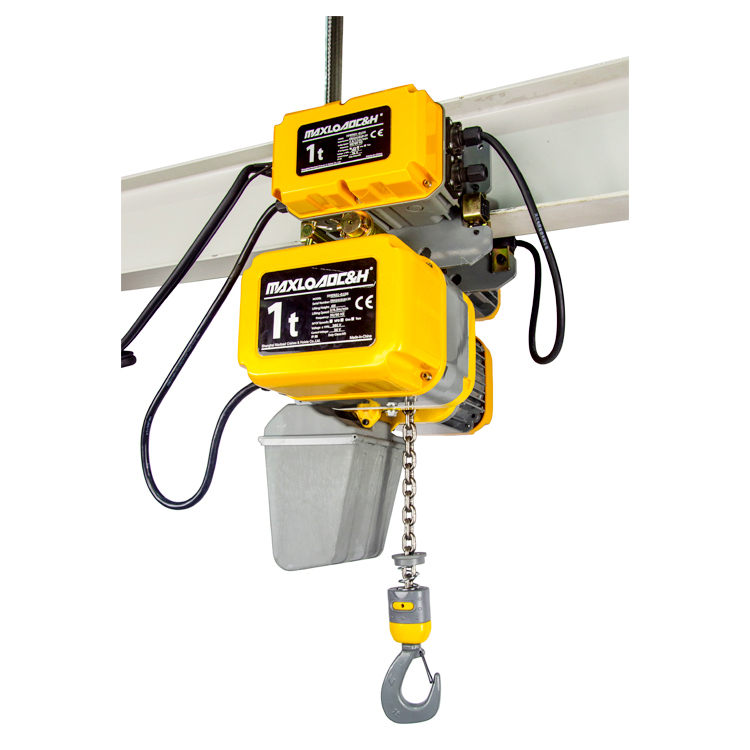
V. Track and installation method must be determined together with the workstation layout, not left until the end
An electric hoist ultimately works suspended from a track, and the form of the track determines how the hoist can move, where the operator stands, and whether the workpiece can cover the entire working area. Fixed suspension is suitable for workstations with a single lifting point where the workpiece is lifted directly below; hand-push or electric trolley types require an extended I-beam track above the workstation so that the hoist can traverse laterally to cover multiple positions.
If the workstation layout is elongated and multiple workstations share one hoist, the track routing and power supply method need to be determined before hoist selection; otherwise, the hoist may be purchased, but the track routing is unreasonable, and the operator has to drag the cable around. For workstations that need to cover a rectangular working area, a single track with a hand-push trolley is usually much more flexible than a fixed lifting point, but the prerequisite is that the structural beam above has the conditions for suspending a track. This is especially important to confirm in advance in old workshop renovations, because the load-bearing capacity of structural beams often limits the combination of track and hoist.
On-site judgment in electric hoist selection, in the final analysis, means abandoning the sequence of "first determine the equipment, then figure out how to install it" and changing to "first measure the workstation, then filter the parameters." Clearance determines body form, rhythm determines speed configuration, dust and humidity determine the protection threshold, cycle frequency determines the duty class, and track layout determines the installation method. Clarifying these five questions before procurement is more useful than comparing any supplier's sample parameter tables.
 0086 156 1824 5535
 0086 156 1824 5535