What the catalog parameters won't tell you when selecting an electric hoist
At equipment exhibitions or when flipping through catalogs, the pages for electric hoists often look the "cleanest": lifting capacity, lifting height, power, protection rating—a few lines of parameters listed neatly. But when you actually install a hoist at a workstation, whether it can be used smoothly and last a long time—the parameter table only determines 30% of that; the remaining 70% lies entirely in the workstation environment. The same 3-ton job is two different things in a mold warehouse versus at a flour feeding port; the same 10-meter span may have opposite answers in a new factory building versus an old workshop.
First look overhead: clearance determines what you can install, not what you want to install
Many people's habit when selecting an electric hoist is to start with lifting capacity, calculate the maximum weight of the lifted object, add a margin, and then choose a machine with a matching rated load. This order itself is problematic. Lifting capacity only determines the hoist's "strength," while the physical space of the workstation determines whether the hoist has room to stand.
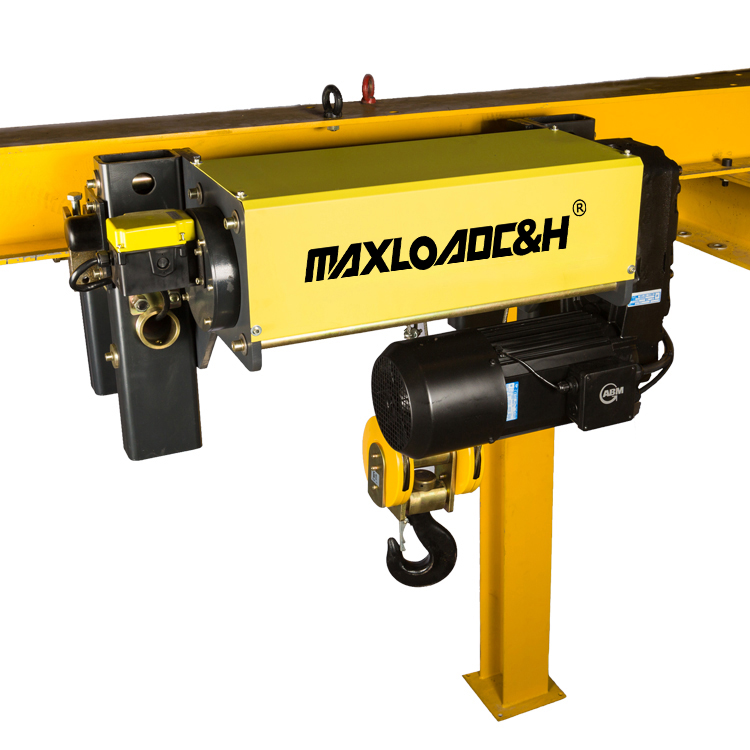
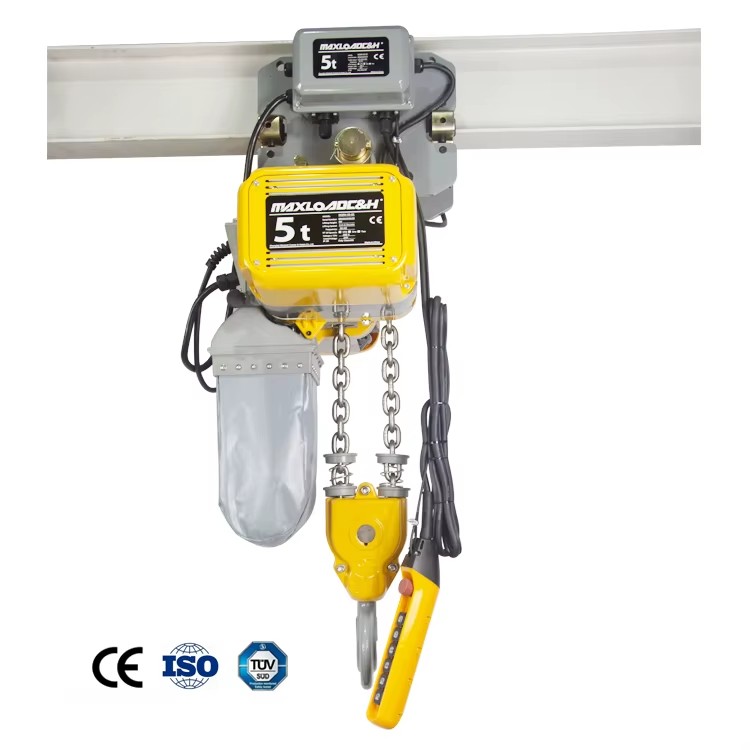
Old workshop renovation is the most typical scenario. The lower chord height of the original building's roof truss, the clearance below the beam, and even the routing of fire protection pipes are all fixed. If layout is carried out according to a conventional wire rope electric hoist, the body height plus the minimum approach dimension of the hook block often consumes most of the clearance, and in the end it is discovered that the workpiece hits the beam halfway through lifting. In this case, a low-headroom chain hoist is a more pragmatic choice. The chain structure itself is more compact than a wire rope drum, and combined with a low-headroom trolley, it can compress the body height to a very limited range, freeing up valuable lifting travel.
Conversely, if the factory building has ample height and a large span, the wire rope hoist has more advantages in lifting height capability and running stability, and there is no need to sacrifice performance in pursuit of compactness. One judgment principle here is: first measure the clearance below the beam, then determine the hoist type, and finally check the lifting capacity. If the order is reversed, it is easy to end up in the awkward situation of "can afford it but can't install it."
Then look underfoot: operating frequency determines service life, not price
Lifting a few times a day at a workstation versus lifting hundreds of times a day are two completely different equipment logics. Catalog pages usually only mark rated lifting capacity, while the working class is often hidden in inconspicuous small print. But for actual use, the working class determines more than tonnage whether this hoist can still work well three years from now.
For intermittent lifting—such as occasionally lifting a motor at a maintenance station or loading goods once every half day in a warehouse—a single-speed model with working class M3 is sufficient, with a simple structure, few failure points, and easy maintenance. But if it is a fixed station on an assembly line, with the takt time following the production line and hundreds of cycles a day, and both lifting and travel requiring precise start-stop, then the working class must be raised to M4 or even M5, and two-speed or variable-frequency control should be considered. The value of the slow-speed gear is not "slowness," but that the hook does not sway, does not collide, and does not require repeated fine adjustment when lowering for positioning. At precision assembly stations, the time wasted by one failed positioning attempt adds up to far more than the price difference of the equipment.
One detail that is easy to overlook is: if the working class is selected too low, the equipment will not fail immediately, but its service life will decay at a visibly rapid rate. Experienced equipment management parties often choose one class higher when uncertain; the cost increase is limited, but subsequent downtime repair and replacement costs are saved.
Environment is a hard constraint: explosion-proof, corrosion-proof, and dust-proof cannot be handled with a "general-purpose model"
This is the link most prone to safety accidents in selection. The motors, electrical boxes, and brakes of ordinary electric hoists generate arcs or sparks during normal operation. This does not matter in ordinary workshops, but in specific environments it is an ignition source.
In chemical workshops, paint spray booths, and near gas pressure regulating stations, attention must be paid to gas explosion-proof ratings. Dust environments are more concealed: at flour feeding ports, starch packaging lines, and wood powder collection areas, floating organic dust will deflagrate upon encountering sparks when it reaches a certain concentration. Agricultural product processing areas are often mistakenly regarded as "not dangerous," but in fact the dust explosion-proof requirements for wheat flour and corn starch are very real. Explosion-proof hoists are divided into two categories: gas explosion-proof and dust explosion-proof. Their rating markings are different and they cannot be used interchangeably. Using a gas explosion-proof machine in a dust workstation, or the reverse, is a selection error.
Corrosive environments are another line. Acid mist in electroplating workshops, salt mist in seaside factory buildings, and alkaline liquid splashes at certain chemical workstations continuously erode wire ropes, chains, hooks, and housings. Ordinary paint coatings cannot last long in such environments; chain joints rusting solid and accelerated wire breakage in wire ropes are both hidden costs. For mild corrosion, corrosion-resistant coating models can be considered, while severe corrosive environments require starting from stainless steel materials or special surface treatment.
There is another type of workstation that is easy to miss: cleanrooms or workshops with high hygiene standards. In electronic component assembly, pharmaceutical packaging, and areas with direct food contact, the hoist's own particle emission and grease volatilization are pollution sources. The focus of selection for such workstations is not "whether the strength is great enough," but whether the equipment's own materials and sealing design can integrate into the environmental standards.
Below the hook: rigging and tooling determine the actual load, not the number on the nameplate
Calculating tonnage based on the net weight of the workpiece during selection is another common deviation. To lift a 3-ton mold, if a four-leg chain sling is used, the sling's own weight may be more than 100 kilograms; if the workpiece's center of gravity is offset, the load on one side will also be amplified. The impact coefficient at the moment of lifting and the fatigue accumulation from long-term high-frequency operation both require a margin in the rated lifting capacity. Under conventional working conditions, a margin of 1.25 times is a relatively safe practice; for frequent operations or outdoor workstations with wind loads, the margin should be increased further.
In addition, the matching of the hook and tooling is also worth confirming at the selection stage. Some workstations use C-hooks, permanent magnetic lifters, or special fixtures, whose interface dimensions and load-bearing methods differ from standard hooks. Providing the rigging information to the equipment supplier in advance is much less troublesome than modifying the hook after the equipment arrives.
A pragmatic selection checklist
Gathering the above clues, when facing a specific workstation, the information that needs to be confirmed can actually be grouped into several items:
Clearance data: height below the beam, available lifting travel, rail suspension method. This determines whether to choose wire rope or chain, conventional body or low headroom.
Cycle characteristics: number of lifts per hour, daily operating duration, whether precise positioning is required. This determines the working class and single-speed/two-speed configuration.
Environmental attributes: presence of explosive gases or dust, concentration of corrosive media, temperature range, cleanliness requirements. This determines the explosion-proof type, corrosion protection level, and protective structure.
Load details: maximum workpiece weight, rigging dead weight, whether the center of gravity is offset, whether frequent full-load operation occurs. This determines the tonnage margin and hook form.
Once these four items are clarified, then compare them against the equipment parameters, and the machine selected will not be one that looks good on the acceptance form but is difficult to use at the workstation. An electric hoist is not an isolated piece of equipment; it is a link in the workstation logistics chain. The endpoint of selection is not "buying a hoist with parameters that meet the standard," but "the material flow at this workstation becomes smooth and accident-free because of this equipment." The former can be achieved by looking at catalogs; the latter requires standing on the workstation floor, looking up at the beams, looking down at the load, and turning around to ask, "How many lifts are actually done in a day?"
 0086 156 1824 5535
 0086 156 1824 5535