Selecting an Electric Hoist by Workstation
Many selection failures stem not from miscalculating the tonnage, but from treating the "workstation environment" as a footnote rather than a precondition. The same lifting capacity may run for ten years on a dry assembly line, yet seize up in half a year in a foundry; installed in a low attic, the hook may already hit the roof beam before the machine even lifts anything. The environment determines the protection rating, structural form, heat dissipation capability, and material lifespan—these factors kill a piece of equipment sooner than the rated load does.
Measure the Clearance First, Then Discuss the Model
Electric hoists fall into two major categories: wire rope hoists and chain hoists, and the structural differences map directly to spatial conditions. If the factory building has ample height and no dense piping overhead, wire rope hoists offer a larger range of lifting height and better running stability, making them suitable for long-distance, long-travel lifting. But many workstations that independent-site sellers commonly encounter are renovated old factories, mezzanine warehouses, or production lines already crowded overhead with air ducts and cable trays, where vertical space is severely constrained.
This is where the advantage of chain hoists emerges. Chain hoists have a slimmer body, and low-clearance models can reduce the limit distance from the hook to the track to a very small figure, yielding several tens of centimeters of extra lifting travel at the same building height. In low spaces, those tens of centimeters are often the dividing line between "usable" and "won't fit." The judgment criterion is simple: measure the distance from the lower edge of the track to the highest obstacle on the ground, subtract the height occupied by the rigging and slings, and if the remaining clearance is below the limit dimension of a conventional wire rope hoist, switch directly to a low-clearance chain model—don't hesitate over the spec sheet.
Duty Cycle Determines Whether the Motor Can Take It
Another hidden variable of the workstation environment is the cycle rate. A warehouse that occasionally lifts a load and a production line with one cycle every two minutes place completely different demands on the motor. Electric hoist motors are designed for intermittent duty cycles, and the duty cycle rating indicates the percentage of time within a cycle that powered operation is permitted. Conventional single-speed models suit intermittent work, but if the workstation involves high-frequency loading and unloading, the heat accumulated from repeated motor starts will rapidly consume insulation life.
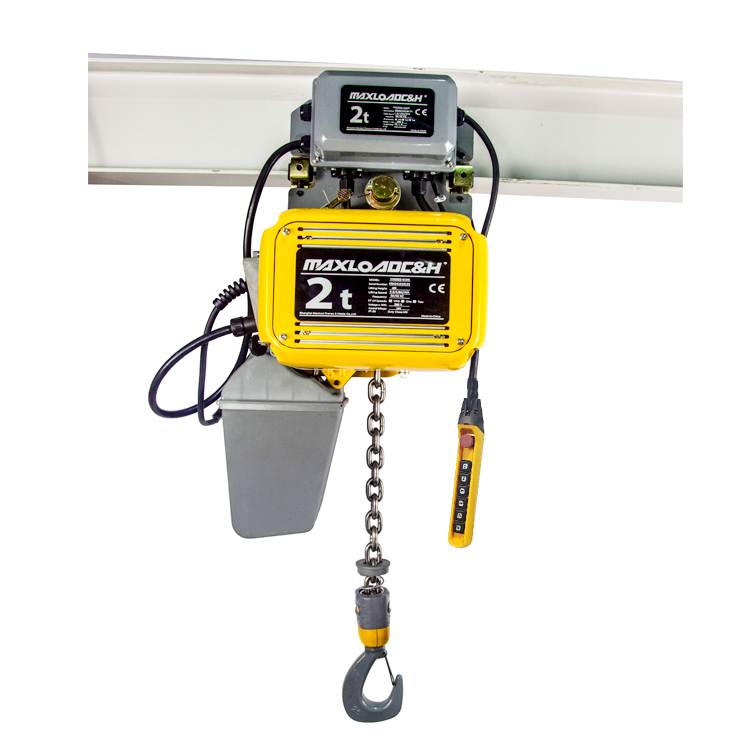
When selecting, don't look only at the single figure of "lifting speed"; ask about the actual cycle characteristics of the workstation: how many lifts per hour, how heavy each load, and roughly what the ratio of full-load to no-load is. For workstations with frequent inching, prioritize dual-speed or variable-frequency models; the slow speed is used for precise positioning and fine adjustment, avoiding operators "nudging" the position by repeatedly tapping the button—that mode of operation causes contactor and motor wear far beyond the factory design expectations. If the workstation rhythm is fixed and the lifting height is not great, a chain hoist's compact structure combined with dual-speed control is usually more responsive than a wire rope model of the same tonnage.
Dust and Moisture Are Two Different Protection Logics
Many selection articles lump "dustproof and waterproof" together, but in reality, dust workstations and humid workstations require solutions in opposite directions. The core contradiction in dusty environments is solid particles intruding into the motor and brake gaps, aggravating wear and clogging cooling ducts. In workstations such as casting, grinding, and powder feeding, the motor's protection rating should be at least IP54, and where dust concentration is high, IP65 should be considered. But raising the protection rating alone is not enough—the structural form of the brake is equally critical. Some brakes are exposed to dust, and after dust accumulates in the gaps, braking response slows and the hook's drift distance lengthens—a fatal problem at precision assembly workstations. When selecting for dust workstations, pay particular attention to the brake's sealing method and whether it is easy to clean periodically.
Humid environments are another matter. Moisture intruding into motor windings causes insulation to degrade; a hoist that sits idle in a humid workstation for long periods may suffer winding breakdown from moisture even without running. High-humidity workshops, areas near washing stations, and factory buildings in coastal regions require attention to motor insulation class and housing anti-corrosion treatment. If the workstation has condensation or occasional washing, a protection rating of IP65 is the bottom line, and it must also be confirmed whether the brake has undergone rust-proof treatment—otherwise corrosion of the brake spring will directly cause braking torque to decay.
Corrosion and Explosion Protection: Two Red Lines That Cannot Be Compromised
Ordinary workstations can discuss cost-effectiveness, but corrosive environments and explosive atmospheres have no "close enough" option. Chemical gases emitted by workstations such as electroplating, acid pickling, and fertilizer production cause continuous and irreversible attack on the hoist's metal structural parts and chain/wire rope. Ordinary coatings begin to peel within a year or two in such environments, and once the underlying metal is exposed, corrosion accelerates. Such workstations require confirmation of two things: whether exposed fasteners have been galvanized or given Dacromet treatment, and whether the chain or wire rope has a corresponding corrosion-resistant coating. If a chain hoist's chain has been galvanized, it is far more durable than a bare chain in mildly corrosive environments, but strongly acidic or alkaline environments still require specially corrosion-resistant models.
Explosive atmospheres involve mandatory regulatory requirements. At workstations where flammable gases or dusts are present, the motor commutation sparks, brake friction sparks, and even static accumulation of an ordinary electric hoist can all become ignition sources. When selecting, the hazardous area classification of the workstation and the gas/dust group and temperature class must be confirmed, and equipment with the corresponding explosion-proof marking must be selected. This cannot be replaced by "beefing up the protection"—an ordinary hoist entering an explosion-proof area constitutes a major safety hazard. If the workstation involves painting, solvent cleaning, dust conveying, or similar processes, confirm the explosion-proof rating first, then come back to tonnage and speed.
Judging Tonnage and Safety Margin
There is a common misconception in tonnage selection: directly matching the maximum lifting weight to the rated capacity. The impact at the moment of lifting, the dead weight of the rigging, and the braking slip after long-term use can all push the actual load above the number on the nameplate. For conventional workstations, it is recommended that the rated capacity be at least 1.25 times the actual maximum load; if the workstation involves frequent starts and stops, vibration, or outdoor wind loads, a margin of 1.5 times is more prudent. For example, if the heaviest actual workpiece is 1.6 tons, don't choose 2 tons to just barely stay within the line—choose 2.5 or 3 tons. The extra cost, spread over every day's failure rate and downtime losses, is almost negligible.
Fill the Workstation Conditions into a Table
By the end of the selection process, you don't need to memorize specifications—you only need to list the facts of the workstation clearly: what the clearance is from the lower edge of the track to the ground, roughly how many lifts per hour the workstation performs, whether the environment contains dust, moisture, or chemical gases, whether there is a hazardous area classification, and how heavy the heaviest workpiece is. Only when this information is given to the supplier can they provide a meaningful proposal. Conversely, if you only tell them "I want a 2-ton hoist," the answer you get will most likely be a quote for a standard model—and no one can guarantee whether that standard model will survive its warranty period at your workstation.
The workstation environment is not the backdrop of selection; it is the starting point. Only after clearly seeing what kind of air the equipment will breathe, how much space remains overhead, and how many times a day it will bend down do the numbers on the spec sheet become meaningful.
 0086 156 1824 5535
 0086 156 1824 5535